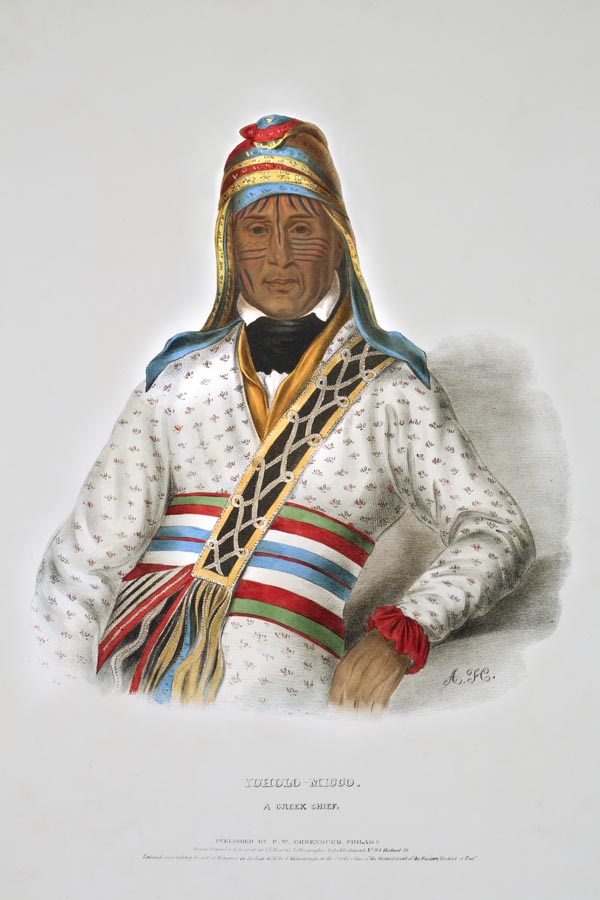
Yoholo-Micco (1790-1838)
Among the delegation were Yoholo Micco and his son Mistippee. Yoholo Micco was the principal chief of Eufaula, an Upper Creek Town located on the Tallapoosa River. McKenney wrote that he, “served with Mclntosh against the hostile Indians, and shared largely and honorably in all the battles that were fought. His bravery was equaled only by his eloquence, which gained him great distinction. He was the speaker of the Creek nation… and opened the councils on all occasions.”
Though the delegation succeeded in renegotiating aspects of the Treaty of Indian Springs, they could not forestall eventual white encroachment on their lands. Under Andrew Jackson the Creek were moved west to Oklahoma. During that journey many died, including Yoholo-Micco.
For more information on the Treaty of Indian Springs and the 1825-1826 Creek Delegation to Washington see: Kathryn Braund, “McKenney and Hall Portrait Gallery: Creek Treaty Delegation to Washington, 1825-1826”, Auburn University, http://www.cla.auburn.edu/cah/assets/File/McKenney%20and%20Hall%20Booklet.pdf
During the nineteenth century native tribes routinely sent delegations to Washington, D.C., to negotiate with the American government. In 1816 Thomas Lorraine McKenney (1785-1859) was appointed the Superintendent of Indian Affairs. McKenney was eager to record the delegations and their distinctive dress for posterity. He engaged artists such as Charles Bird King (1785-1862), James Otto Lewis (1799-1858), and George Cooke (1793-1849) to paint portraits of these visitors to Washington.
President Andrew Jackson (1767-1845) was critical of McKenney and his sympathetic treatment of America’s native peoples. In 1830 he removed McKenney from office. Following his dismissal McKenney arranged to have the portraits secretly copied by the artist Henry Inman (1801-1846) and taken to Philadelphia for engraving. McKenney partnered with the author James Hall (1793-1868) and the first volume of “History of the Indian Tribes of North America” was published in 1836. Two more folio-sized volumes would follow.
Eventually the original portraits by King, Lewis, and Cooke, were be deposited in the Smithsonian Institution. A fire at the Smithsonian in 1865 destroyed the vast majority of the original works on which McKenney and Hall’s prints were based.
RELATED OBJECTS: MESDA owns the original portrait of Mistippee by Charles Bird King. This is one of the few paintings commissioned by McKenney to survive (3543). MESDA also owns three other prints from this book: Yoholo-Micco’s son, Mistippee (5507.1); and Cherokee Chief Major Ridge (5507.3) and his son John Ridge (5507.4).
DESCRIPTION: Hand colored lithograph on paper of Yoholo-Micco; taken from original print by James Otto Lewis, and later painted by Charles Bird King. Three-quarter view of Yoholo-Micco standing with left arm resting. Yoholo-Micco is facing forward and wears a fabric headdress consisting of layers of blue, yellow, and red, with small unidentifiable pattern; the headdress falls onto his shoulders. His face is painted with red and blue stripes: vertical alternating on his forehead, nine alternating on his left check, three alternating horizontal on his right cheek with a diamond pattern just under his eye; three vertical marks along his right jawbone. He wears a white collared shirt with black cravat, gold vest, and white shirt with red ruffles at wrist. The shirt has a red and black print. A large multi-colored band around his waist: red, green, white, and blue. A bag is draped across his left shoulder, with large strap in black and gold; the bag is black, gold, blue, red, and white.