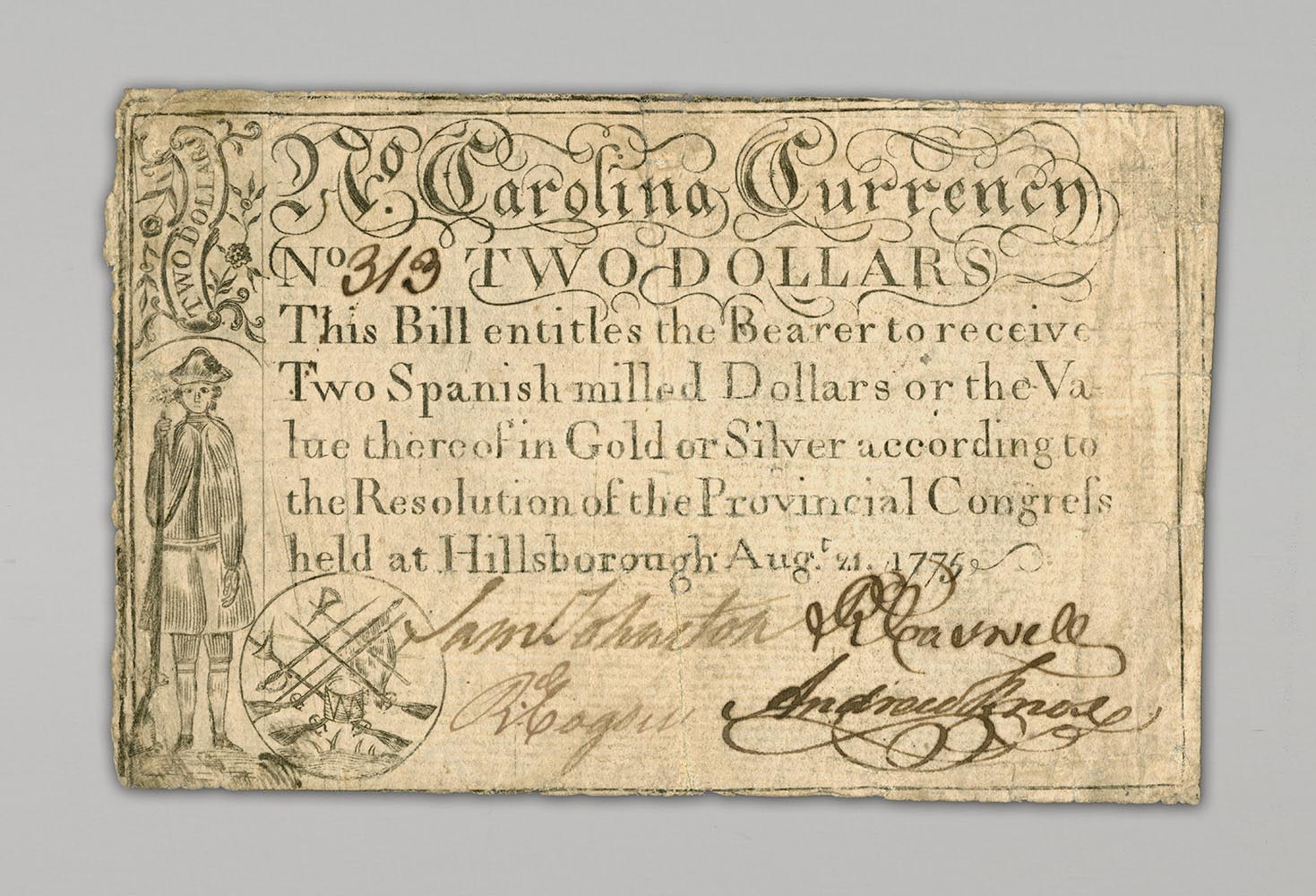
Two Dollars North Carolina Currency
To combat counterfeiting, early currency was hand signed. Five members of North Carolina’s Provincial Congress were deputized for this task, and each bill carries the signatures of four. This bill is signed by Samuel Johnson (1733-1816), Richard Cogdell (1724-1787), Andrew Knox (d.1775 or 1776), and Richard Caswell (1729-1789). Caswell, who represented North Carolina at the 1774 and 1775 Continental Congresses in Philadelphia, was probably the person responsible for contracting with Baltimore silversmith and engraver Gabriel Lewyn (w.c. 1768-1780) for the copperplates for this note. The MESDA collection also contains a silver cream pitcher made by Lewyn (MESDA acc. 2946). Caswell was also the commander of the New Bern district of the North Carolina Militiamen. This might explain the choice of a militiaman for the vignette. Though it is tempting to see the militiaman as a stock vignette, North Carolina’s Colonial-era currency did sometimes depict real images of the Tarheel State: both Tryon’s Palace and Chirst Church in New Bern were depicted on notes.
As North Carolina issued more and more notes—eight issues succeeded this one!—the designs became simpler. Rather than pay for engraved copperplates, the Legislature contracted with printers to set the notes using type and simple stock vignettes. Though cheaper, these later notes were also much easier to counterfeit. Though notes like this one circulated as currency, they were technically promissory notes: their enabling legislation specified both a redemption date and a date after which notes ceased to be payable. Subsequent legislation during and after the Revolution either extended these dates or required earlier notes to be turned in for new ones. This helps to explain why no other examples of this note survive.
REFERENCES: Eric P. Newman and Stuart Levine, “The Early Paper Money of America” (Iola, WI: Krause Publications, 2008) 321.