The Natural History of Carolina…
Artist/Maker
Catesby, Mark
Place Made
London Great Britain
Date Made
1771
Medium
leather, paper, ink
Dimensions
LOA: 21 1/4; WOA: 14 1/2
Accession Number
1012.1 a
Description
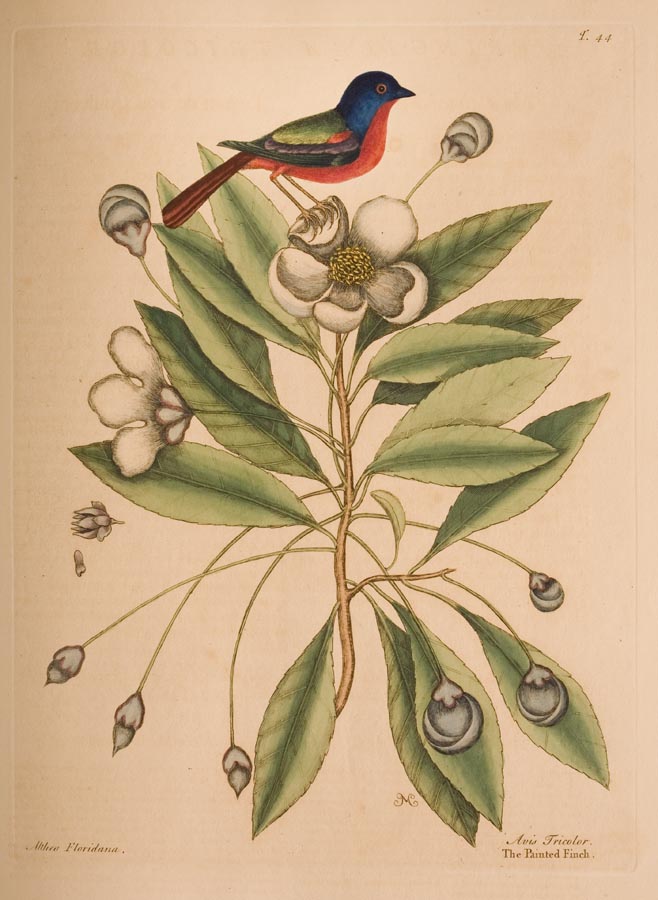
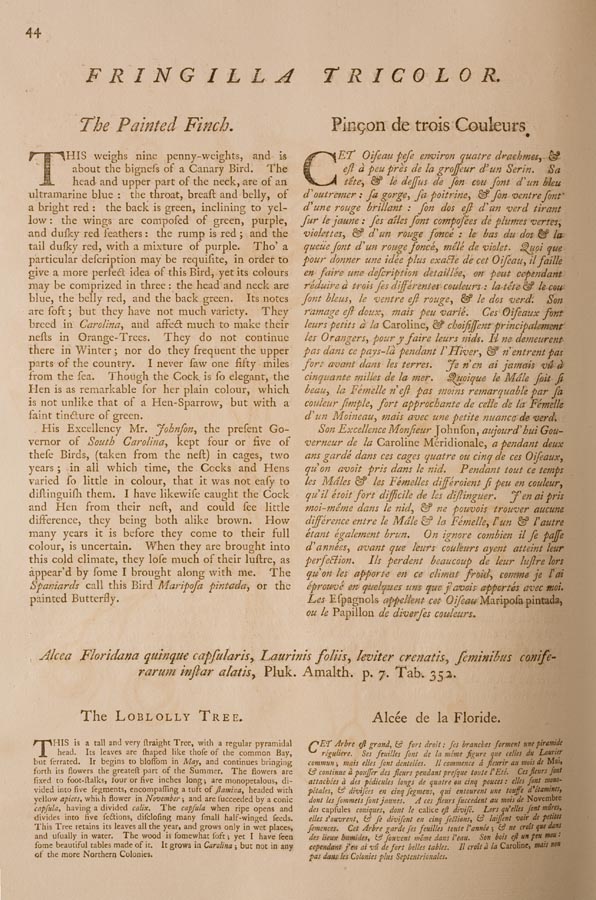
First volume of Mark Catesby’s (1683-1749) two-volume “Natural History of Carolina, Florida, and the Bahama Islands.” The first edition of the first volume appeared in 1731; the second volume of the first edition appeared in 1743. Catesby’s work went through two editions in the eighteenth century and was again published in the nineteenth century. MESDA’s copy is a hybrid of second-edition text (published in 1771) with third-edition (printed in 1815) prints.
Catesby traveled extensively in Virginia, the Carolinas, Georgia, and Caribbean collecting specimens for his work. He is notable for being one of the first naturalists to show species interacting with each other. The majority of the fauna are shown with their related flora. Short on funds, Catesby learned to engrave his own copper plates to keep publications costs low. His initials, “MC” can be seen on some of the plates. For especially important specimens, like the magnolia, he paid a professional engraver.
Catesby remains one of the most important naturalists to work in early America.
Artist Biography
ARTIST: Catesby, Mark (c.1679-1749). English naturalist and etcher. Catesby made two visits to America, spending the years 1712 to 1719 with relatives in Virginia and on the second trip, 1722-1725, traveling through the Carolina, Georgia, and Florida and spending some time in the Bahamas before returning to England in 1726. The result of his American residences was the important Natural History of Carolina, Florida and the Bahama Islands (London, 1731-1743), for which Catesby etched upward of 100 plates, the first set of which he also colored himself. In recognition of his scientific work Catesby was elected to the Royal Society in 1733. A posthumously published volume, Hortus Britanno-Americanus, also contained a number of Catesby’s etchings of American trees and shrubs, many of which he had himself introduced to English horticulturalists. He died in London, December 23, 1749. (p. 115, Groce & Wallace, The New-York Historical Society’s Dictionary of Artist in America)
Credit Line
Anonymous Gift