The Chiefs of the Cherokee
The seven men, Oukah-Ulah, Kitagista, Tiftowe, Clogoitah, Kilonah, Onokanowin, and Oukounaco set sail from Charleston harbor on the Man of War Fox on May 4, 1730. The Cherokees dined with King George II and kissed his hand and the hands of his sons. The Indians remained in England four months and concluded an article of agreement by which the Cherokees agreed to trade only with the English, to allow no other white people to settle in their country, to aid the English in war, and to permit white offenders within their nation to be punished by English Law.
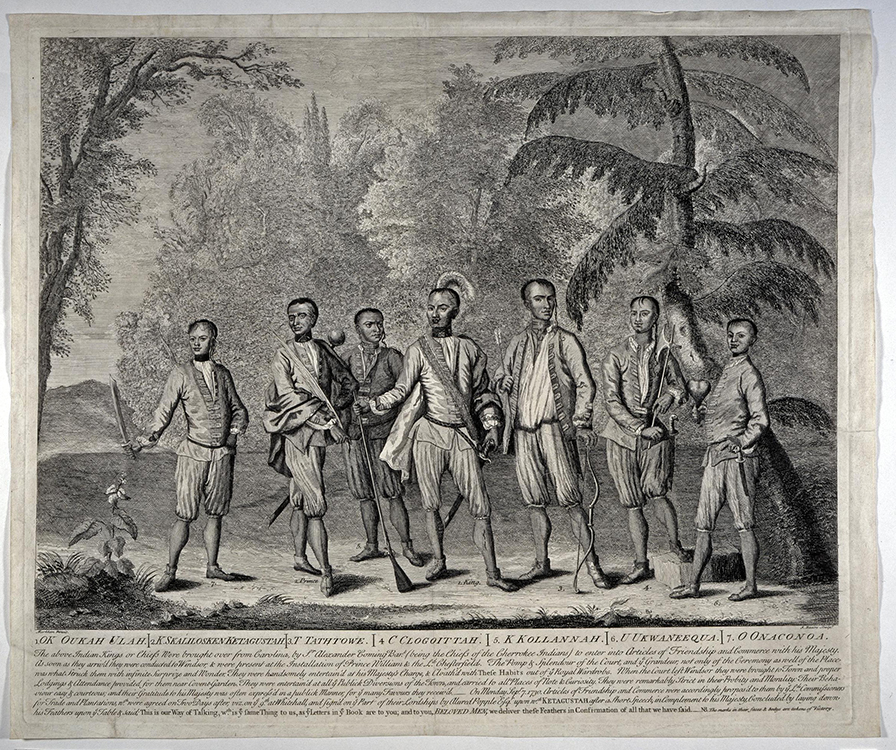
During the visit, an artist identified only as Markham painted a group portrait, subsequently engraved by Isaac Basire. While contemporary accounts describe the natives as being “naked, except an Apron about their Middles,” in this image they are pictured primarily, though not completely, clothed in European attire. Despite their clothing and the fact that their deportment was rendered in a manner characteristic of the aristocracy, their facial tattooing and hairstyles leave little doubt that these men were not submitting completely to the expected norms of British culture and custom. Each of the seven is pictured brandishing some form of weaponry from European swords and firearms to Indian tomahawks, clubs, bows and arrows.
The caption below the images of the seven chiefs contains a description of their visit, the events of which were recorded in great detail in the London newspapers. On one occasion, a visit to the court at Windsor, they were “handsomely entertain’d at His Majesty’s Charge and Cloath’d with These Habits out of ye Royal Wardrobe.”
The caption also records that on Monday Sept. 7th 1730, Articles of Friendship and Commerce were proposed by the Lords Commissioners of Trade and signed two days later on September 9 at Whitehall by Alured Popple, Esq. on behalf of the Lords Commissioners. (Alured Popple was the brother of cartographer Henry Popple, whose monumental “Map of the British Empire in America . . .” was published in 1733.) At the end of this occasion the caption records that “KETAGUSTAH after a short speech, in complement to his Majesty, concluded by laying down his Feathers upon ye Table & said; This is our Way of Talking wch is ye same Thing to us, as ye Letters in Ye Book are to you; and to you, BELOVED MEN we deliver these Feathers in Confirmation of all that we have said.”
The young man to the far right, No. 6, identified as Ukwaneequa in the caption, came to be known as Attacullaculla, or “Little Carpenter.” Upon his return to South Carolina, he became one of the most recognized leaders of the Cherokee nation – involved in negotiations for alliances and treaties as well as in conflict. A shrewd politician, he often played the British against the French and the Virginians against the Carolinians, always with the goal of establishing a better situation for his people in matters of land control and commerce.