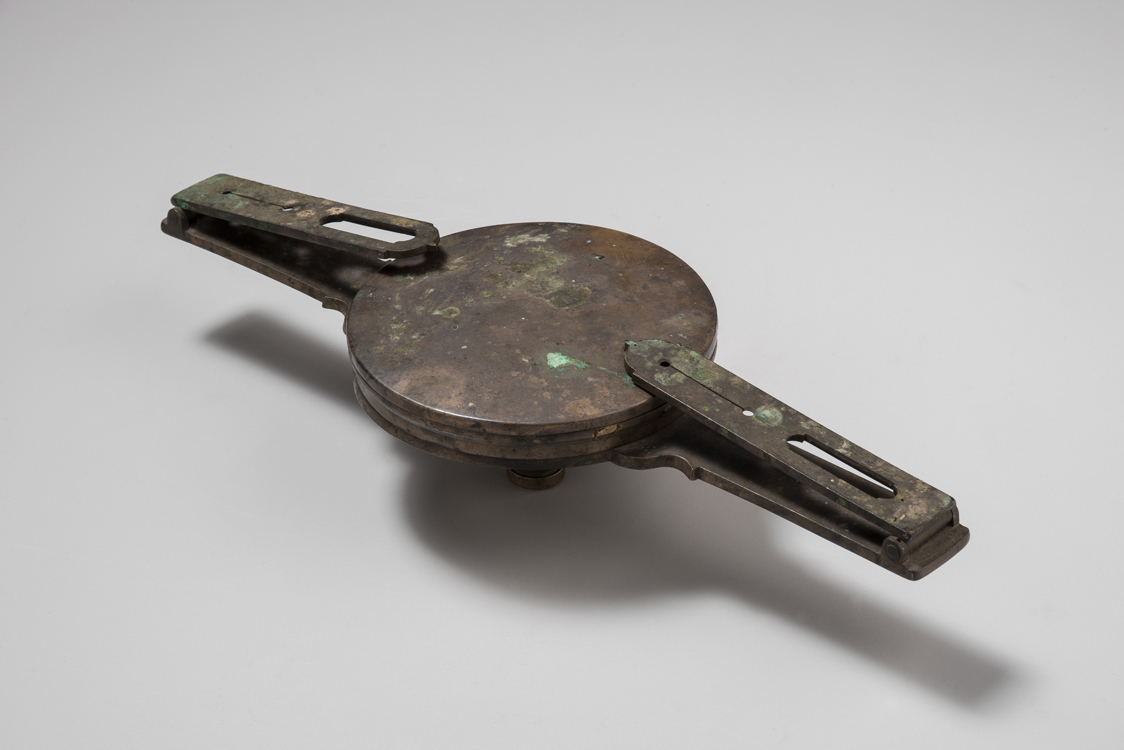
Surveyor’s Compass
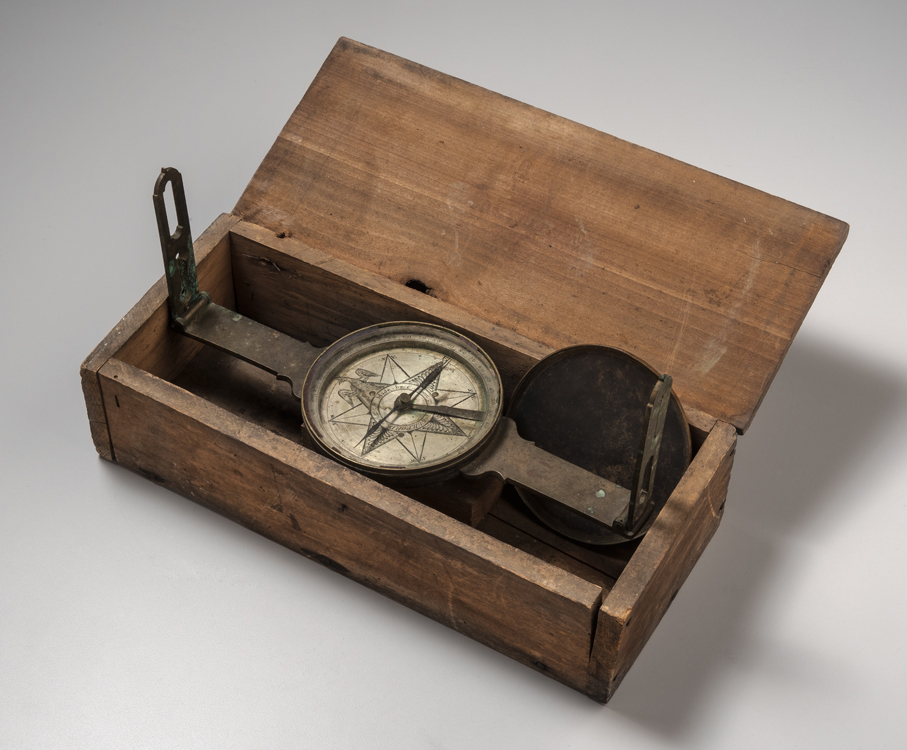
Box: HOA: 4-1/4″; WOA: 15-1/4″; LOA: 6-1/2″
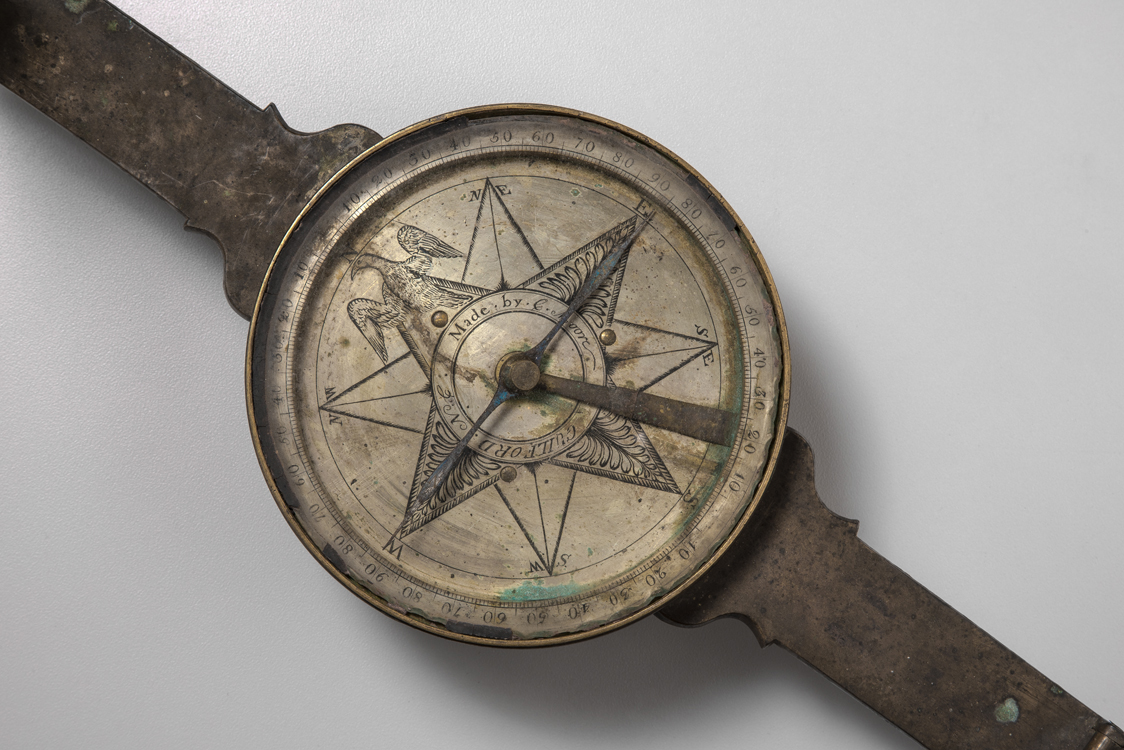
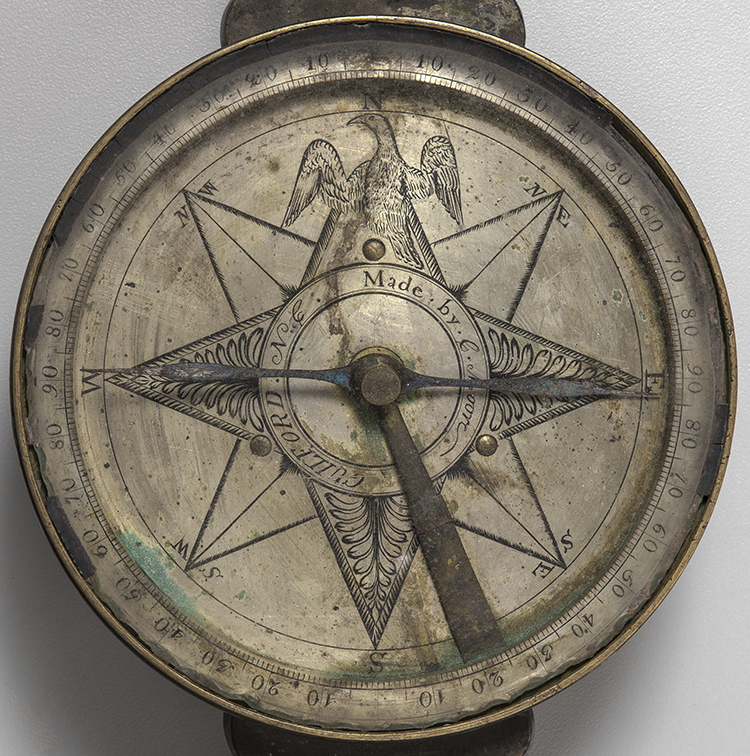
INSCRIPTION: In the center is a circle with the inscription “Made • by • C • Moore / GUILFORD • N.C.”
MAKER: Born into a Hanover Co., Virginia Quaker family in 1755, Camm Moore was received as a member of Guilford County’s New Garden Monthly Meeting in 1778 and married Sophia Benbow that same year. The couple transferred their membership to nearby Dover Meeting, also in Guilford County and much of their family’s records are in the Dover Meeting minutes. Camm and Sophia Moore had seven children together, and Sophia died in 1821. Five years later, in 1826, the Moore children moved to Indiana while their father remained in Guilford County until his death in 1845. Moore was one of the earliest silversmiths working in Piedmont North Carolina. In 1787 the Guilford County courts ordered that Samuel Short, aged 12, be bound to Camm Moore to learn the art and mystery of the silversmith. The tools and materials sold from Moore’s estate in 1846 included those used by a silversmith as well as a craftsman working with other metals. Despite being recognized as a silversmith, the only known surviving product from Moore’s shop are compasses—five others have been identified in addition to the compass under consideration. Moore seemed to have found making compasses agreeable and profitable, for in 1834 he advertised in the Greensborough Patriot that he had: “…discovered a valuable improvement in the Surveyor’s Compass, by applying an infallible plumb sight, the cost of which will not exceed two dollars. Any person wishing to have his Compass furnished in this way, can have it done by applying to the subscriber near Saunder’s Mill.” Four years before he died, in 1841, Moore wrote his will and specified that he owned 189 acres of land and that all of his “moveable property” be sold except his silversmith’s tools, which should be advertised for “two months or more and described what use they are for in [some] sootable Newspaper.”
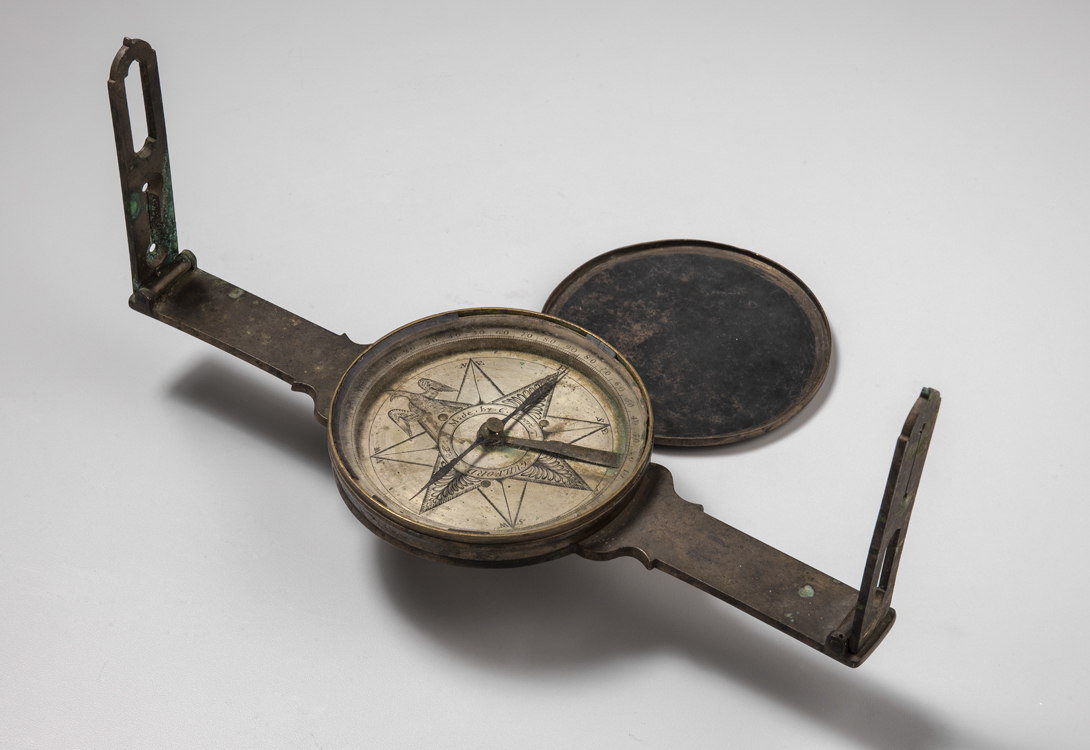
FORM: The surveyor’s compass, or circumferentor, is an instrument used in surveying to measure horizontal angles. It consists of a circular brass box containing a magnetic needle, which moves freely over a brass circle. Such compasses were typically mounted on tripods. By the early nineteenth century, Europeans preferred theodolites to circumferentors; however, the circumferentor remained in common use in America through much of the century.
Sources:
— William Wade Hinshaw, ed., Encyclopedia of American Quaker Genealogy (Baltimore, MD: Genealogical Publishing, 1978 [reprint of 1936 original]), vol. 1 (North Carolina).
— 1860 United States Federal Census.
— Wills, 1838-1859, Vol. C, pp. 470-471, Guilford Co., NC.
— Inventories, 1856-1858, Vol. X-20, pp. 285-288, Guilford Co., NC.
— Darrin Lythgoe, “The Benbow Family of the United Kingdom, and Selected Allied Families”; online: http://www.benbowfamily.com/getperson.php?personID=I31&tree=B1 (accessed 14 September 2014).