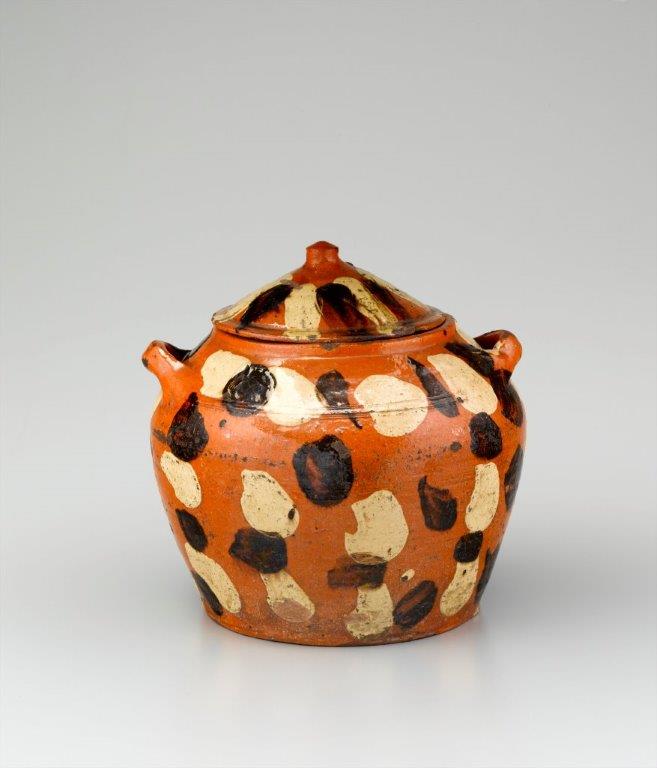
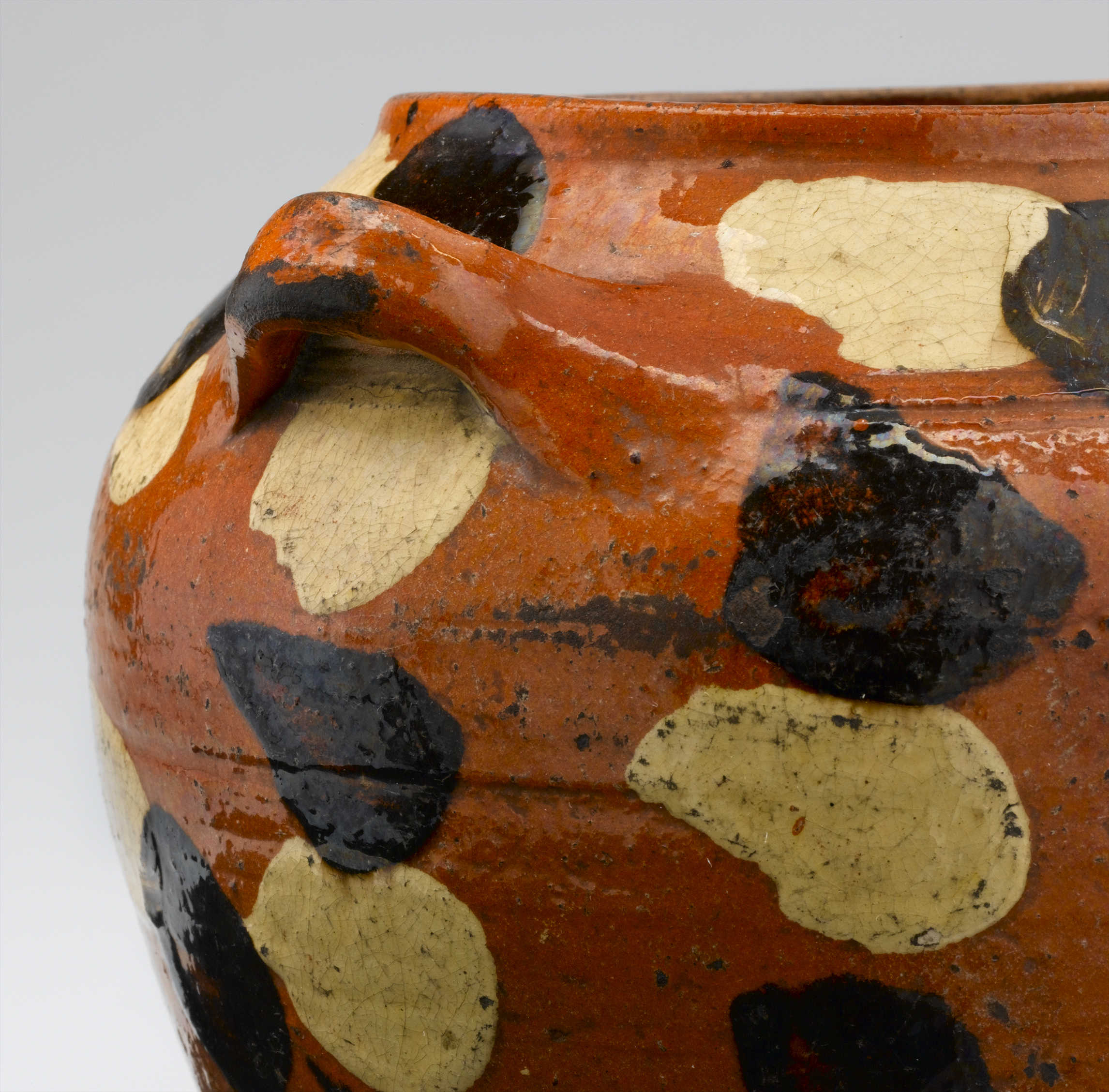
Sugar Jar
MAKER: Solomon Loy’s career spanned the second quarter of the nineteenth century, a period when earthenware production began to wane and many potters in the piedmont region of North Carolina began shifting production to salt-glazed stoneware. He probably apprenticed with his father Henry, who worked at the pottery operated by Jacob Albright Jr. (Father-in-law to Henry and grandfather to Solomon). Albright’s manufactory may have been the primary training ground for many of the St. Asaph’s potters of Solomon’s generation. Archaeology at Solomon Loy’s kiln site has documented the production of a wide range of forms, glazes, and decorative techniques including the use of dripped polychrome slips. Most of Solomon’s trailed designs – stylized leaves, imbricated triangles, nested triangles, lunettes, and dots with jeweled edges – have antecedents in Alamance County pottery from the last quarter of the eighteenth century.
Beckerdite, Luke, Johanna Brown, and Linda Carnes-McNaughton. “Slipware from the St. Asaph’s Tradition.” CERAMICS IN AMERICA (2010): 14-65.
Carnes-McNaughton, Linda. “Solomon Loy: Master Potter of the Carolina Piedmont.” CERAMICS IN AMERICA (2010): 106-139.