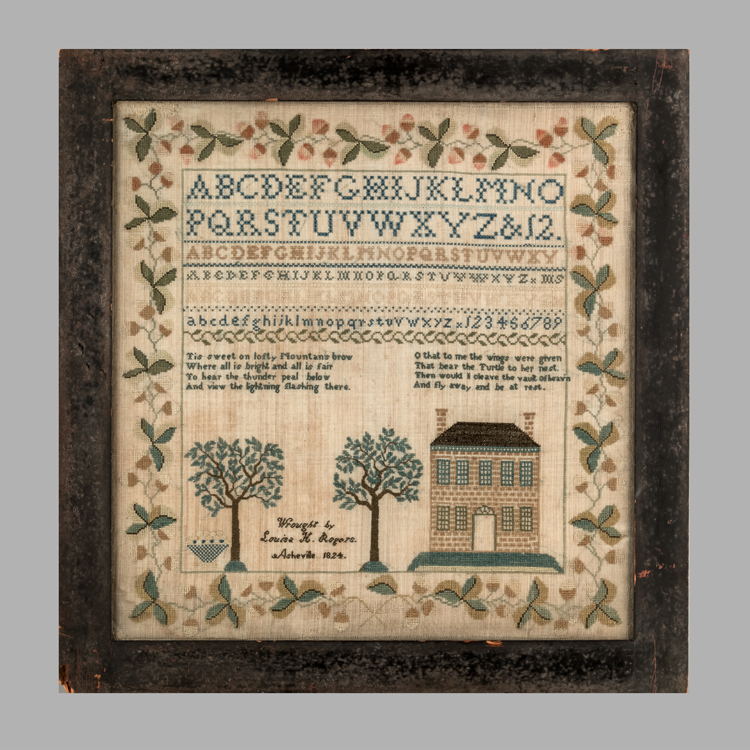
Sampler by Louisa Hanson Rogers
Louisa’s trip to Asheville is well documented in a surviving diary and letters that reside at Emory University. (Loula Kendall Rogers papers, Manuscript Collection No. 696, Stuart A. Rose Manuscript, Archives, and Rare Book Library, Emory University). Among the letters is a collection of poetry written by Louisa. It is thought that the first portion of the verse on her sampler was written by her, describing her experience in the mountains of North Carolina. “Tis sweet on lofty Mountains brow/Where all is bright and all is fair/To hear the thunder peal below/And view the lightning flashing there.”
In 1902, Louisa’s daughter, Loula Rogers (1838-1931)wrote a detailed family history on behalf of the local DAR chapter that was published in the Atlanta Constitution. She wrote of a family member who “remembers when my mother traveled from Athens to Asheville in her girlhood, before any railroads were built in Georgia (in 1825). I have a diary that was kept during the visit and a sampler on which is embroidered the home of Governor Swain, which is still standing.”
David Lowry Swain (1801-1868) was the cousin of Louisa Rogers. In 1823, David Swain returned to his hometown of Asheville with a law degree and a promising career. He quickly became active in politics and in 1824 was elected to a seat in the House of Commons representing Buncombe County. It was quite the accomplishment for a twenty-three-year-old. As Louisa stitched her sampler, she was a witness to her cousin’s rapid rise to prominence. Nine years later David L. Swain became the youngest governor for the state of North Carolina – a superlative he still holds to this date. However, David Swain is most well-known for serving as President of the University of North Carolina at Chapel Hill from 1836 until his death in 1868.
Louisa Rogers was the oldest daughter of James Peleg Rogers (1778-1815) and his wife Winifred (Lane) Rogers (1780-1872). Winifred’s father, Jesse Lane, moved his family to Georgia from Wake County, North Carolina in 1784. Claiming a presence in early Georgia history, the Lane family originally settled in Elbert County and were neighbors of Nancy Hart, a Revolutionary war heroine. (Louisa would later write of Nancy Hart and her exploits in letters as told to her by her mother.) After Winifred’s marriage to James Rogers in 1799, she and James resided by the Oconee River near Athens, Georgia. Sixteen years later Winifred was left a widow with “eight little children” and “indomitable energy” as remembered in her obituary written by her granddaughter Loula.
This sampler is unusual as it is the work of a young woman of twenty years, not a schoolgirl. Louisa apparently stitched this sampler as a creative endeavor and expression of needlework skills. Louisa’s early education is recorded by her daughter as a “pupil of Professor Thomas Stanley, Dr. Waddell, Miss Wood and others of the early teachers of Athens.” Louisa was most likely educated at the Athens Female Academy. The “Rev. Mr. Stanly and his Lady” were “exclusive managers of this seminary” and were assisted by Miss Wood as documented in The Georgia Journal, (Milledgeville, Dec. 16, 1823). On the list of Trustees at this institution was “M. Waddell”. Moses Waddel was well-known as an educator in the South, working in Georgia and then South Carolina before returning to Athens in 1819 to serve as the president of the University of Georgia. Advertisements of the Athens Female Academy emphasize an academic education, with no specific mention of needlework. However, in 1822 they do claim to offer “with the exception of Music, every branch of a solid and ornamental education may be here acquired”.
Three years after completing her sampler, Louisa married James Cuthbert Steele (1800-1833) in Athens, Georgia. They had two children. After James Steele’s death, Louisa married for a second time to Dr. David Kendall. They had four children and built Bellwood Plantation in Upson County, Georgia. A pastel drawing by Loula Kendall Rogers of her childhood home is in the digital collection of the Atlanta History Center. https://album.atlantahistorycenter.com/digital/collection/athpc/id/1304
Louisa Rogers Kendall lived to be seventy-seven years old and is buried in the Kendall family cemetery in Upson County, Georgia.
Louisa Rogers sampler measures 22 ¾” x 22” and is thought to be in its original painted frame. The condition appears very good with some minor loss of linen and water staining. The sampler was conserved in 1991 by Dorothy D. McCoach. The overall composition of the sampler includes a strong border of trailing vines and berries enclosing five alphabet bands featuring eyelet, queen, cross and four-square stitches. The initials “MS” stitched on the third alphabet band and are most likely for Louisa’s cousin, Mary Swain (1803-1828). Louisa and Mary were only one year apart in age and Mary was living in the Swain household during Louisa’s visit. Two trees and a basket of fruit frame Louisa’s inscription, documenting her time in Asheville, North Carolina. While the first verse on the sampler is thought to be an original composition by Louisa, the second verse is the last portion of a poem entitled “I Would I were a Reckless Child” by Lord Byron (1788-1824). It was originally published in 1816.
This sampler was included in the Georgia Museum of Art’s 2015 exhibition Georgia’s Girlhood Embroidery: Crowned with Glory and Immortality and is published in the accompanying catalog.
This sampler encompasses not only North Carolina history – with the inclusion of the home of David Swain (built by his father George Swain) – but important Georgia history as well. The sampler could have been partially worked at Louisa’s home in Athens, Georgia.
The provenance of this sampler is impressive. It descended in the family to Louisa’s great-granddaughter who sold it to dealer James Allen from Atlanta, Georgia. It was then owned by Carol Wahler. MESDA acquired it in January of 2025.