Quilt
As early as 1770, the Webster household was a center for Methodist preaching. In 1821 Richard Webster built on their land a Methodist chapel they named Calvary. This church still stands today and is a Harford County Landmark and listed in the Maryland Inventory of Historic Places.
At age twenty-two, Elizabeth married Joseph Downing (1769-1841), a prominent Quaker from Chester County, Pennsylvania. Their lives are highlighted by author Francis Brown in his book entitled “Downington Friends Meeting: An Early History of Quakers in the Great Valley” in which he states that “Elizabeth Webster Downing stands out as one of the most important personages in the history of our Meeting.”
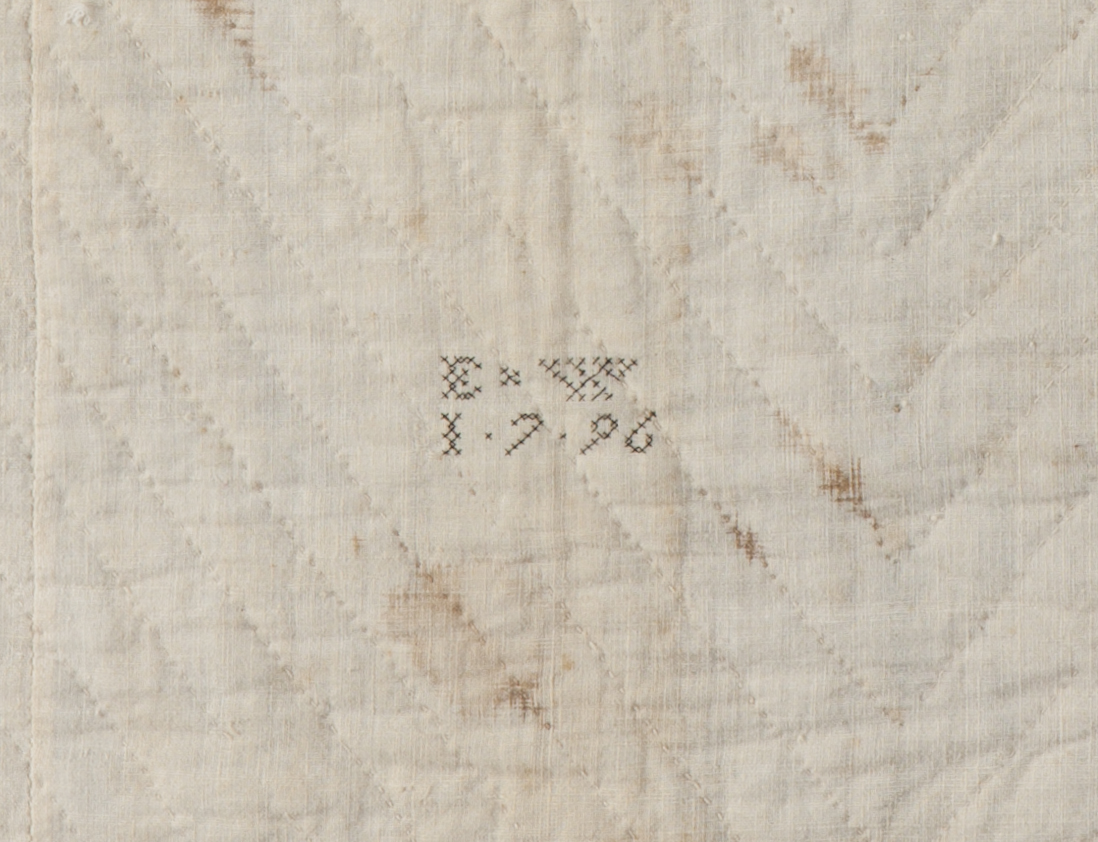
The nineteen-year-old Elizabeth Webster most likely made this quilt in anticipation of her marriage. The marking of linens, including towels, sheets, and tablecloths, were a common practice in the 18th century. Using skills learned as young schoolgirls working stitched samplers, this technique typically was used to inventory very valuable and precious textiles.
After Elizabeth’s marriage in 1799, she moved to her husband’s home in Downington, Pennsylvania – a town named after his grandfather. She immediately accepted his faith in the Society of Friends. Their home was the Downing family farm, built by Joseph Downing’s grandfather, Thomas Downing. Their life centered around their church, which still stands today – the Downington Friends Meeting. The Society of Friends, or Quakers, were against slavery and many were active in the Underground Railroad. Maryland was a slave-holding state, and the Webster family were slaveholders. Every year after her marriage, Elizabeth Webster Downing would bring from her Maryland home two slaves to be freed in the North. It is thought that Elizabeth was behind the 1813 decision to set aside in the church graveyard a section “for the internment of such persons of color as Friends may judge it proper to admit”.
One of Elizabeth’s most important contributions may be her and her husband’s donation of land in 1818 for the building of a school. A building was to be constructed using stone and materials from their property. It was an octagonal school house and was known as the Bell School. The school operated through the 1880’s and taught both black and white children.
Elizabeth Webster Downing died in 1840 and is buried at the Downington Friends Meetinghouse Cemetery in Chester County, Pennsylvania.
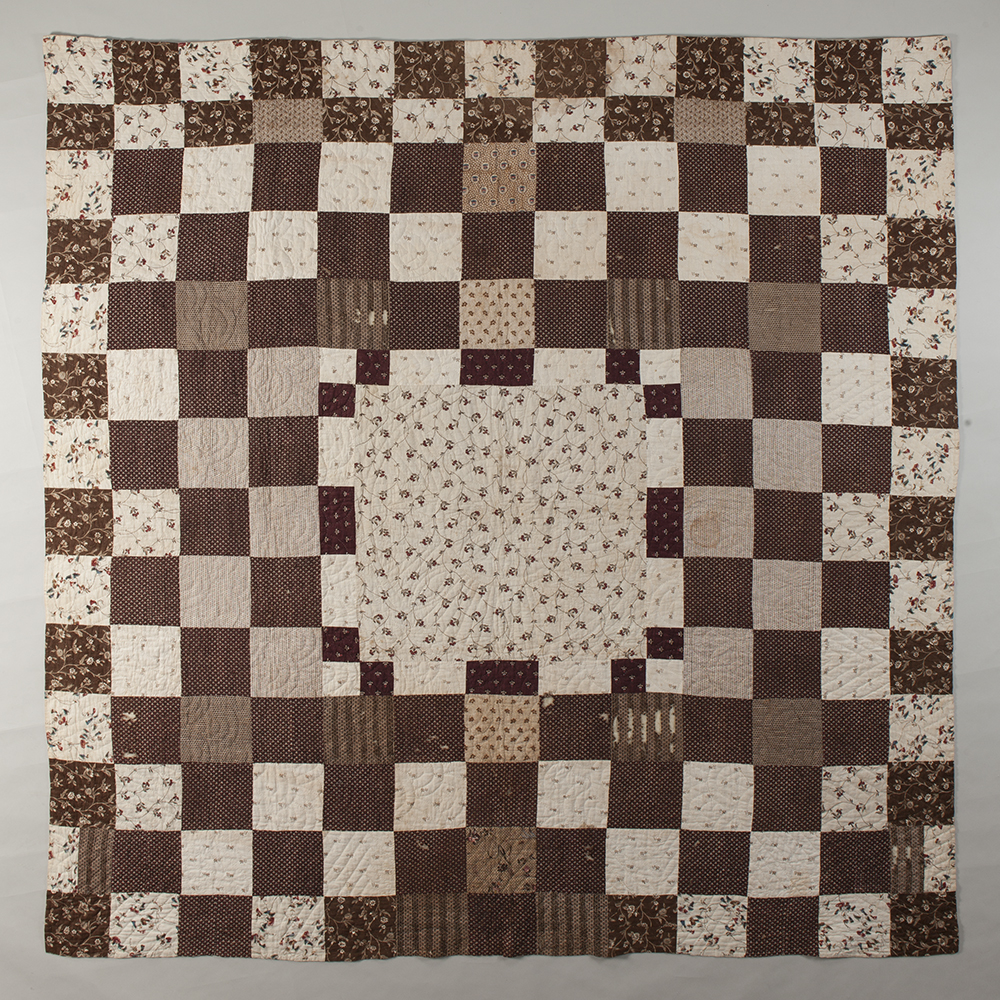
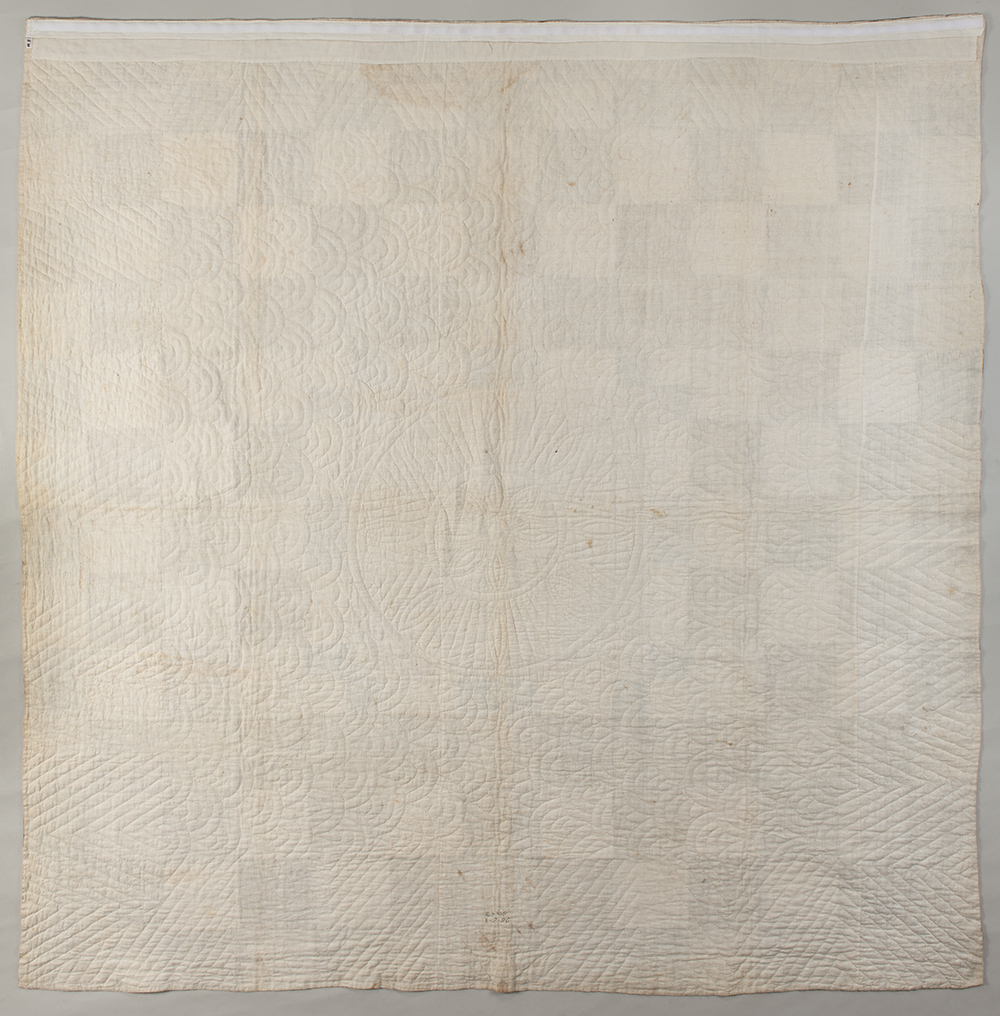
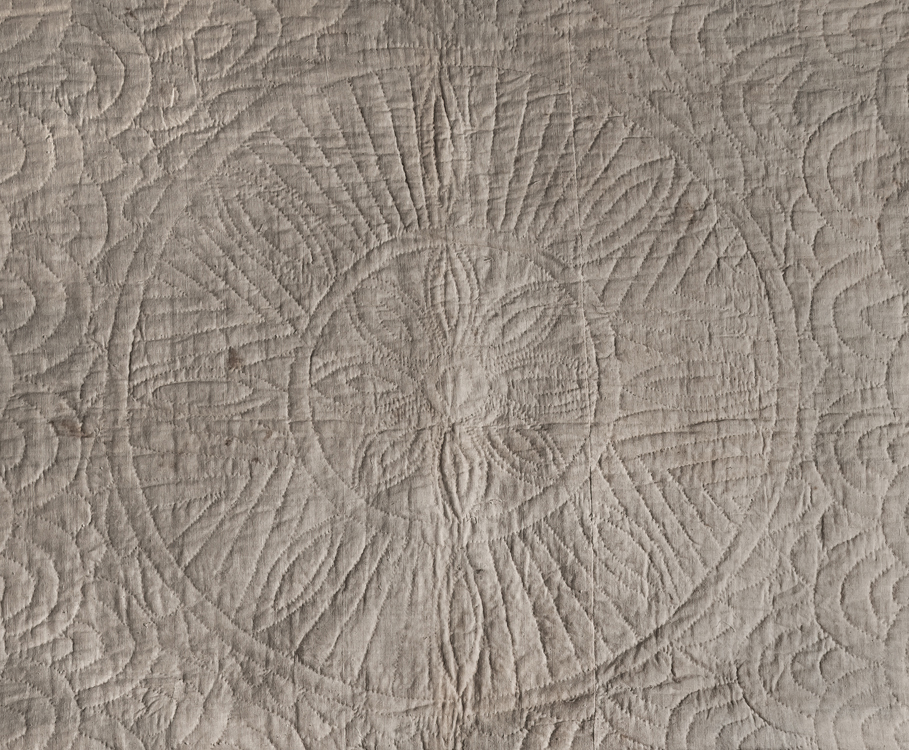
DESCRIPTION: Elizabeth’s patchwork quilt utilizes twelve woodblock printed cotton patterns. The quilt is characterized as a “hit or miss” patchwork using small squares cut to a uniform size and shape and are pieced in an all over pattern. When light and dark materials are alternated, the resulting design is known as the “brick” pattern. Contrasting dark and light ground fabrics was the earliest of American patchwork styles dating from about 1785-1820. While the patchwork on the top of the quilt is pretty straightforward, it is interesting to note the variety of quilting designs. Diagonal parallel quilting borders the bedcover, with a clamshell or scallop design filling in to the center medallion which is quilted in a circle pattern with a variety of geometric designs within it. The inscription sits at the top (or bottom) of the quilt on the backside.