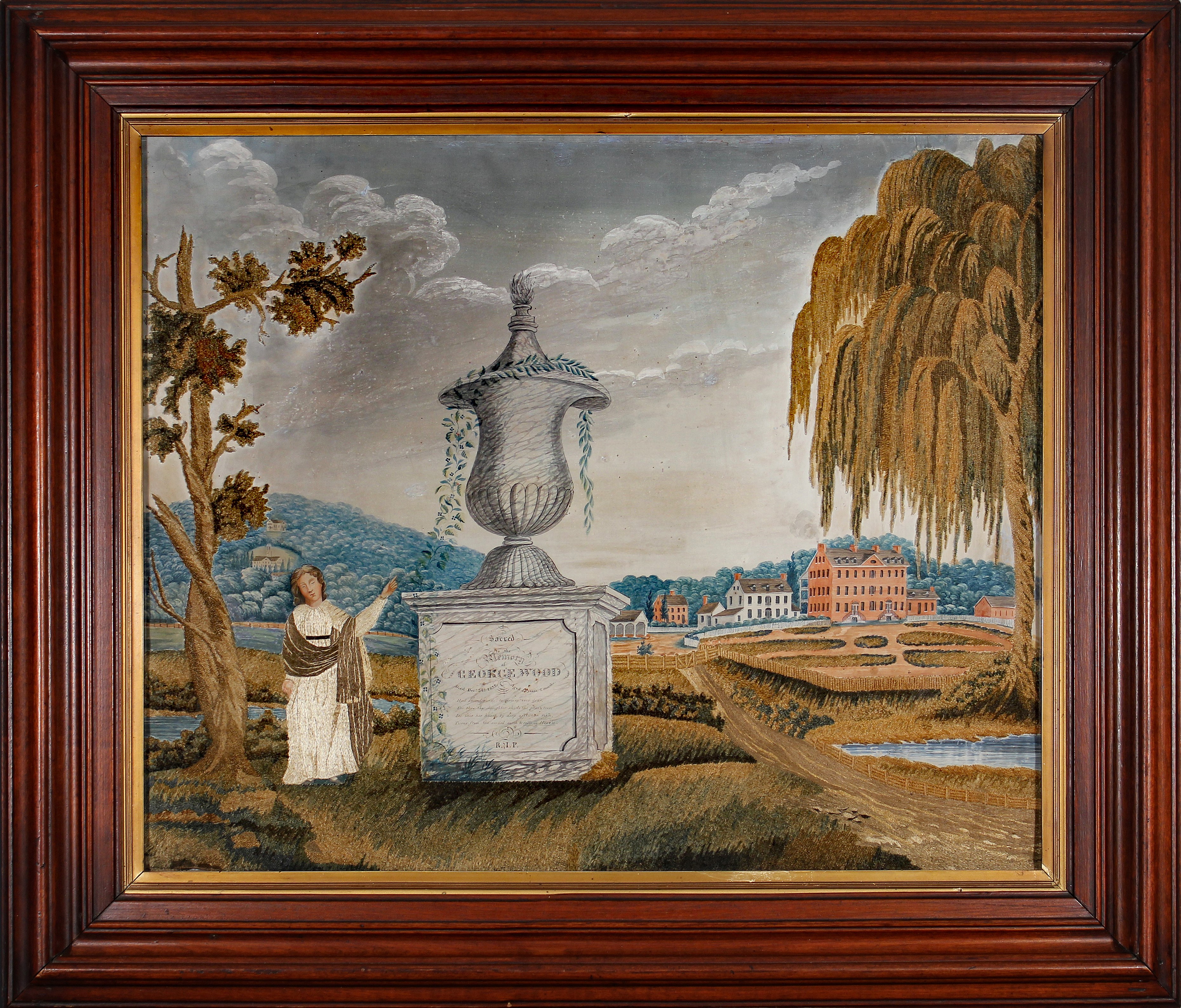
Pictorial Embroidery
St. Joseph’s Academy for girls in Emmitsburg (Frederick County), Maryland was first opened in 1809 under the direction of Elizabeth Ann Seton (1774-1821), America’s first canonized saint. This school, conducted by the newly formed Sisters of Charity, was to become one of the most important Catholic schools for girls. The needlework produced at this school makes up the largest surviving group of any school in Maryland.
Needlework from St. Joseph’s is characteristically ambitious. While styles evolved and changed, the needlework from this school remained of a very high quality. Between 1822 and 1832 embroideries from St. Joseph’s Academy are notable for featuring landscapes, real and imaginary, some with mourning themes and architectural features. This time period corresponds with the arrival of Sister Josephine (formerly Ann Collins, 1801-1850) from Philadelphia. These sophisticated silk on silk embroideries were drawn and painted by Sister Josephine and overstitched with silk and silk chenille thread by the student.
Of this group of surviving needlework the most coveted are the neoclassical mourning embroideries that include the Emmitsburg landscape, such as this one. Margaret Jane Wood’s work features a massive urn inscribed ‘Sacred to the Memory of George Wood Died Dec. 24th 1822’, with a female figure positioned beside it. The monument, which is draped in a grape vine, is surrounded by the academy buildings of St. Joseph’s, painted in great detail and perfect perspective. Also depicted in the distance is Mount Saint Mary’s College and Seminary, the neighboring Catholic school for boys. The scene closely mirrors period prints of the school as well as elements of the surviving landscape today. This work is a testament to the skill of both Sister Josephine and Margaret Jane Wood.
Little is known of Margaret Jane Wood. Details about her father, presumably the George Wood whose name is inscribed on the memorial urn, have remained elusive. Records from St. Joseph’s show that her tuition was provided by Charles F. LeBaron, likely working as an executor or guardian for her.
Jane did not sign her embroidery, but the combination of a strong provenance and the name on the urn makes the identity of its’ maker clear. This needlework descended directly from its maker, Jane, to her daughter Margaret Jane Houseweart (1834-1913), and through the family line to her great-great-granddaughter.
St. Joseph’s Academy is one of the most important schools educating girls and young women in the early 19th century. Betty Ring’s well-known publication “Girlhood Embroidery”, as well as Gloria Seaman Allen’s “A Maryland Sampling”, each dedicate an entire chapter to the work from St. Joseph’s Academy.