Mourning Embroidery
Sight Size: HOA 16 1/4″; WOA 25 1/4″
SCHOOL: Mary was enrolled at St. Joseph’s Academy in Emmitsburg, Maryland in 1839. St. Joseph’s Academy was established by Mother Elizabeth Seton in 1810. Samplers and pictorial needlework made by students of St. Joseph’s make up the largest surviving group from a Maryland school. They are typically complex and executed with great skill.
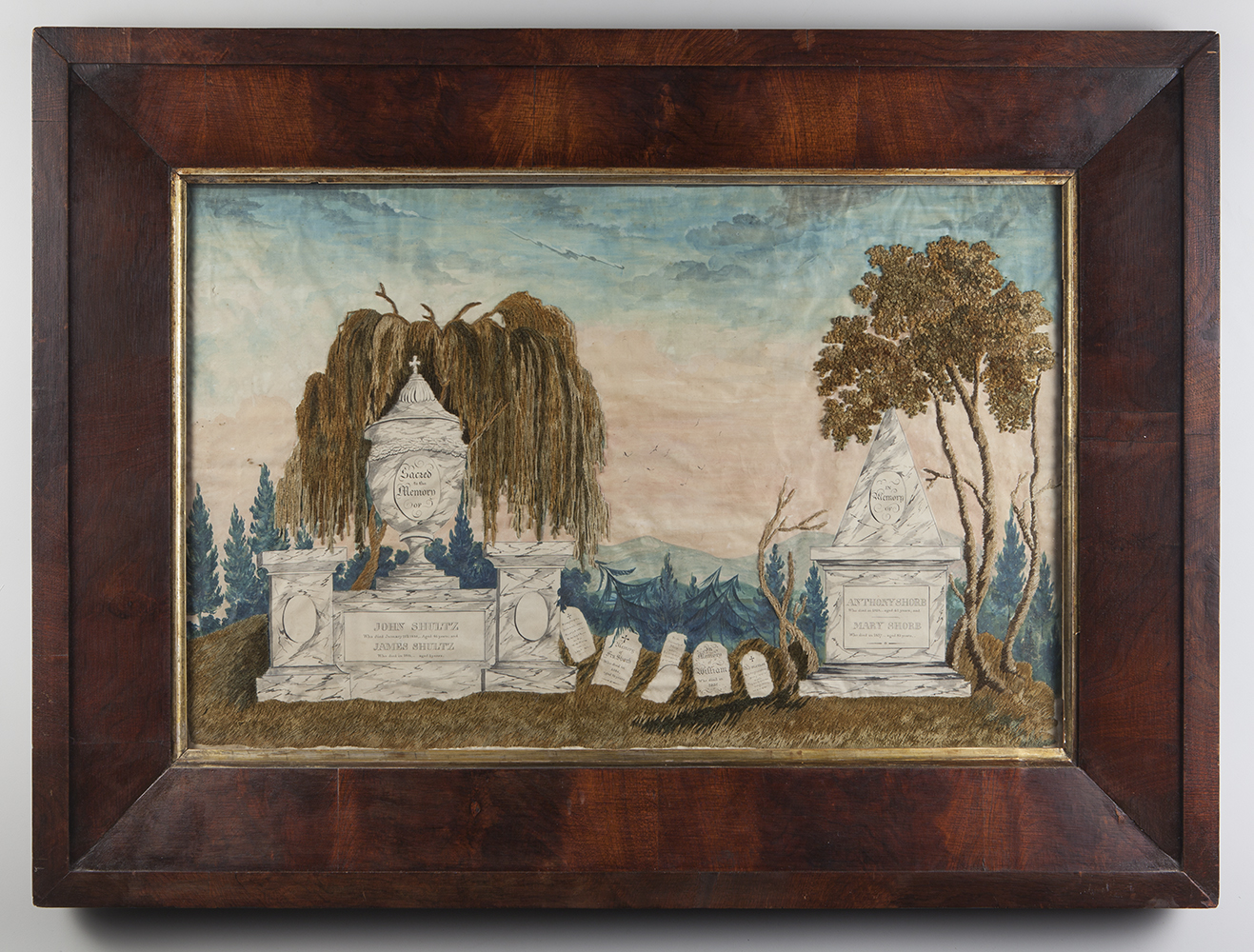
DESCRIPTION: Silk mourning embroidery with chenille and painted scene. The varying shades of green chenille have been used to create the grass and large weeping willow trees. The background consist of a painted sunset with trees and mountain range. The sky is light shades of blue, pink and orange. The painted trees are blue-green in-color. Birds also appear in the sky between the two weeping willows. A large urn tomb with cross finial, flanked by columns is located on the left with the following inscription: “SACRED / TO THE / MEMORY / OF / JOHN SHULTZ / WHO DIED JANUARY 15TH 1828, – AGED 41 YEARS; AND / JAMES SHULTZ / WHO DIED IN 1815, – AGED 3 YEARS.” To the right sets an obelisk tomb with the following inscription: “IN / MEMORY / OF / ANTHONY SHORB / WHO DIED IN 1818, – AGED 42 YEARS; AND / MARY SHORB / WHO DIED IN 1837, – AGED 83 YEARS.” Six tombstones separate the large memorials and all but one stone has an inscription: (from left to right) The first stone has a cross at the top with writing that cannot be deciphered; The second stone has a cross at the top and the following, “MEMORY / OF / FRS SHORB / WHO DIED IN / 1816, / AGED 15 YEARS”; The third stone has the following, “TO THE / MEMORY OF / MARY …..” the rest cannot be deciphered; The fourth stone is blank; The fifth stone has the following, “IN / MEMORY / OF / WILLIAM / WHO DIED IN 1836.”; The sixth stone has a cross at the top and the following, “IN MEMORY / …..” the rest cannot be deciphered.
FORM: Mourning embroideries were a popular form of needlework taught in schools and academies in the early 1800’s. Inspired by neoclassical design, classical imagery is stitched with silk threads on a ground of silk fabric including tombs, weeping women, urns, swags, and willow trees. Watercolors and ink are typically found enhancing the backgrounds and providing details on faces and tombs.