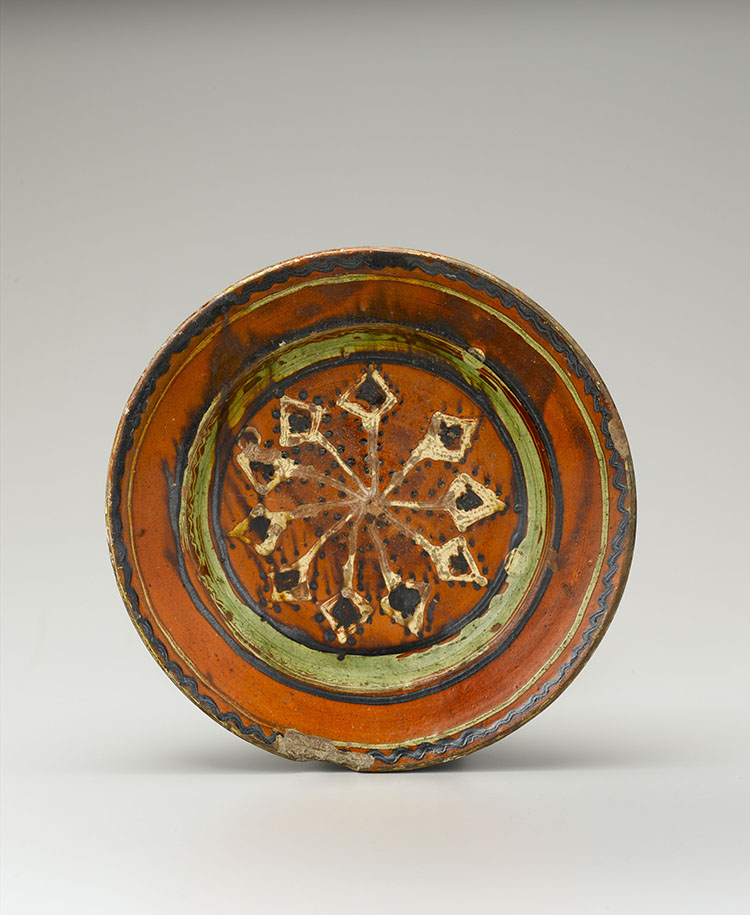
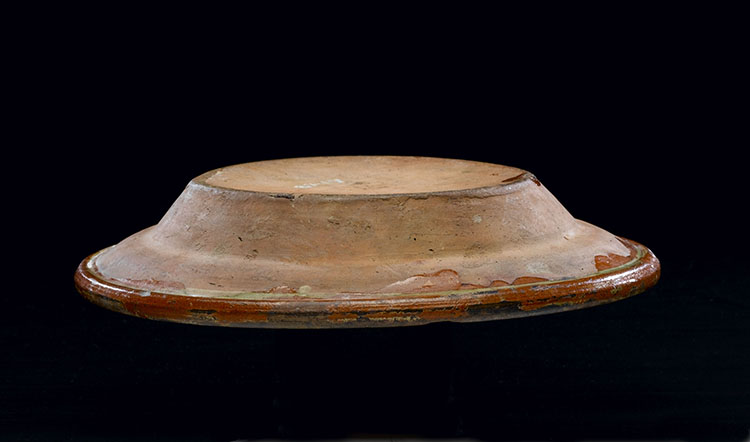
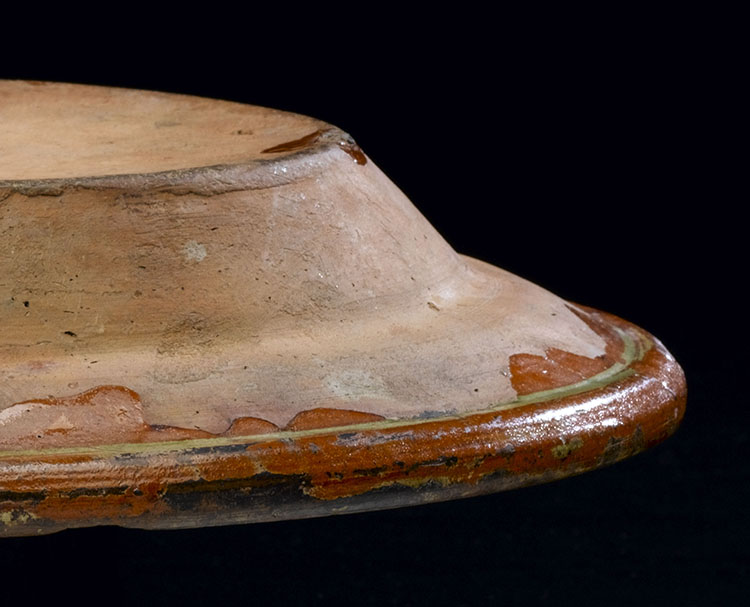
Dish
MAKER: Potters of British descent were responsible for much of the earthenware produced in the North Carolina backcountry, particularly during the late eighteenth and nineteenth centuries. The most elaborate examples of slipware are associated with Quakers William (1769–1847) and Thomas (1791–1839) Dennis, who worked at town of New Salem in northern Randolph County.
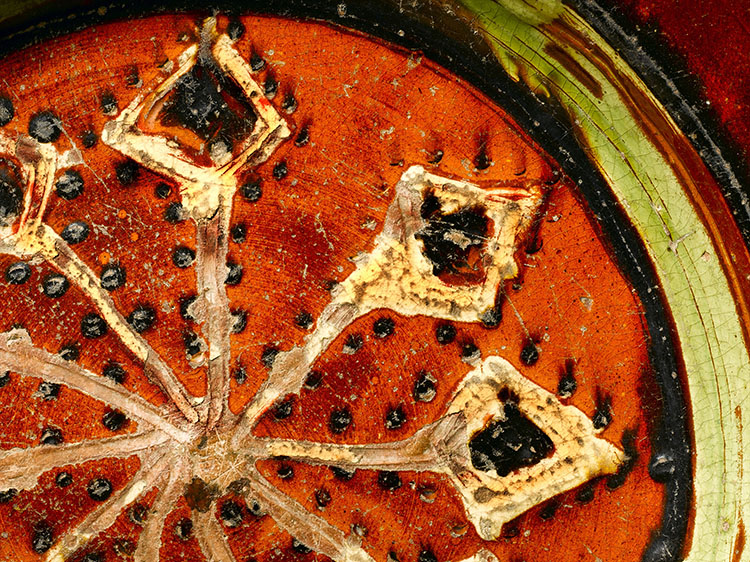
The technically accomplished wares associated with the Dennis sites suggest that William learned his trade from a highly skilled potter and passed his knowledge on to his son Thomas. Quaker craftsmen typically trained their own children or apprenticed them to other members of their faith. The Society of Friends’ Disciplines advised brethren “to bring up their children to habits of industry, placing them with sober and exemplary members of the society, for instruction in such occupations as are consistent with our religious principles and testimonies.” Slipware associated with William and Thomas Dennis includes dishes with floral motifs and abstract patterns that resemble skeletons, clock hands, and radiating serpentine leaves with jeweled dots around their edges. Both men also made decorated hollow ware, although no examples have been discovered thus far. (Art in Clay Gallery Guide)
Pugh, Hal E. and Eleanor Minnock-Pugh. “The Dennis Family Potters of New Salem, North Carolina.” CERAMICS IN AMERICA (2010): 140-167.
Potters of British descent were responsible for much of the earthenware produced in the North Carolina backcountry, particularly during the late eighteenth and nineteenth centuries. The most elaborate examples of
slipware are associated with Quakers William (1769–1847) and Thomas (1791–1839) Dennis, who worked at New Salem in northern Randolph County. The technically accomplished wares associated with the Dennis sites suggest that William learned his trade from a highly skilled potter and passed his knowledge on to his son Thomas. Quaker craftsmen typically trained their own children or apprenticed them to other members of their faith. The Society of Friends’ Disciplines advised brethren “to bring up their children to habits of industry, placing them with sober and exemplary members of the society, for instruction in such occupations as are consistent with our religious principles and testimonies.” Slipware associated with William and Thomas Dennis includes dishes with floral motifs and abstract patterns that resemble skeletons, clock hands, and radiating serpentine leaves with jeweled dots around
their edges. Both men also made decorated hollow ware, although no examples have been discovered thus far. (Art in Clay Gallery Guide)
See also “Ceramics in America” 2010, pp. 66-105