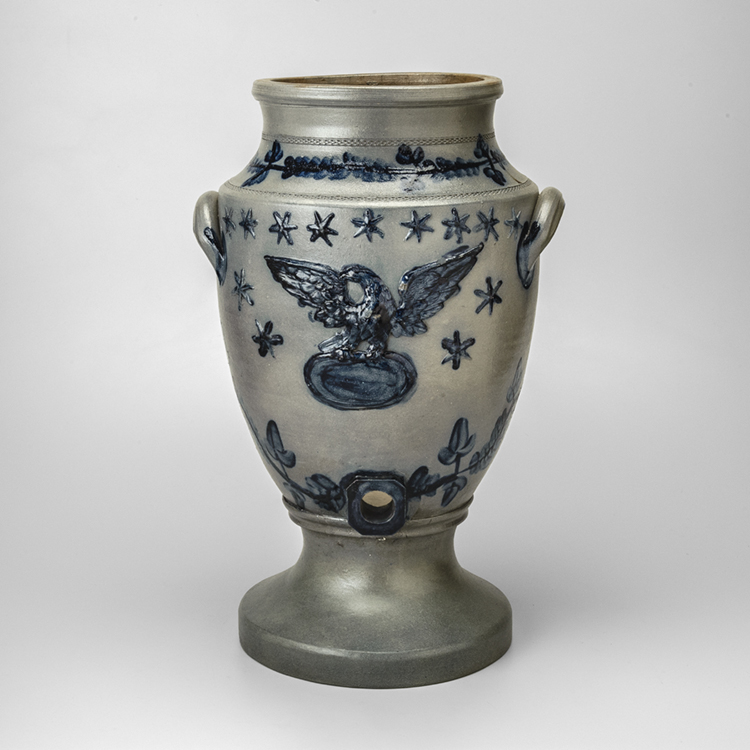
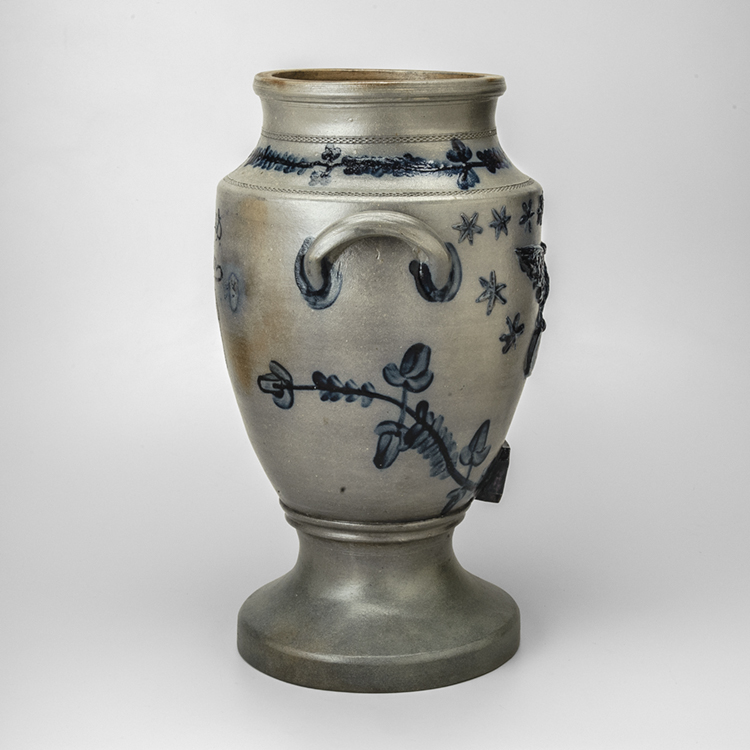
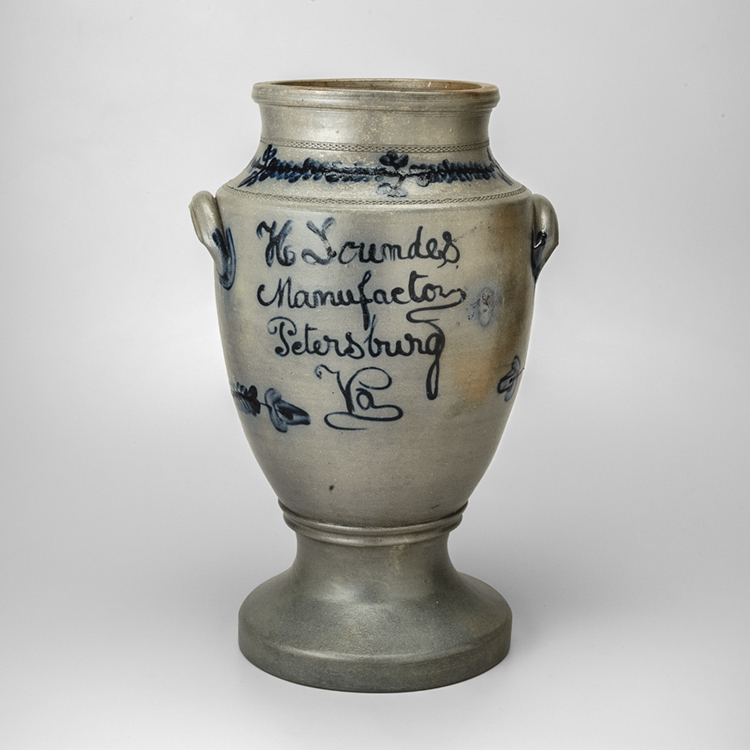
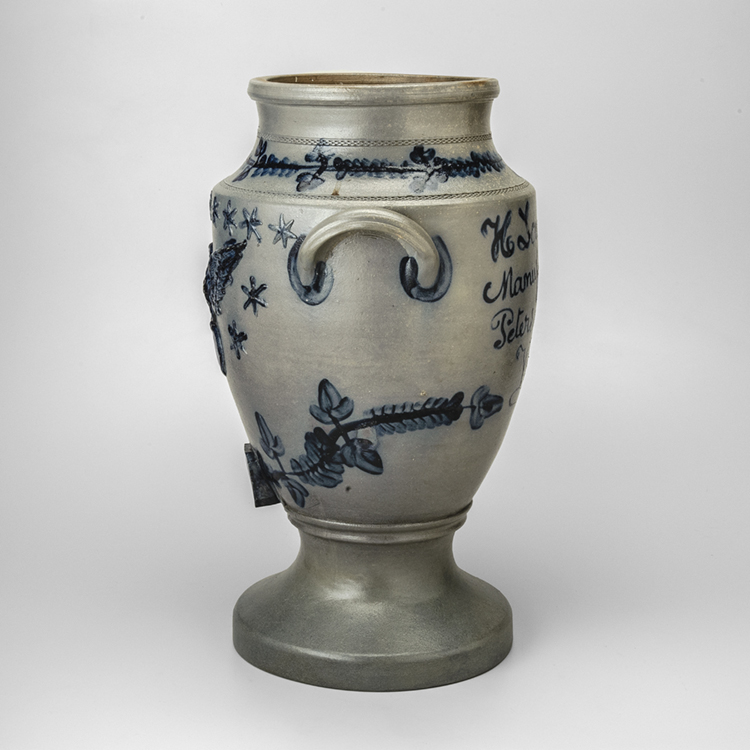
Water Cooler
Salt glazing is a technique used by stoneware potters to create the glassy surface. When the pottery kiln reached over 2000 degrees Fahrenheit, salt was introduced to the kiln, creating a vapor. This vapor adhered to the silica in the clay, forming a glass. From the high temperature, the clay is often non-porous, or vitrified. This, combined with the salt glazing, allowed the potters to not have to apply a glaze to the interior of the vessel. It could hold liquids and not seep, unlike earthenware storage vessels.
Thomas Lowndes (d. 1811), the father of Henry Lowndes (d. 1842), was producing pottery in the northeastern region of Petersburg, Virginia by 1806. Thomas Lowndes was an immigrant from the Staffordshire district in England, and although little evidence of his work exists, the work of his son Henry is an example of the skills he likely passed on to his children. Thomas Lowndes died in 1811 and left the pottery factory to his sons. Henry Lowndes would become the most notable and his work was distinctive. The former pottery of Henry Lowndes was sold to brothers John Ducey (1824-1878) and Thomas Ducey (1822-1867) in 1855.
Umstott, Charles E.”The Lowndes Stoneware Pottery of Petersburg, Virginia.” Journal of Early Southern Decorative Arts (Winter 1995) 83-97.
Russ, Kurt, Robert Hunter, Oliver Mueller-Heubach, Marshall Goodman. “The Remarkable 19th-Century Stoneware of Virginia’s Lower James River Valley.” CERAMICS IN AMERICA (2013) 246-248.