
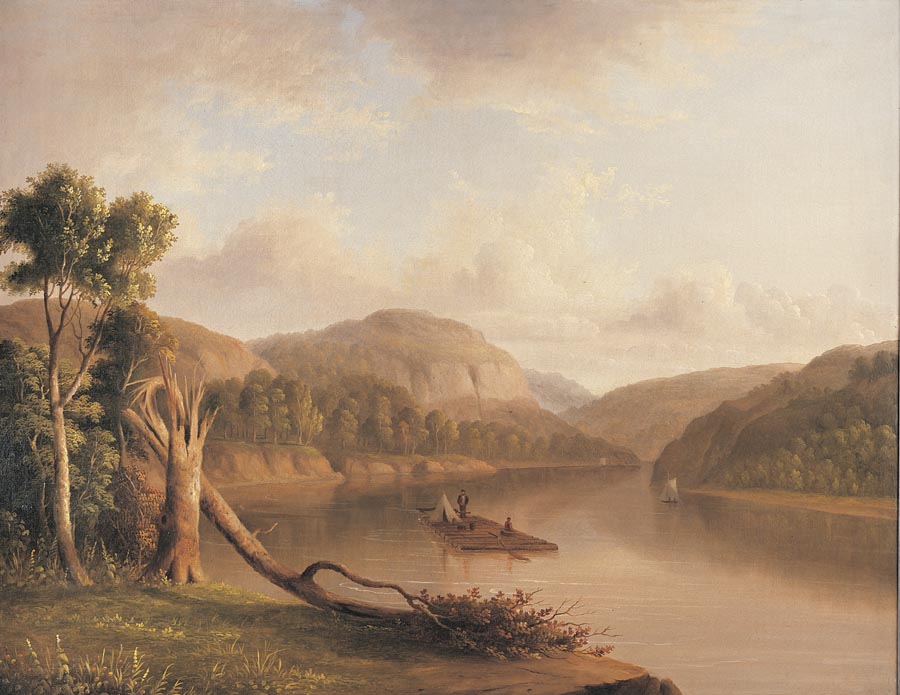
The Cumberland River

Artist/Maker
Earl, Ralph E. W.
Place Made
Nashville Tennessee United States of America
Date Made
1820-1823
Medium
oil on canvas
Dimensions
HOA: 31″; WOA: 39″
Accession Number
2023.39
Description
This painting depicts a bend in the Cumberland River near the Hermitage, the home of Andrew Jackson (1767-1845). It was a scene that the artist returned to regularly. Another version of this composition is in the collection of the Greenville County Museum of Art.

ARTIST: Ralph Eleazer Whiteside Earl (1785-1838) was the son of New England painter Ralph Earl (1751-1801). Earl learned the essentials of painting at a young age. He and his father were working together in Connecticut by 1800. Later, at London’s Royal Academy, Earl was introduced to the works of artists such as John Trumbull (1756-1843) and Benjamin West (1738-1820), who influenced him greatly. Earl also traveled to France where he studied with Jacques-Louis David (1748-1825).

Upon returning from Europe in 1815, Earl traveled the South painting portraits for an eventual, but unrealized, grand historical painting of the Battle of New Orleans. This project brought Earl into contact with Andrew Jackson, the hero of the Battle of New Orleans. Jackson soon became his mentor and patron. In 1818 Earl married Jackson’s niece and moved to Nashville, Tennessee, where he became a popular portraitist. When Earl’s wife died in 1819, he was invited to live at the Hermitage, Jackson’s Nashville home.

Earl is best known for his many portraits of Andrew Jackson. Many of these portraits were reproduced and circulated as engravings to increase Jackson’s public recognition, and to serve as propaganda for his political candidacy. On his election to the Presidency in 1829, Earl accompanied Jackson to Washington, serving as secretary and public relations adviser during Jackson’s eight-year presidency. Earl’s close relationship with the President led to his reputation as Jackson’s “court painter.” Earl painted portraits of many of Jackson’s aides. In 1837 Jackson and Earl returned to the Hermitage. Earl died the following year.
History
The painting descended in the family of Josiah Nichol (1772-1833) of Nashville, Tennessee, to David Harrover.
Artist Biography
ARTIST: Ralph Eleazer Whiteside Earl (1785-1838) was the son of painter Ralph Earl. Brought to America by his father as a child, R.E.W. Earl learned the essentials of painting at a young age. He and his father were working together in Connecticut by 1800. Later, at London’s Royal Academy, Earl was introduced to the works of artists such as John Trumbull and Benjamin West, who influenced him greatly, and at the Louvre other painters made lasting impressions on him. According to a letter of recommendation Earl studied with Jacques-Louis David while in Paris. Upon returning from Europe in 1815, Earl painted “The Battle of New Orleans,” and Andrew Jackson soon became his mentor and patron. He worked in Georgia, Alabama, Tennessee, and along the Mississippi. In 1818 Earl married Rachel Jackson’s niece and moved to Nashville, where he became a popular portraitist. When Earl’s wife died in 1819, he was invited to live at the Hermitage. It is not surprising, then, that Earl’s greatest contribution to posterity came in the form of protraits of Andrew Jackson. In fact, many works were reproduced and circulated as engravings to increase Jackson’s public recognition, and to serve as propaganda for his political candidacy. Because of his known position with Jackson in Washington, he was jocularly known as “the King’s painter.” Earl also painted portraits of many of Jackson’s aides. In 1829, Earl accompanied the president to the White House, serving as secretary and public relations advisor during Jackson’s eight year presidency. In 1837, Earl returned with Jackson to the Hermitage to continue with his painting and to supervise the completion of the home. The following year Earl died.
Credit Line
Anonymous Gift