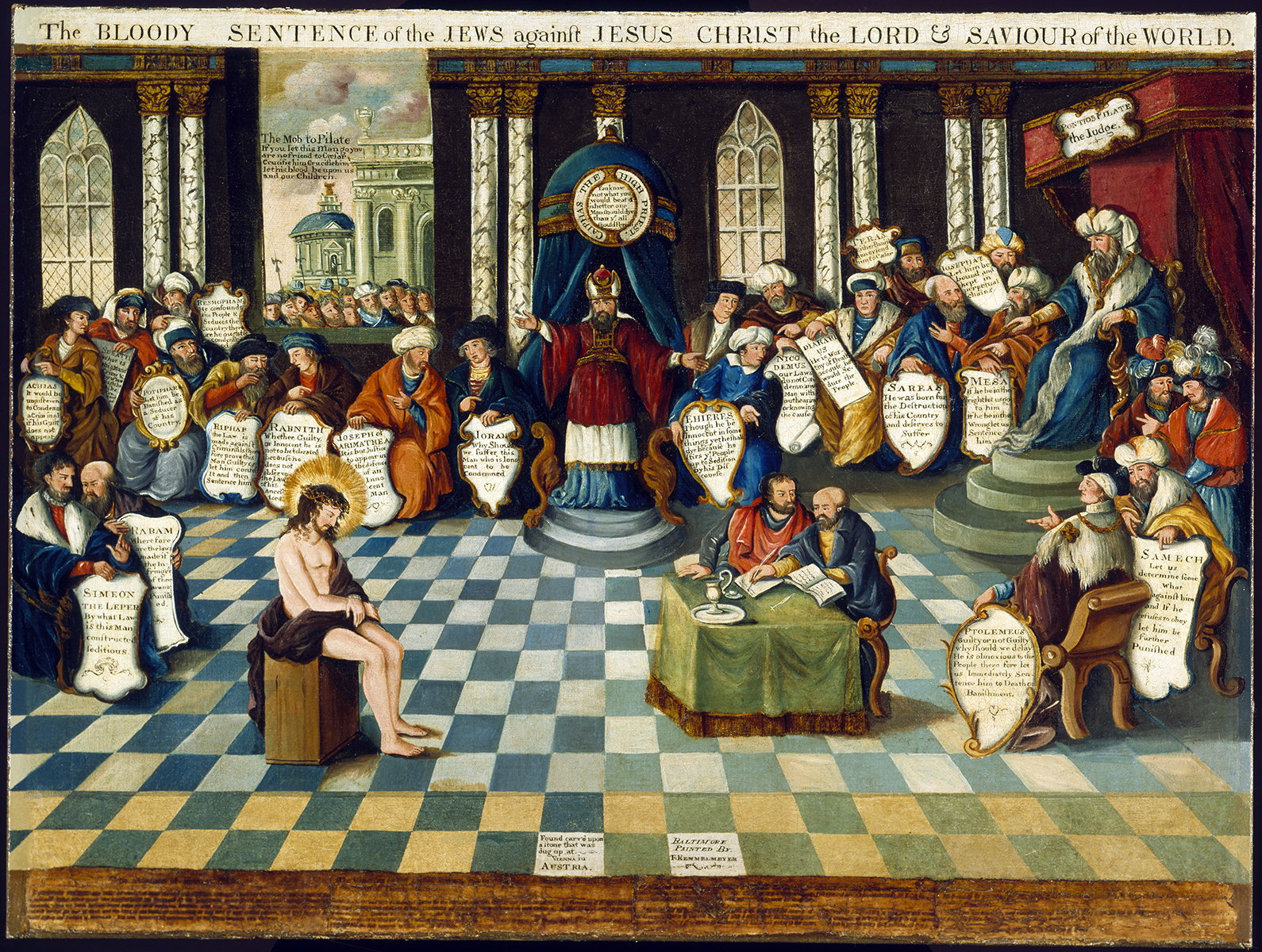
The Bloody Sentence…
Religious paintings were relatively uncommon in the American colonies and in the early part of the 19th century since, with the exception of the Lutheran church, they were not a part of the Protestant heritage. In the South, there are only four recorded religious paintings in addition to this example: Gustavus Hesselius painted “The Last Supper” c. 1750 for St. Barnabas Church, Prince George County, Maryland; William Joseph Williams painted a crucifixion scene now hanging in St. Paul’s Roman Catholic Church in New Bern, N. C.; and Thomas Coram’s “Christ Blessing the Little Children” was painted for the Charleston Orphanage around 1805 (a copy of a print of a 1754 Benjamin West painting). Kemmelmeyer is known to have painted one additional religious work: a portrait of Martin Luther in the collection of the National Gallery of Art (NGA acc. 2014.136.142).
This picture is based on a legendary story of the trial of Christ as it is related in three apocryphal (non-Biblical) documents: the Gospel of Nicodemus, the Death Warrant of Jesus, and the Protocol of the Sanhedrin, the origins of which are uncertain. These documents—and the many related popular prints— reflected a theological debate which raged in the 16th century in Europe over whether Pilate or the Sanhedrin actually sentenced Christ. The debate continued in America. William Essex, a book seller of Lexington, Kentucky advertised in 1814, a print “Pilot’s [sic] Trial of Christ.”
ARTIST: Frederick Kemmelmeyer (b.1752-1753; d.1820-1825) was a Hessian soldier and doctor. Research by A. Nicholas Powers now places Kemmelmeyer in America as early as 1776. Following the American Revolution Kemmelmeyer settled in Charleston, South Carolina, where documents suggest he married, fathered a child, and got divorced.
Sometime between 1784 and 1788 he moved to Baltimore, Maryland. He first advertised on June 3, 1788 in the Maryland Gazette that he had “opened a Drawing-School for young Gentlemen.” He later advertised as a portrait painter in miniature and watercolor and announced the establishment of “An Evening Drawing-School for the instruction of young gentlemen who may have a desire of learning that polite art.” Between 1803 and 1805 Kemmelmeyer worked in the District of Columbia.
The final years of Kemmelmeyer’s career were spent in western Maryland and the Valley of Virginia. During this period he advertised in Hagerstown and Frederick newspapers. His last known advertisement is dated 1816.
In Charleston, Baltimore, and the Valley of Virginia, Kemmelmeyer was closely associated with the German-speaking Lutheran community.
Kemmelmeyer is best known for his military paintings featuring General George Washington including two versions of “George Washington Reviewing the Western Army…” at the Winterthur Museum (WM acc. 1958.2780) and the Metropolitan Museum of Art (MMA acc. 62.201.2) as well as his portraits of Washington (MESDA acc. 3814).
REFERENCES: A. Nicholas Powers, “Research Note: Frederick Kemmelmeyer—From Hessian Soldier to American Artist,” Journal of Early Southern Decorative Arts, vol. 34, 2013. http://www.mesdajournal.org/2013/research-note-frederick-kemmelmeyer-from-hessian-soldier-american-artist/
DESCRIPTION: Painting, oil on canvas, depicting the deliberations of Jewish elders and Roman officers on the fate of Jesus Christ. The scene is set in a marble columned chamber with a green and white checked floor. On the left, Jesus sits on a box, head bowed, arms crossed, head crowned with thorns. At the center, Caiaphas stands in front of his green draped chair arms outstretched in an oratorical pose. At right, Pilate presides from a red-canopied throne. There are 24 other figures, including two scribes, prominently located between Jesus and Pilate. The lower 2 3/4 inches of the painting are covered with a text on paper which is darkly discolored with varnish. The printing is mostly illegible and it is apparently four pieces of a page of a book. It is a direct transcript of the document entitled: “The Sentence of Pontius Pilate” followed by an early contemporary Roman document containing a description of Christ as he appeared in life. The final line of the document reads: “A man for his singular beauty surpassing the Sons of Men.”