Tea Service
Cream Pitcher: HOA: 7 3/4; WOA: 6 1/8 ( handle to spout) Sugar Bowl: HOA 9″ (with lid); WOA: 9″
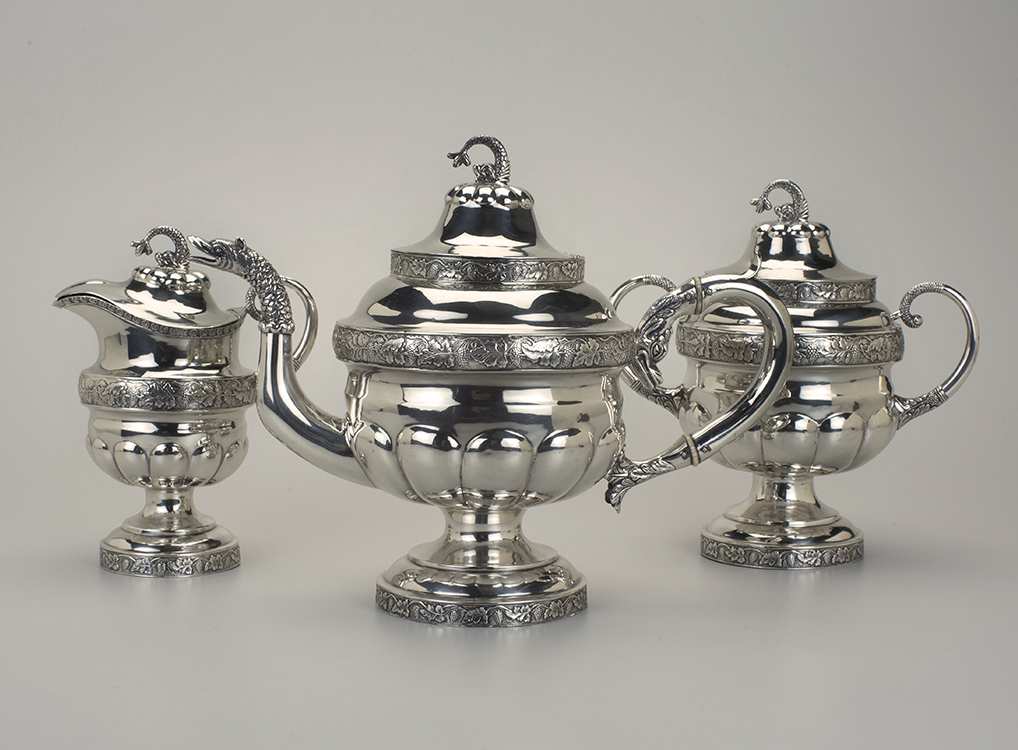
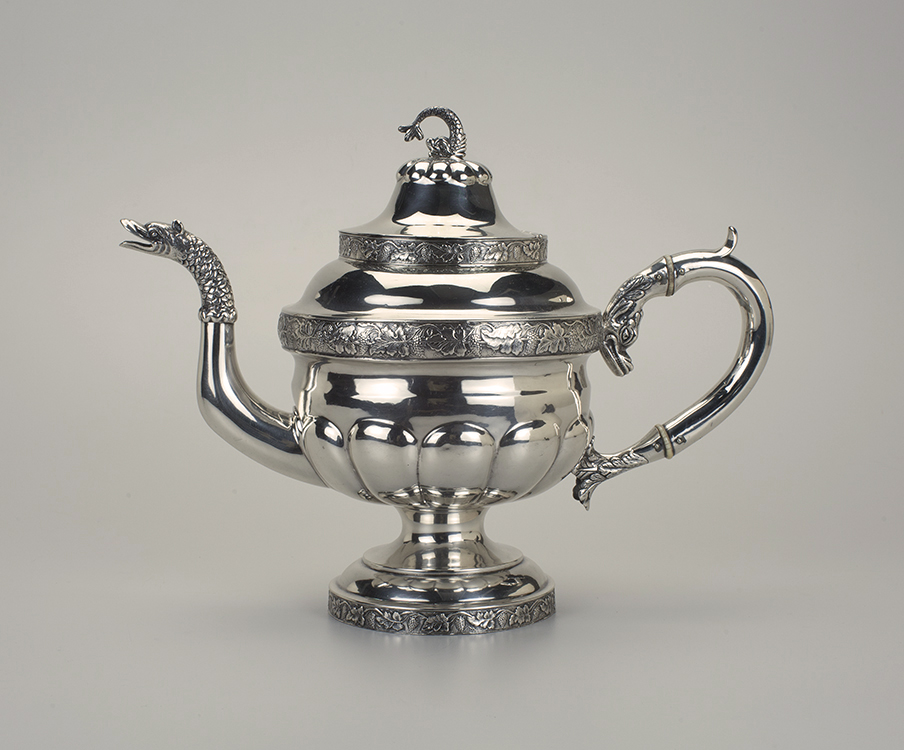
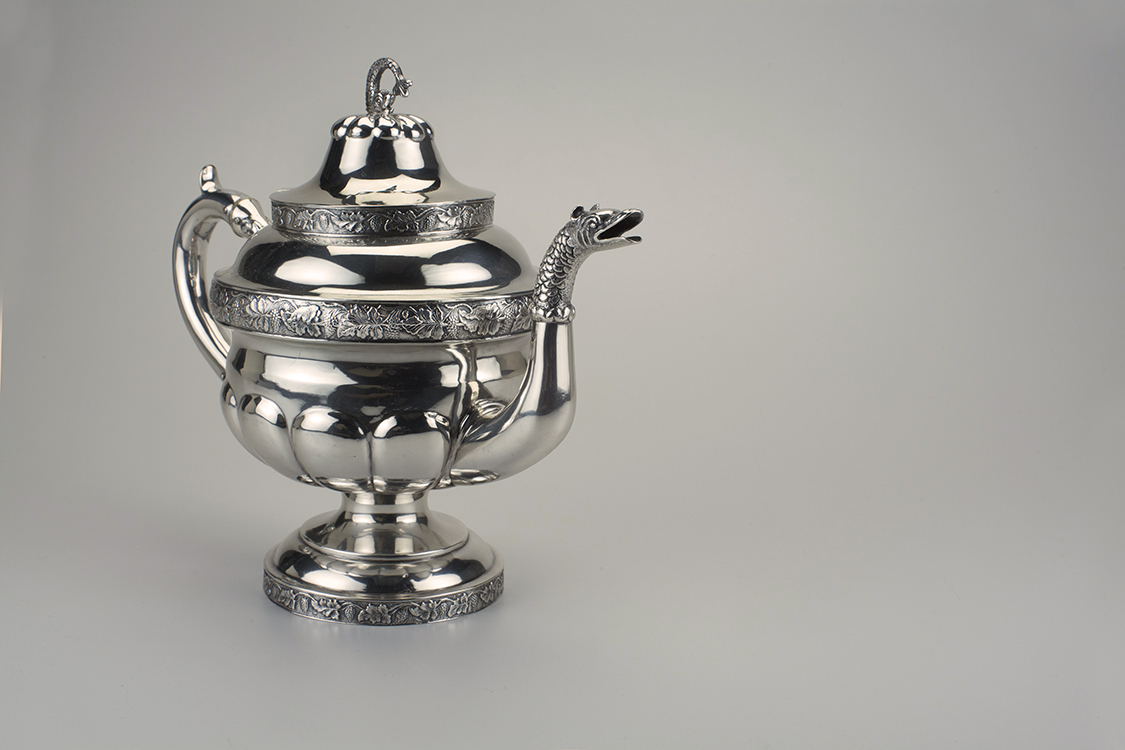
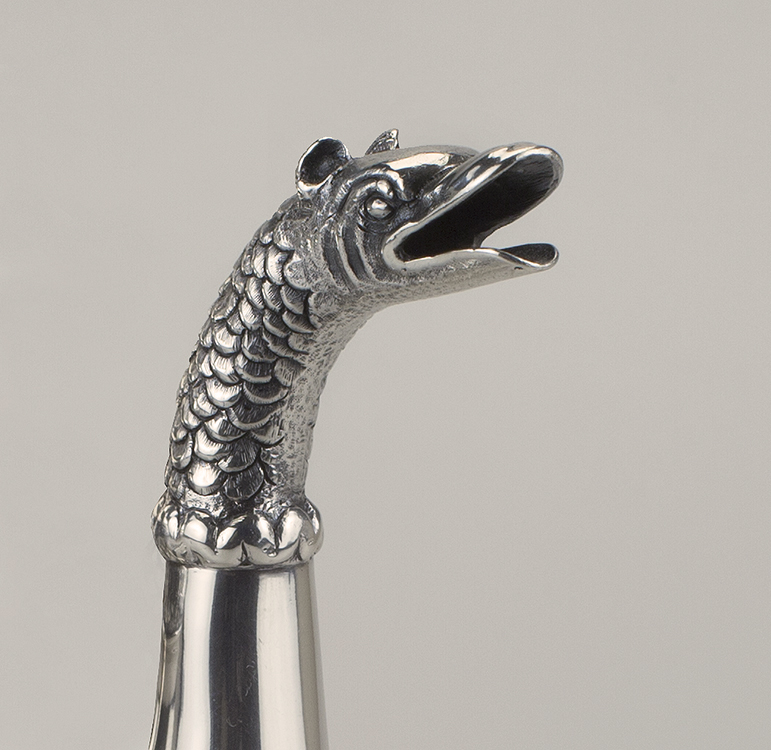
The teapot has a hinged lid and an applied handle with bone or ivory insulators and a cast sea serpent head and tail at the top and bottom of the handle where it connects to the body. The applied spout terminates with an open-mouth sea serpent head. The spout has interior strainer. The applied top band of foliage and grapes is approximately 1/2″ wide; the middle band approximately 11/16″ wide; and the bottom band approximately 9/16″ wide.
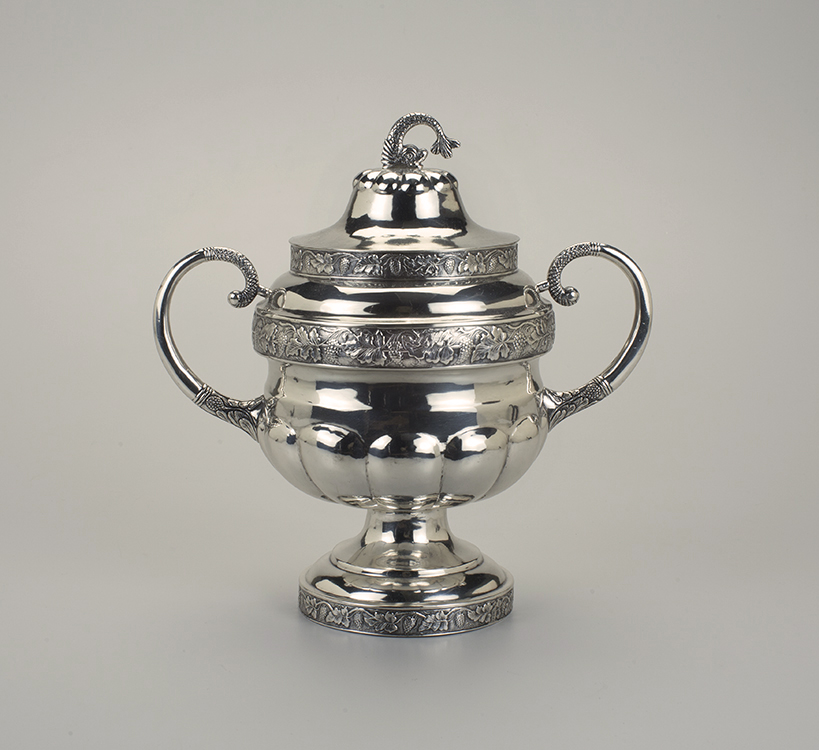
The sugar bowl has a detachable lid and two applied handles with foliage design and cross-hatch pattern. The handles are connected to body of piece by cylindrical-shaped pieces of silver. The applied top band of foliage and grapes is approximately 1/2″ wide; the middle band approximately 3/4″ wide; and the bottom is approximately 9/16″ wide.
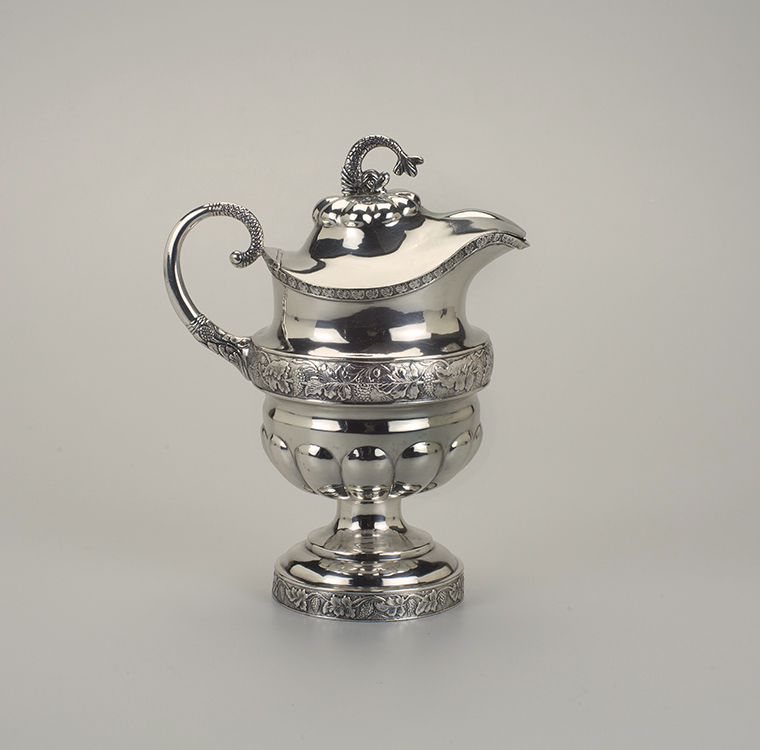
The cream pitcher features a hinged lid and an applied handle. Around the rim and spout is a band of embossed shell designs. The applied handle with foliage design connects at the middle banding on the body and curls upward to connect again at the rim with a cross-hatch pattern that resembles a sea serpent’s tail. The applied band of foliage and grapes on the body is approximately 5/8″ wide and the bottom band is approximately 1/2″ wide.
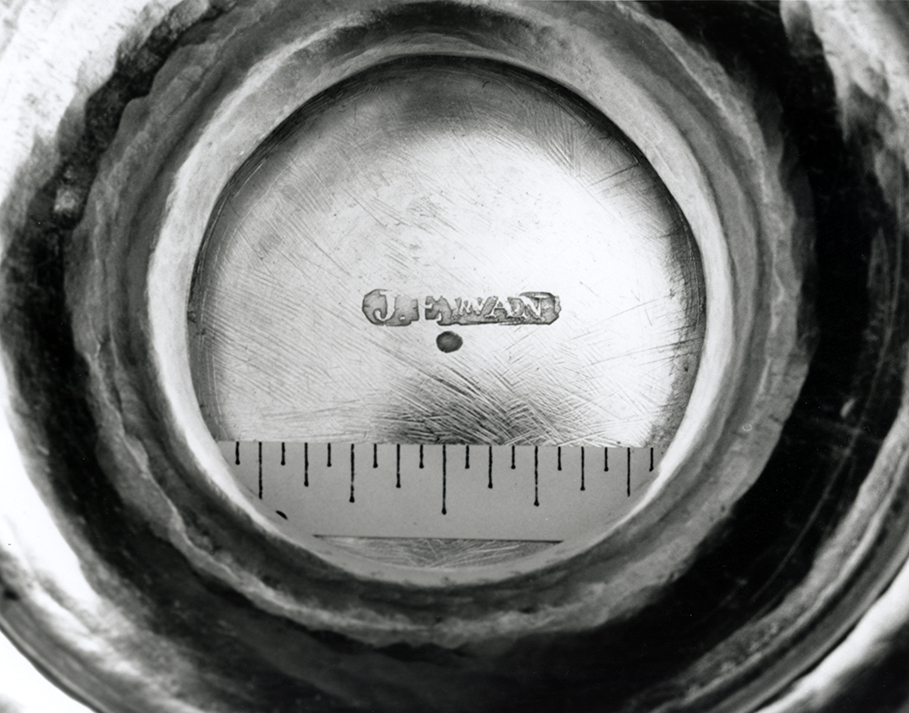
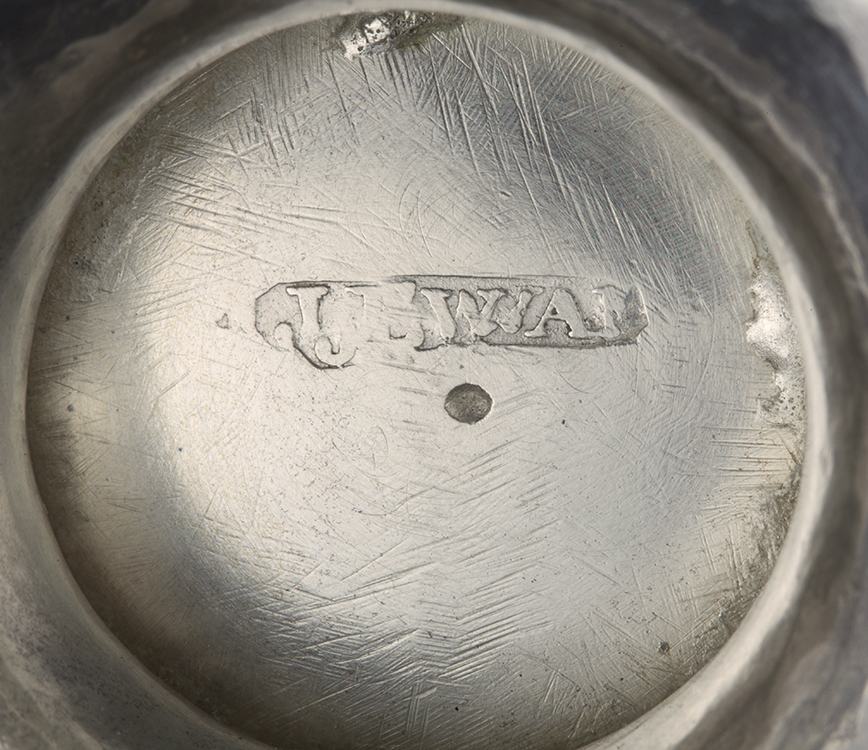
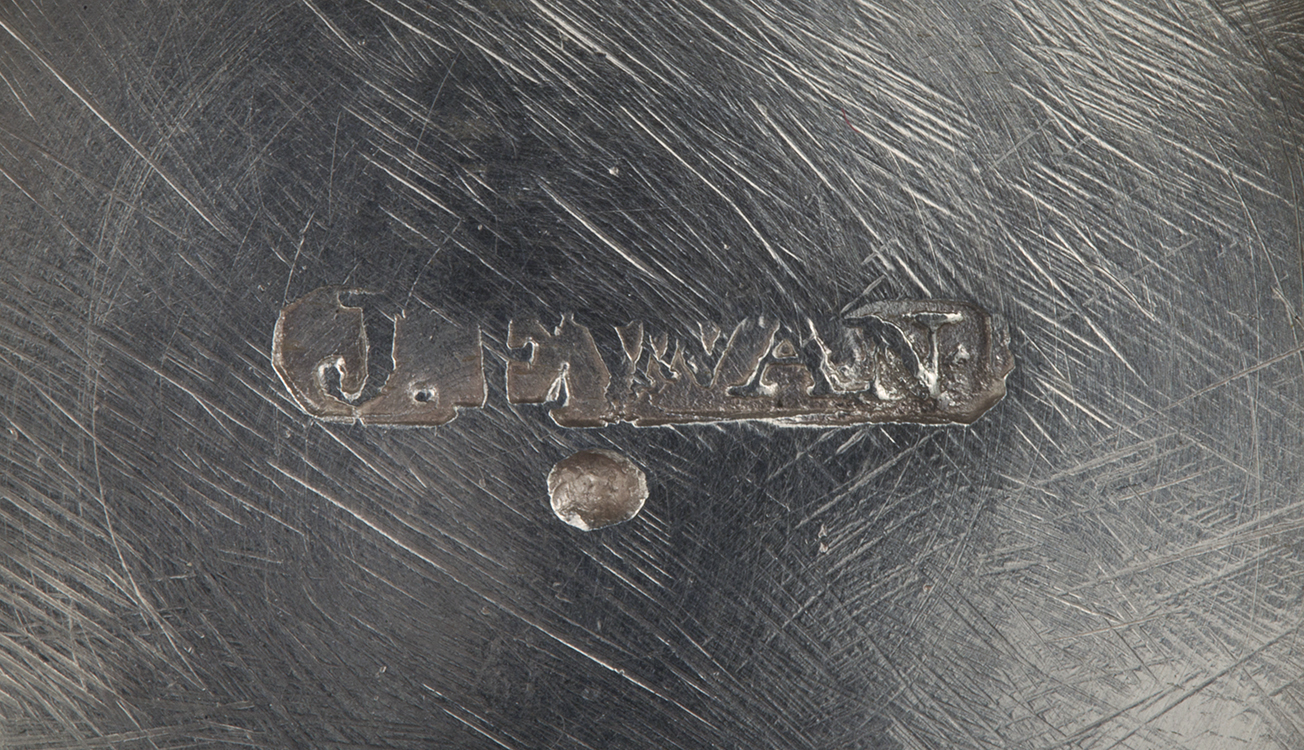
MARK: All three piece of the service are struck on the underside of the body with an intaglio “J.EWAN” mark in a rectangular reserve with rounded corners.
MAKER: From the amount of his silver still in existence, John Ewan (b.c.1786-1852) must have been one of the most prolific of the silversmiths working during the first half of the nineteenth century in Charleston, South Carolina. Although born in New York, there is a possibility that Ewan arrived in Charleston by way of the West Indies. This latter supposition is based on the fact that some silver with his mark has been found in Jamaica. The first knowledge that we have of Ewan’s presence in Charleston comes from an advertisement that appeared in 1823 stating the Ewan and Peter Mood Jr. (1796-1879) were in business together under the firm name of P. Mood & Co. Doubtlessly he was associated with Mood before they formed this partnership. Two years later Ewan was advertising under his own name at 203 King Street as a gold and silversmith, adding that he had jewelry for “Freemason’s Lodges and Knights Templars… .” In addition to being a silversmith, Ewan seems to have operated a rather extensive jewelry business, for he frequently stated in advertisments that he had just received a fine shipment of jewelry and watches. His shop was destroyed in a 1838 fire, but he seems to have saved much of his stock for he reopened at 38 Queen Street. See E. Milby Burton, “South Carolina Silversmiths 1690-1860” (Charleston, SC: Charleston Museum, 1967).
FORM: For most of the eighteenth century the accouterments of the tea ceremony were acquired separately and did not necessarily match in style and shape. By the 1790s, all elements of a tea service (coffeepot, teapot, sugar bowl, waste bowl, and cream pitcher) were made somewhat uniformly in style, with the smaller pieces following the form of the coffee and teapots.