Taufschein of Maria Margaretha Hausihl
Inscription:
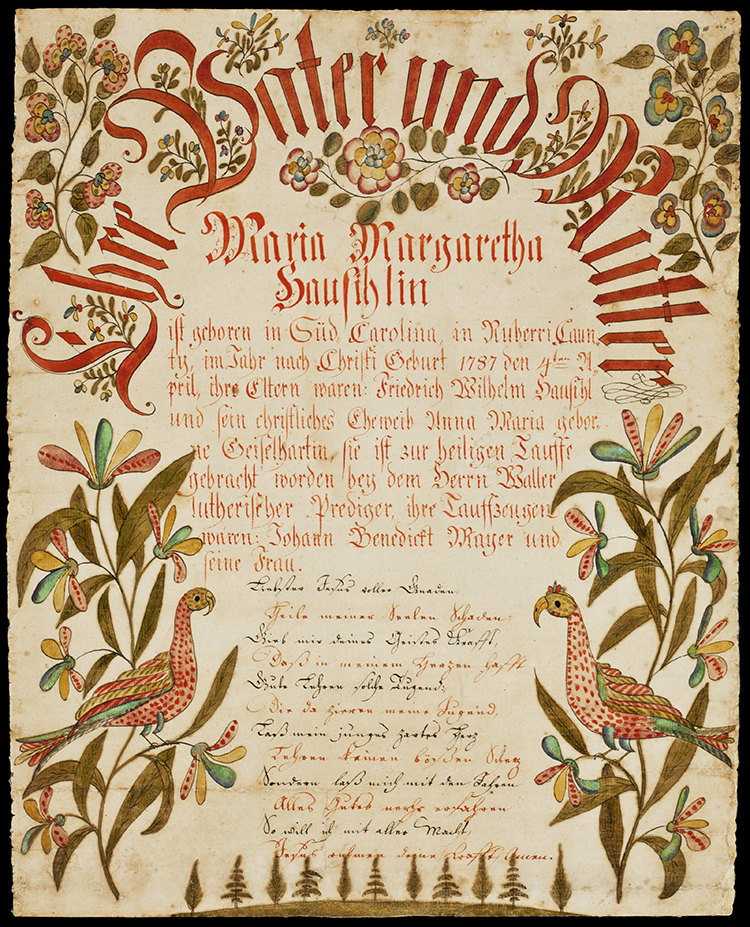
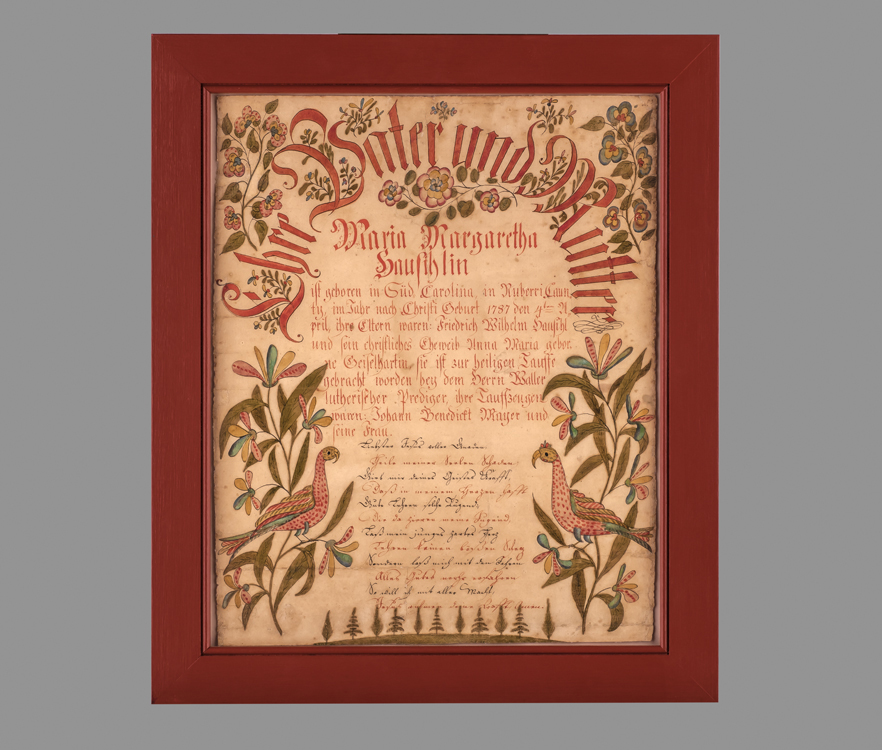
Ehre Vater und Mutter / Maria Margaretha Hausihlin / ist geboren in Süd Carolina in Nuberri Coun / ty, im Jahr nach Christi Geburt 1787 den 4ten A / pril, ihre Eltern waren Friedrich Wilhelm Hausihl / und sein christliches Eheweib Anna Maria gebor. / ne Geiselhartin, sie ist zur heiligen Tauffe / gebracht worden bey dem herrn Waller / lutherischer Prediger, ihre Tauffzeugen / waren: Johann Benedict Mayer und seine Frau.
Translation:
Honor Father and Mother / Maria Margaretha Hausihl / was born in South Carolina in Newberry Coun / ty, in the year after Christ’s birth 1787 the 4th of A / pril, her parents were Friedrich Wilhelm Hausihl / and his Christian wife Anna Maria / nee Geiselhart, she was brought to holy baptism / by Mr. Waller, Lutheran minister, her sponsors / were: Johann Benedict Mayer and his wife.
Dearest Jesus full of grace / Heal the wounds of my soul, / Give me your Spirit’s strength / That in my heart’s keeping / Good teaching, such virtues / Shall adorn my youth / Let my young and tender heart / Learn no evil jests / Rather let me with the years / Experience more all that is good / So that I will with all my might / Praise your strength, Jesus. Amen.
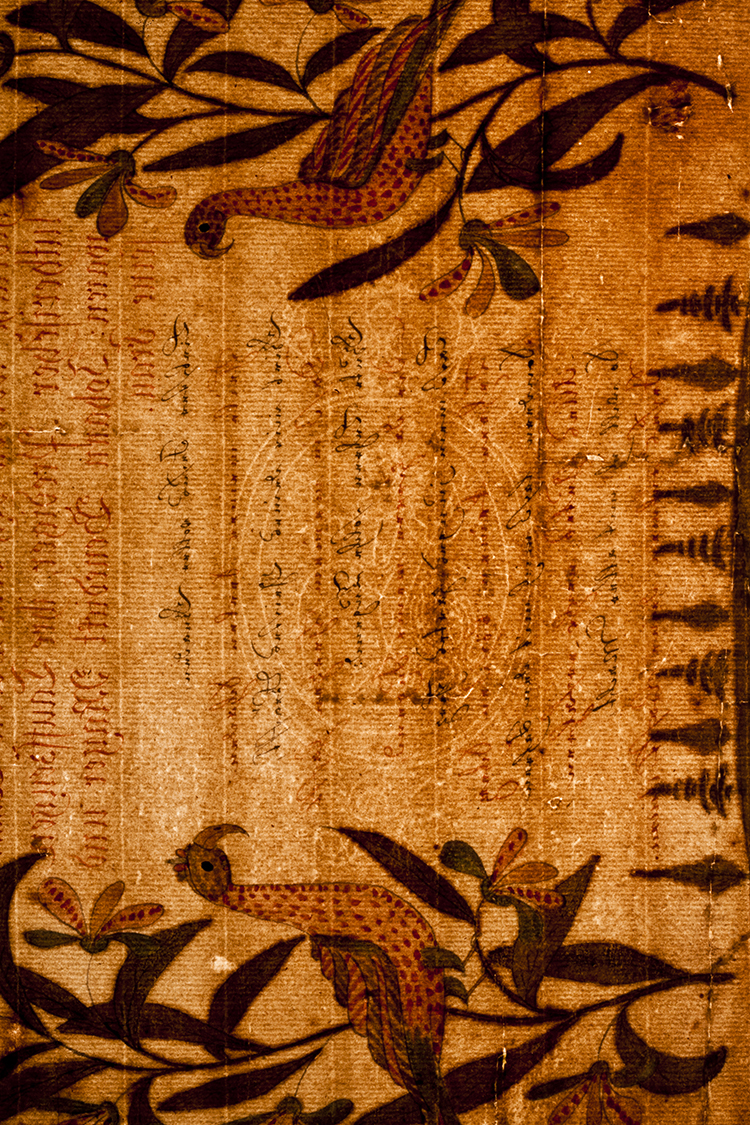
Artist/Maker: Ehre Vater Artist (working 1782-1828). This itinerant artist was given the working name of the Ehre Vater Artist in 1961 by Donald Shelley in his publication Fraktur Writings or Illuminated Manuscripts of the Pennsylvania Germans (1961: Pennsylvania German Folklore Society). The name derives from the artist’s frequent use of the bold masthead “Ehre Vater und Mutter” (Honor Father and Mother). Scholars John Bivins and Frederick Weiser have suggested that the artist may have been an itinerant parochial schoolmaster of the Lutheran or Reformed faith. The artist’s attributed works cover a wide geographic range from South Carolina through North Carolina, Virginia and Pennsylvania. The largest concentrations of works appear in the Germanic communities of Pennsylvania and the Moravian settlements of the Wachovia Tract in North Carolina. At least five taufscheine were created by the Ehre Vater Artist for families living in Newberry County and neighboring Lexington County, South Carolina, a region known as the “Dutch Fork,” due to the large number of German settlers who arrived there in the second and third quarters of the 18th Century. Evidence suggests that these were produced between 1799 and 1804. The Ehre Vater Artist’s fraktur texts are executed with accomplished penmanship in Gothic and copperplate scripts, and occasionally in old German script. Motifs commonly used by this artist include leafy vines and flowers, large stylized tulips, overlapping veined leaves, lunettes, hearts, parrots (one of which is often crested, indicating a male), spiral columns, small colorful dots, a row of evergreen trees, and colorfully ornamented compass-drawn devices. A three-dimensional effect on flowers, hearts and leaves was often achieved through a shading technique seldom employed by fraktur artists. The majority of the Ehre Vater Artist’s fraktur are in a vertical format. Several fraktur by this artist are on paper that bears the “S” watermark of the Salem (NC) Paper Mill.
Related Objects: Other objects in the Old Salem and MESDA collections attributed to this artist include Acc#’s 209.2, 2533, 4646.1, 5782
See:
Bivins, John, Jr. “Fraktur in the South: An Itinerant Artist.” MESDA Journal vol. I, no. 2 (November 1975)
Kolbe, Christian and Brent Holcomb, “Fraktur in the ‘Dutch Fork’ Area of South Carolina,” MESDA Journal vol. 5, no. 2
(November 1979) 36-51
Magill, Courtney. “The Taufschein of Mary Margaret Hauseal: A Glimpse into German-American Life in the Dutch Fork, South Carolina. Journal of Backcountry Studies Vol, 8, No. 1 (Summer 2013). Available online at http://libjournal.uncg.edu/jbc/article/view/732/418