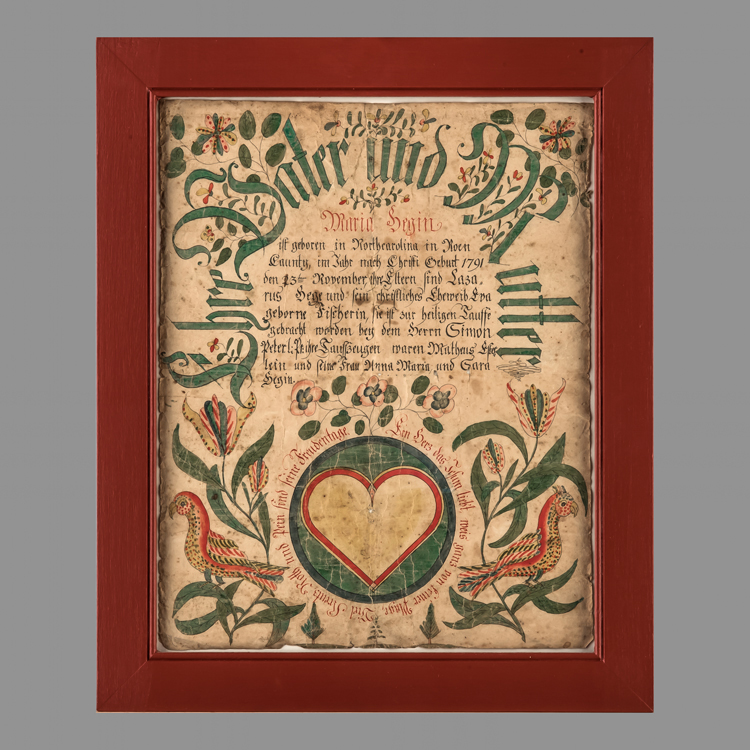
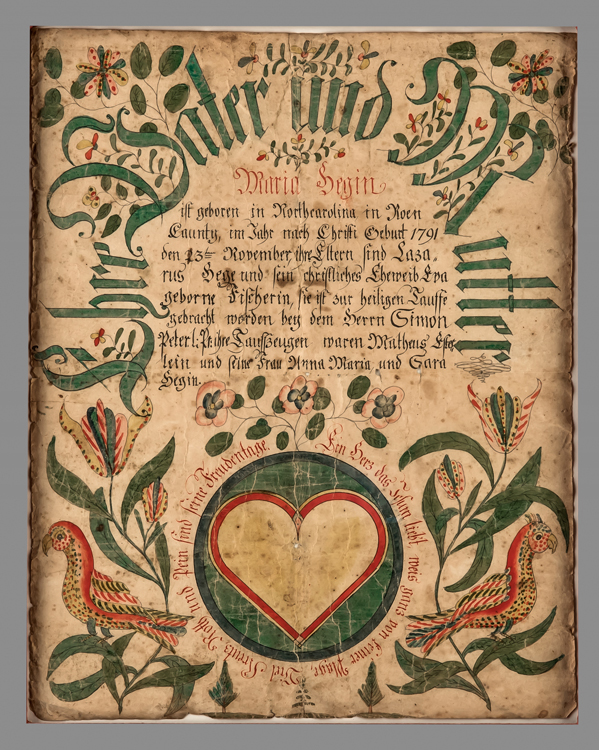
Taufschein of Anna Maria Hege (1791-1816)
Inscription:
Maria Hegin / Ist geboren in Northcarolina in / Roen County, im Jahr nach Christi Geburt 1791 / den 13ten November, ihre Eltern sind Laza / rus Hege und sein christliches Egeweib Eva / geborne Fischerin, sie is zur heilige Tauffe / gebracht worder bey dem Herrn Simon / Peter Li Pr; ihre Tauffzeugen waren Matheus Ester / lein und seine Frau Anna Maria und Sara / Hegin.
Ein Herz das Jesum liebt, weis ganz von keiner Plage, Viel Kreutz, Noth und Pein sind seine Freudentage
Translation:
Maria Hege / was born in North Carolina in/ Rowan County, in the year after Christ’s birth 1791 / on the 13th of November, her parents are Laza / rus Hege and his Christian wife Eva / nee Fisher, she was brought to holy Baptism / by Mr. Simon / Peter Pastor; her sponsors were Matthew Öster / lein and his wife Anna Maria and Sara / Hege.
A heart that loves Jesus knows naught of torment’s way; much cross, distress and pain with joy does fill the day.
Artist/Maker: Ehre Vater Artist (working 1782-1828). This itinerant artist was given the working name of the Ehre Vater Artist in 1961 by Donald Shelley in his publication Fraktur Writings or Illuminated Manuscripts of the Pennsylvania Germans (1961: Pennsylvania German Folklore Society). The name derives from the artist’s frequent use of the bold masthead “Ehre Vater und Mutter” (Honor Father and Mother). Scholars John Bivins and Frederick Weiser have suggested that the artist may have been an itinerant parochial schoolmaster of the Lutheran or Reformed faith. The artist’s attributed works cover a wide geographic range from the “Dutch Fork” region of South Carolina through North Carolina, Virginia and Pennsylvania. The largest concentrations of works appear in the Germanic communities of Pennsylvania and the Moravian settlements of the Wachovia Tract in North Carolina, where most of the known works were created for families in the Friedberg and Friedland communities. The relative uniformity of the North Carolina works suggests that they may have been produced within a brief time span during the first decade of the 19th century. The majority of the texts are written with accomplished penmanship in Gothic and copperplate scripts, and occasionally in old German script. Motifs commonly used by this artist include leafy vines and flowers, large stylized tulips, overlapping veined leaves, lunettes, hearts, parrots (one of which is often crested, indicating a male), spiral columns, small colorful dots, a row of evergreen trees, and colorfully ornamented compass-drawn devices. A three-dimensional effect on flowers, hearts and leaves was often achieved through a shading technique seldom employed by fraktur artists. The majority of the Ehre Vater Artist’s works were executed in a vertical format. Several fraktur by this artist are on paper bearing the “S” watermark of the Salem (NC) Paper Mill built by Gottlieb Schober in 1790 and operated by him in partnership with different residents of Salem until 1836 when it was sold to John Christian Blum.
See:
Bivins, John, Jr. “Fraktur in the South: An Itinerant Artist.” MESDA Journal vol. I, no. 2 (November 1975)
Welshimer, Paula and John Bivin. Moravian Decorative Arts in North Carolina 1981, p.91
Related Objects: Acc. #’s 2533, 4646.1, 5646 and 5782