Tall Case Clock
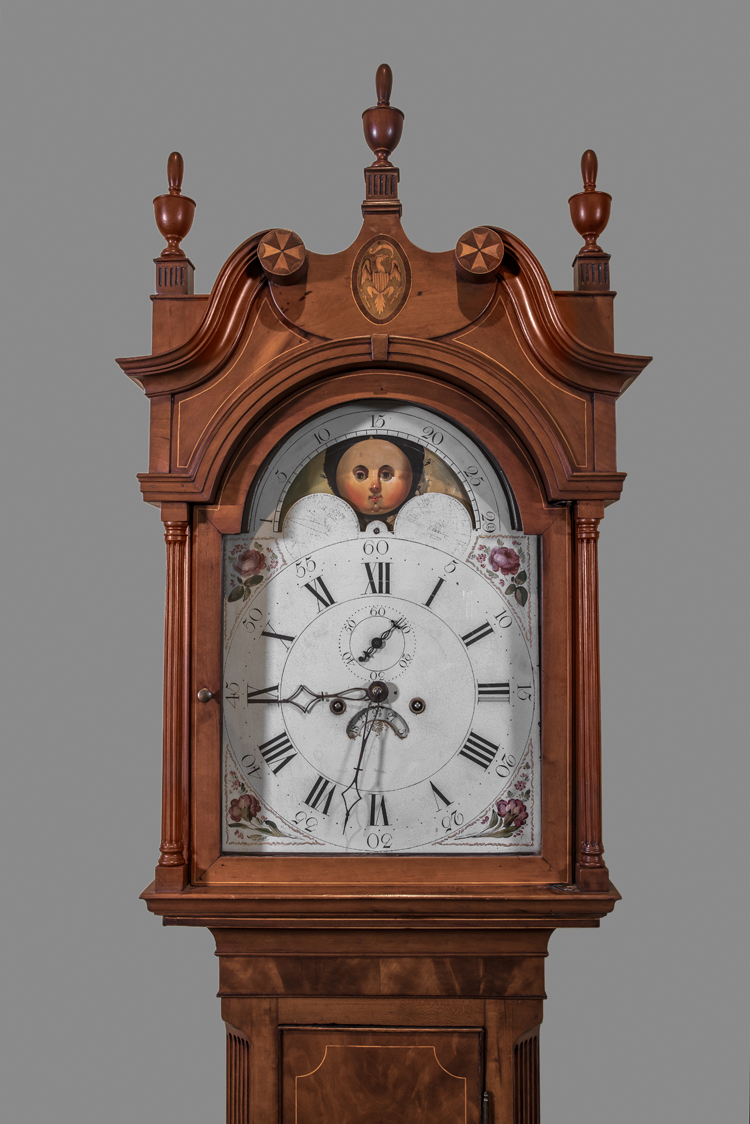
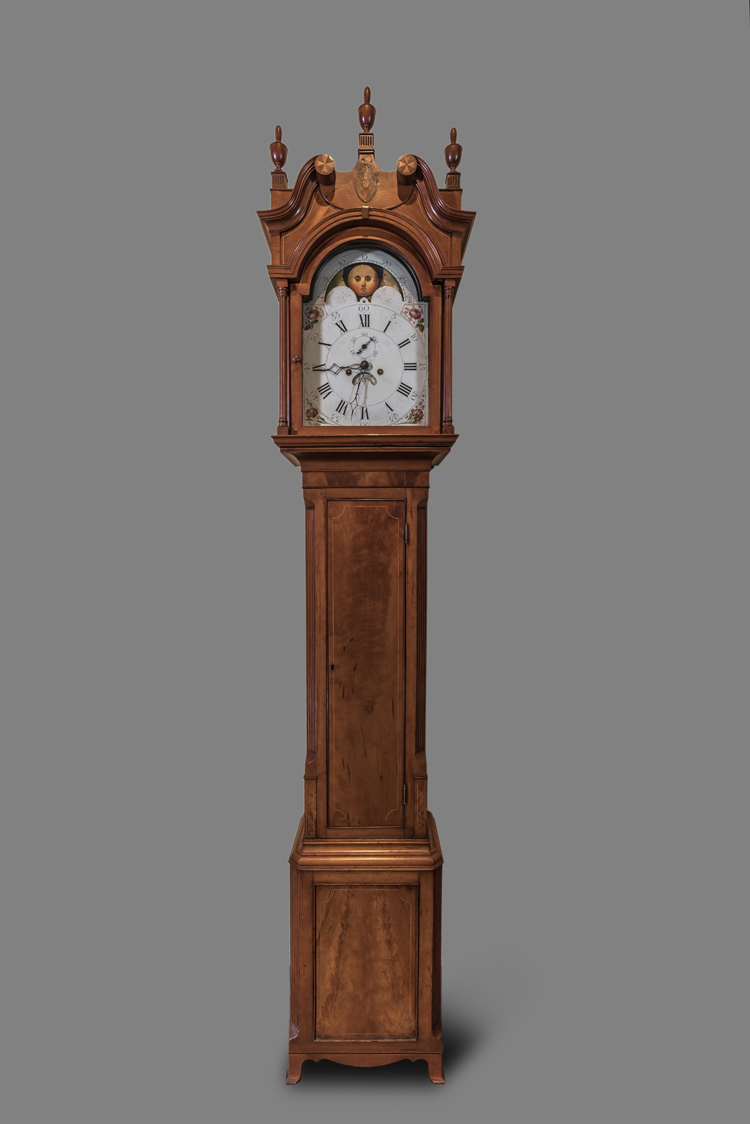
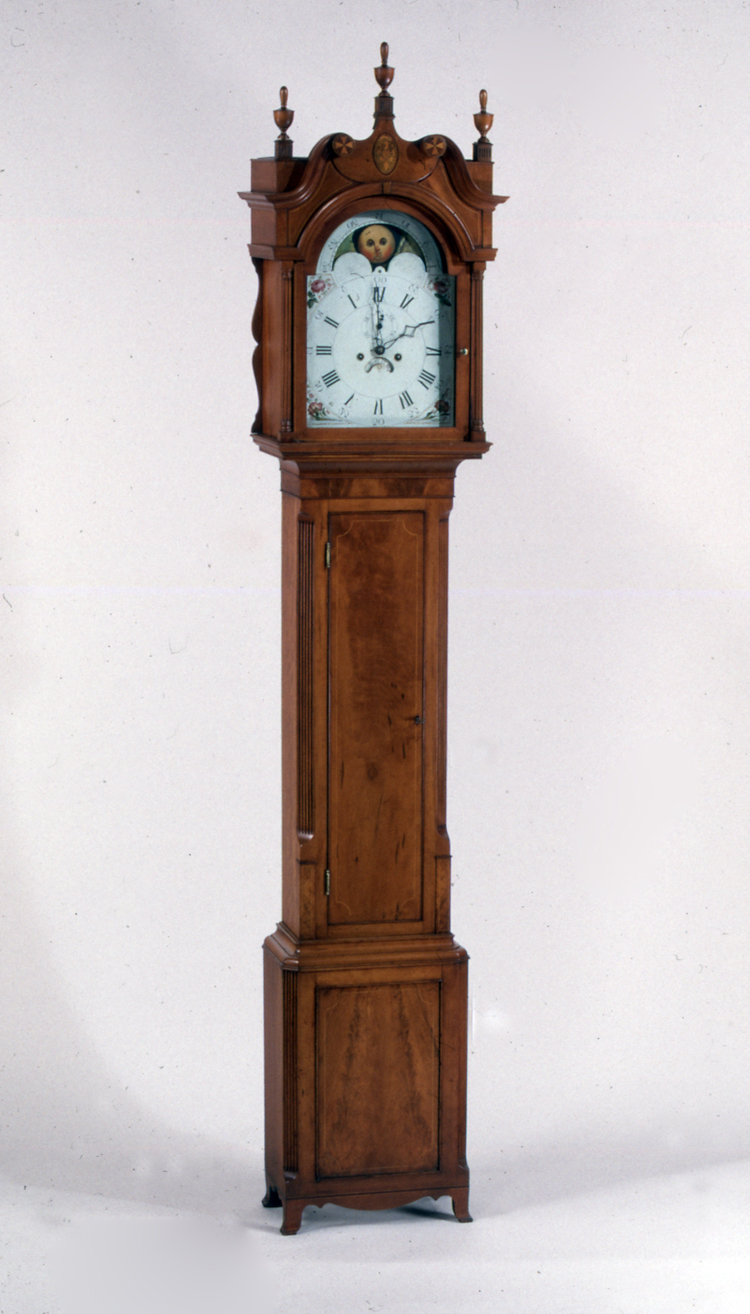
Eight day clock movement with enameled moon dial face and two weights; brass pendulum.
Height of hood: 20 1/2; Depth of hood 10 1/2
WOODS: Cherry and cherry veneer with light and dark wood inlays; poplar secondary.
GROUP: This clock case is very similar to another example with a case attributed to John Brown (1761-1835) and works made and labeled by Hugh Andrews (1761-1821). Its dial is signed “Hu. Andrews/Charleston” and an inscription bears the date “May 4, 1802.” Both Brown and Andrews worked in present-day Brooke County, West Virginia, from 1801 to 1803. Known as “Charleston” from 1791 to 1815, the town of Wellsburg was a thriving commercial center on the east side of the Ohio River in the western panhandle of the state. As there were then three Charlestons or Charles Towns in Virginia, its name was officially changed by the state legislature to Wellsburg in 1816. Another nearly identical case was made for a clock by Samuel Martin (1768-1825), who worked at Wheeling, located only ten miles away, from 1798 to 1801. Two other tall clocks with cases attributed to John Brown feature movements by a later Wellsburg clockmaker, Thomas McCarty (1805-1876). See Sumpter Priddy III, “Cabinetmaker John Brown and the Tall Case Clocks of Wellsburg, West Virginia, 1800-1825,” MESDA Journal, 2019 (Vol. 40); online: https://www.mesdajournal.org/2019/cabinetmaker-john-brown-and-the-tall-case-clocks-of-wellsburg-west-virginia-1800-1825/ (accessed 30 August 2019).
The Brown/Martin clock as well as both Brown/Andrews clocks feature identical eagle inlay at the top of the hood that was made and purchased from a Baltimore specialist.
In their 1992 article in the Journal of Early Southern Decorative Arts, Sumpter Priddy, Jon Prown, and Ron Hurst noted that this small group of West Virginia clock cases bear a strong relationship to Fredericksburg, Virginia, cases as well as to prototypes that were produced in 18th-century Lancaster, England.
MAKER:
John Brown (1761-1835) was one of three woodworking brothers born in Maryland to Reverend Solomon Brown (1729–1803), a carpenter and Methodist circuit rider who emigrated about the year 1750 from The Isle of Man. Evidence of John Brown’s skill as a woodworking artisan survives in what began as a small log cabin that he built for his family in the settlement at “Buffalo Creek” (now Bethany) seven miles east of Wellsburg. In 1811, his daughter Margaret (1791–1827) married the Presbyterian Reverend Alexander Campbell (1788–1866) from County Antrim, Ireland. Over the following four years Brown resided with his daughter and son-in-law at Buffalo Creek while he produced furnishings for them and expanded the log cabin into a much larger, clapboard house. In 1815, Brown deeded the property to the Campbells for $1 and returned to Wellsburg. Five years later he sold them the surrounding 136 acres of land for $100. The couple founded Buffalo Seminary in 1820, which became Bethany College and the original house that John Brown built is a museum at the school, complete with the original woodwork and furnishings he built for the family. Brown remained in the Wellsburg area until his death on 24 June 1835. His body was interred in the Brown-Campbell Cemetery on land he had previously owned in Bethany, West Virginia. From Sumpter Priddy III, “Cabinetmaker John Brown and the Tall Case Clocks of Wellsburg, West Virginia, 1800-1825,” MESDA Journal, 2019 (Vol. 40); online: https://www.mesdajournal.org/2019/cabinetmaker-john-brown-and-the-tall-case-clocks-of-wellsburg-west-virginia-1800-1825/ (accessed 30 August 2019).
Hugh Andrews (1761–1821), was a clockmaker and silversmith who worked in present-day Brooke County, West Virginia, from 1801 to 1803. In her book Virginia Silversmiths, Jewelers, Watch- and Clockmakers 1607-1860, Catharine B. Hollan identifies Andrews as a clockmaker possibly from the Pittsburgh area of Alleghany County, Pennsylvania. In 1802, when he signed the brass movement of the clock in Fig. 6, Andrews was forty-one years old and had about twenty years of clockmaking experience. Hollan documented that Andrews was assessed personal property tax in Brooke County, West Virginia in 1800 and 1801 before migrating east to nearby Washington County, Pennsylvania in 1802 and again further east within the county to Monongahela, where he died in 1821 at the age of sixty. From Sumpter Priddy III, “Cabinetmaker John Brown and the Tall Case Clocks of Wellsburg, West Virginia, 1800-1825,” MESDA Journal, 2019 (Vol. 40); online: https://www.mesdajournal.org/2019/cabinetmaker-john-brown-and-the-tall-case-clocks-of-wellsburg-west-virginia-1800-1825/ (accessed 30 August 2019). See also Catherine B. Hollan, “Virginia Silversmiths, Jewelers, Watch- and Clockmakers, 1607–1860: Their Lives and Marks” (McLean, VA: Hollan Press, 2010), 21-22.