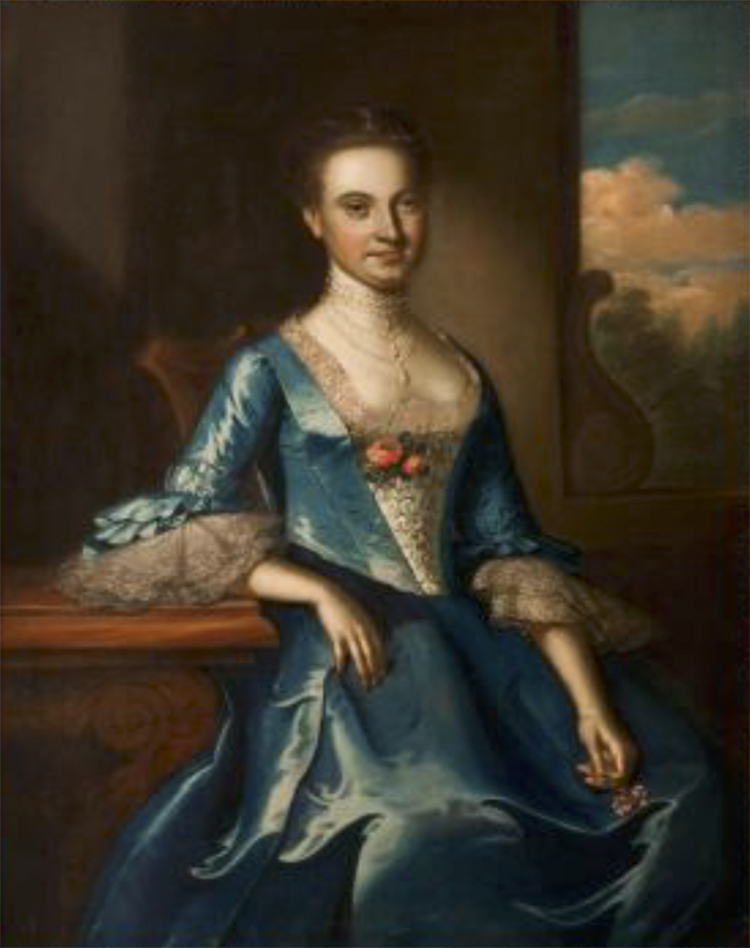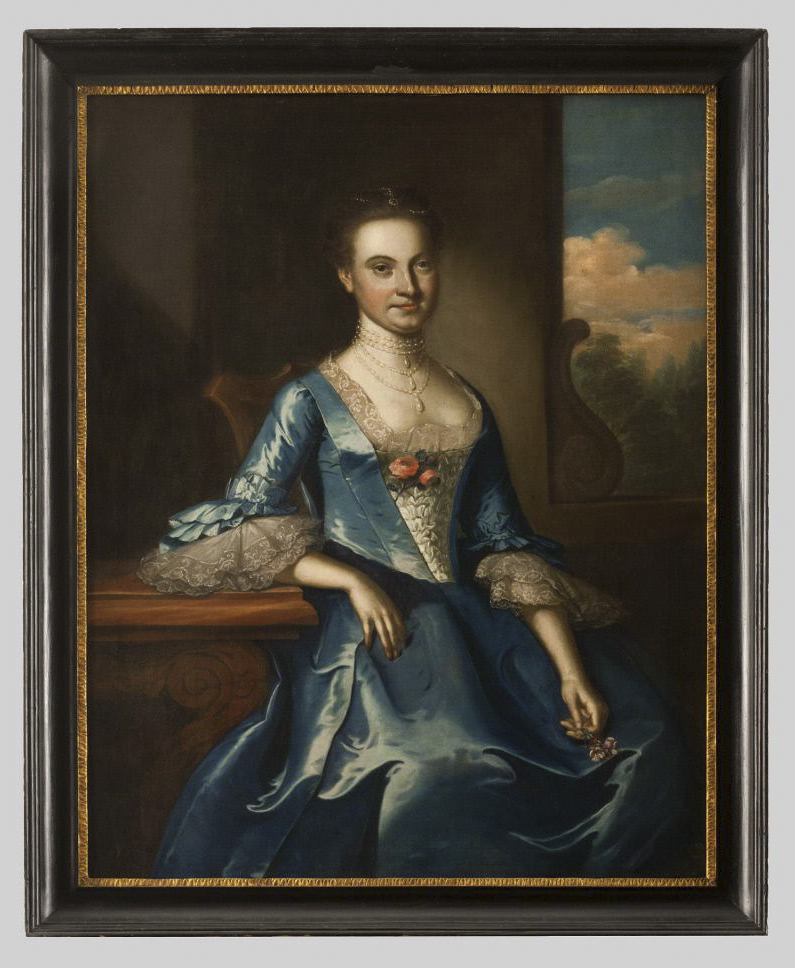
Susannah Rose Lawson
Susannah married Gavin Lawson (1738-1805) lived at Hampstead plantation, Stafford County, Virginia, and moved later to Geneva, Seneca County, New York. He was a successful merchant. No doubt the Lawsons commissioned these extraordinary likenesses because of a familiarity with some of the many paintings that Hesselius created of his wife’s family, the Fitzhughs. The Lawson portraits show a strong influence of the English itinerant artist John Wollaston (1710-1775) as well as Hesselius’s fully developed interpretation of the rococo style. They rank among his most ambitious portraits with highly developed compositions, complex perspective, and sophisticated coloring, particularly in the use of warmer hues for shading.
The chair that Lawson sits in is highly suggestive of the work of King George County, Virginia, cabinetmaker Robert Walker 1710-1777).
ARTIST: John Hesselius (1728-1778) was one of the major American-born artists working in the Middle Colonies and the South in the third quarter of the eighteenth century. The son of Gustavus Hesselius (1682-1755), a Swedish painter who came to America in 1711, John was probably born in Philadelphia. His earliest signed work is dated 1750. It is thought to depict Millicent Conway Gordon (b.1725) of Lancaster County, Virginia. It is in the collection of the Virginia Historical Society (1984.4). Hesselius’ latest signed work dates to 1777.
During his career, Hesselius traveled extensively in Virginia, Maryland, Delaware, Pennsylvania, and possibly in New Jersey. His work seems to have been confined to portraits. All known examples are in oil on canvas, and there is little reason to suspect that he deviated from this practice. He worked exclusively in the late English Baroque and English Rococo traditions of painting, and his style shows the influence of Robert Feke and John Wollaston more strongly than that of his father.
Hesselius married Mary Young Woodward, the widow of Henry Woodward, in 1763, and after that date his energies were divided between his art and the management of his plantation near Annapolis, Maryland. He was also active in the religious affairs of St. Anne’s Parish in Anne Arundel County, Maryland. His interests appear to have been many, and as an artist and landowner he associated with most of the leading citizens of the colony. Hesselius contributed to American painting, and he extended and modified the English tradition of painting in the Colonies.
FRAME: Thought to be original.
RELATED OBJECTS: The portrait of Lawson’s husband Gavin Lawson (1738-1805) is also on loan to MESDA from Colonial Williamsburg (CWF 1954-261,A&B; MESDA acc. 5957.1). Colonial Williamsburg also owns Hesselius’s portrait of Susannah’s mother, Ann Fitzhugh Rose (1721-1789) (CWF 1989-338,A&B).
MESDA has two additional portraits by Hesselius in its collection: Richard Sprigg (1739-1796) of Annapolis, Maryland, painted in 1761 (MESDA acc. 2023.9) and Samuel Chew (1737-1790) of Anne Arundel County, Maryland, painted in 1762 (MESDA acc. 2661).
DESCRIPTION: A three-quarter-length portrait of a young woman, seated and turned in three-quarter view towards the viewer’s right. Her proper right arm is bent, her elbow resting on a marble-topped pier table with carved cabriole legs. She wears three strands of pearls at her throat, each centered by a drop, and scattered pearls in her brown hair. She wears a pale blue satin (in appearance) dress with a white stomacher and ruffles at the low, square neckline and the elbow-length sleeve cuffs. Pink roses are tucked in her bodice and also held in her proper left hand. The background is a shadowed, warm brown interior wall with, to the viewer’s right, a window opening set with a volute in the lower left corner. Through the window, trees and a clouded sky are visible. A rectangular shape in the upper left corner of the composition is indistinct.
Christine Rose (“Bibliography”), p. 75, diverges from the preceding in saying that the portraits went from Arthur P. Rose to his daughters, Miss Mary and Miss Hester Rose of New York, NY, thence to Knoedler’s.