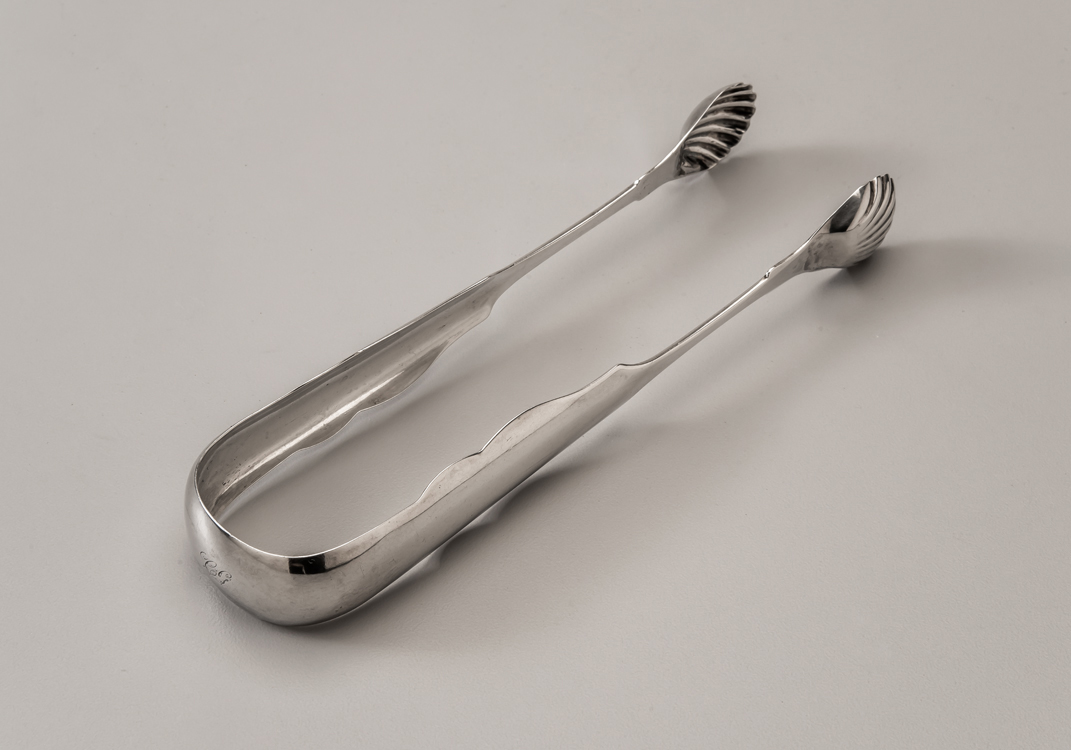
Sugar Tongs
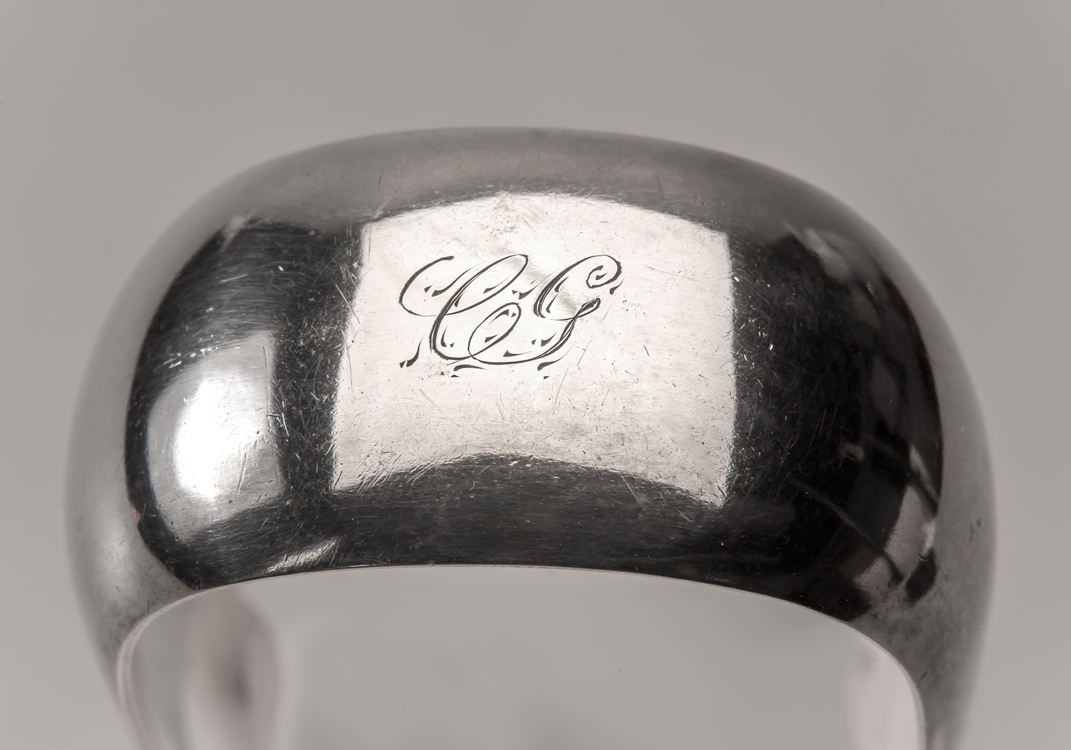
INSCRIPTION: Engraved on the outside of the bend with letters “CG” in script.
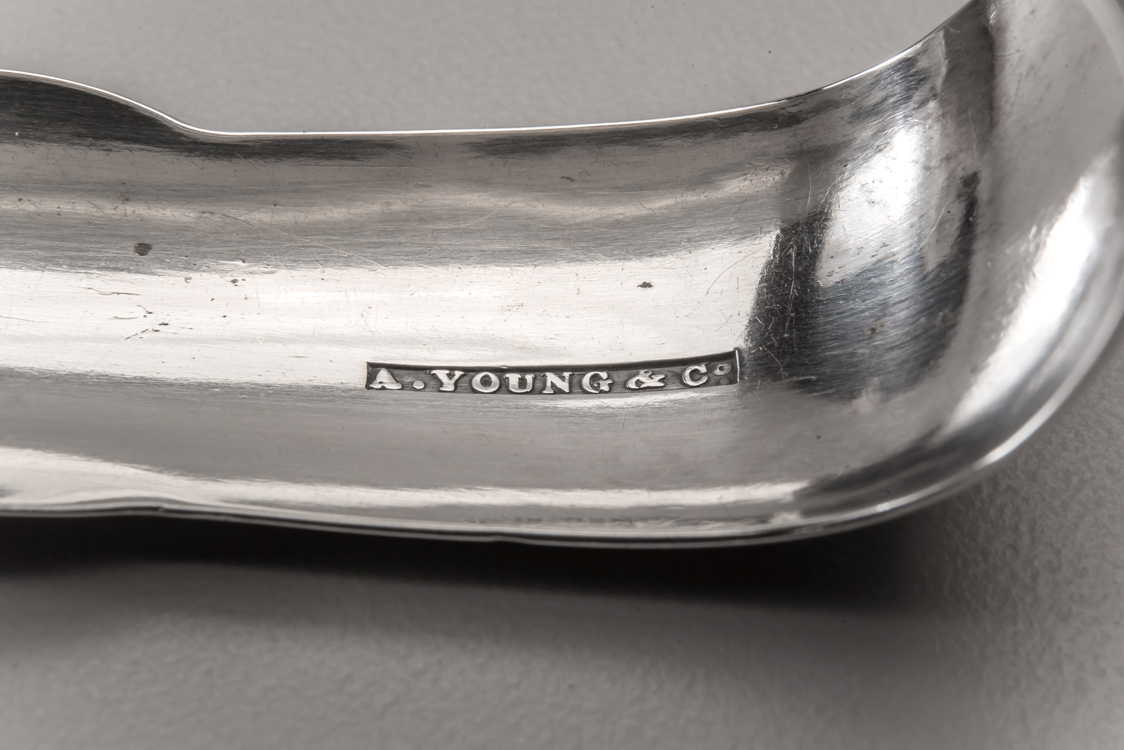
MARK: Struck on inside, below the bend, with an incuse “A.YOUNG & Co.” mark in a rectangular reserve.
MAKER: The partnership of Alexander Young (1784-1856) and his son Edward Young (1818-1848) formed in Columbia, South Carolina by 1841. The firm was sometimes branded A. Young & Son. The business was run by Edward in Columbia as his father remained in Camden, South Carolina, during the time it was in operation. The shop was shut down in 1848 after the unexpected death of Edward Young.
Alexander Young was a silversmith and watchmaker born in Fifeshire, Scotland. He emigrated first to Baltimore and sometime before 1807 moved to Camden, as is indicated by a mortgage he executed that year. Extant silverware indicates that Young was a highly skilled and prosperous craftsman. As his business thrived, he expanded it to include jewelry, cutlery, and military and fancy goods. In 1825, Young produced the trowel used by Lafayette in laying the cornerstone of the Baron Johann DeKalb (1721-1780) monument in Camden. Young was also appointed as a delegate sent to Augusta, Georgia in effort to establish direct trade with European ports. He supported his son Edward in a Columbia partnership with John Veal Sr (Young & Veal; see MESDA Acc. 5793.1-3). Young most probably trained his son Edward as a silversmith. Alexander Young eventually opened a bookstore along with his jewelry business but lost a great deal of wealth when he was called upon to pay a note he had endorsed for a friend. He continued to practice his trade as a silversmith until his death in 1856. See Catherine B. Hollan, “Hidden Treasures: Re-Assessing South Carolina Silversmiths and Related Artisans to 1861 (McLean, VA: Hollan Press, 2021); E. Milby Burton, “South Carolina Silversmiths 1690-1860” (Charleston, SC: Charleston Museum, 1967); and “Palmetto Silver: Riches of the South” (Columbia: University of South Carolina for the McKissick Museum, 2003).
FORM: Sugar tongs were first introduced during the second quarter of the eighteenth century and were often shaped like scissors joined with a flat hinge. By the end of the century and into the next, however, tongs were cut from sheet silver and usually decorated with bright-cut engraving that bordered long, tapering arms that ended in oval, shell, acorn, or eagle claw tips.