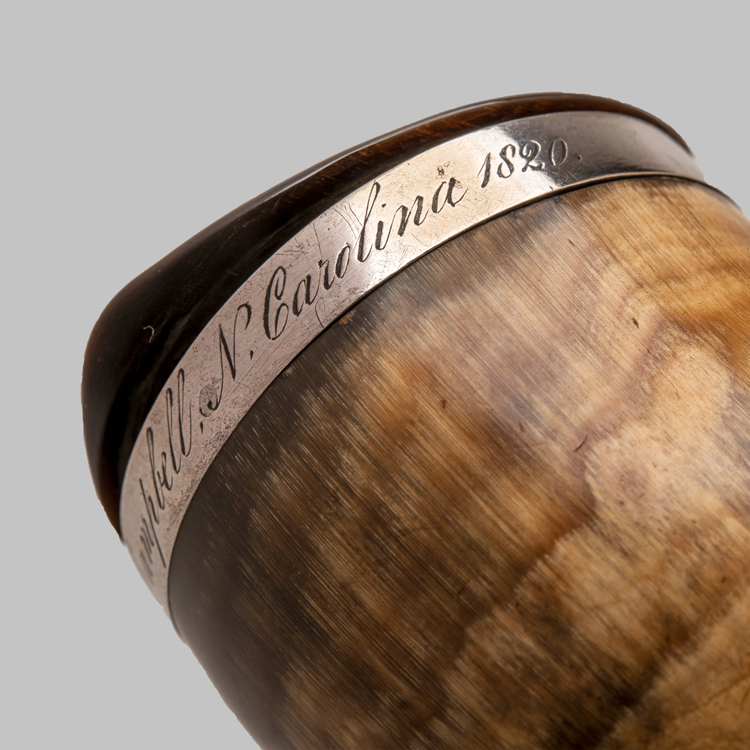
Snuff mull
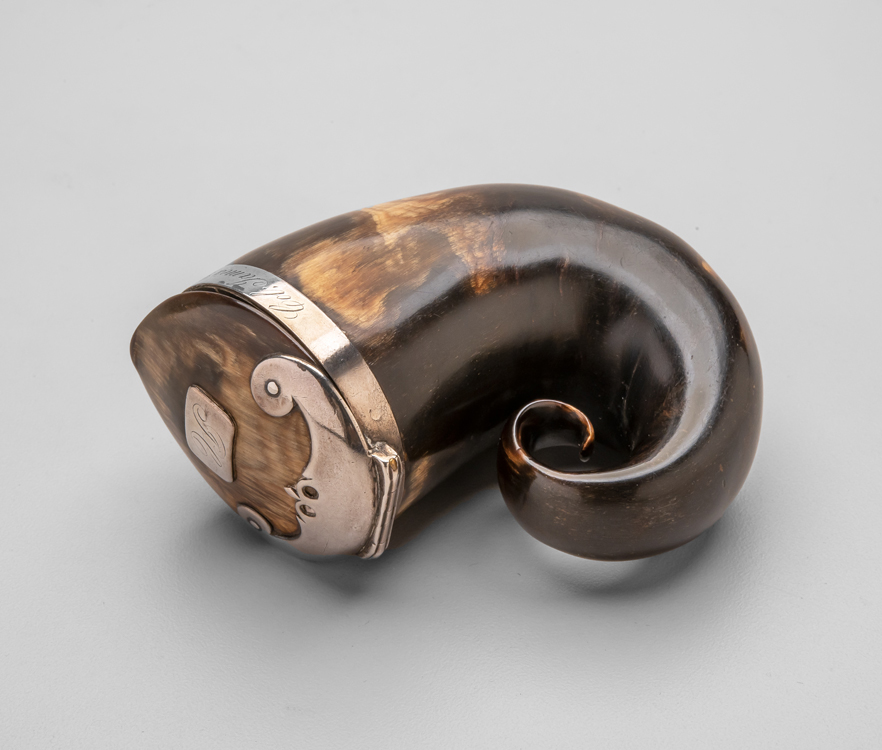
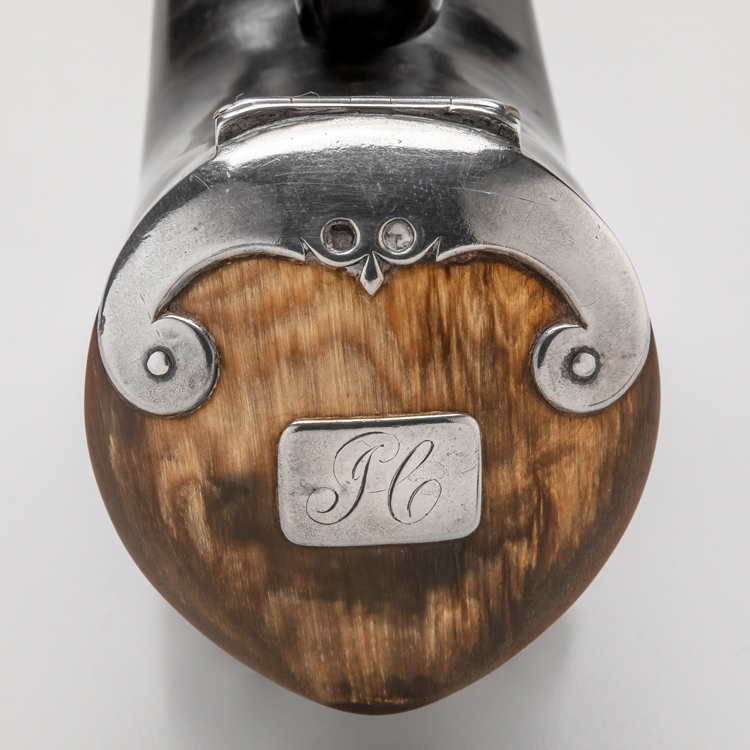
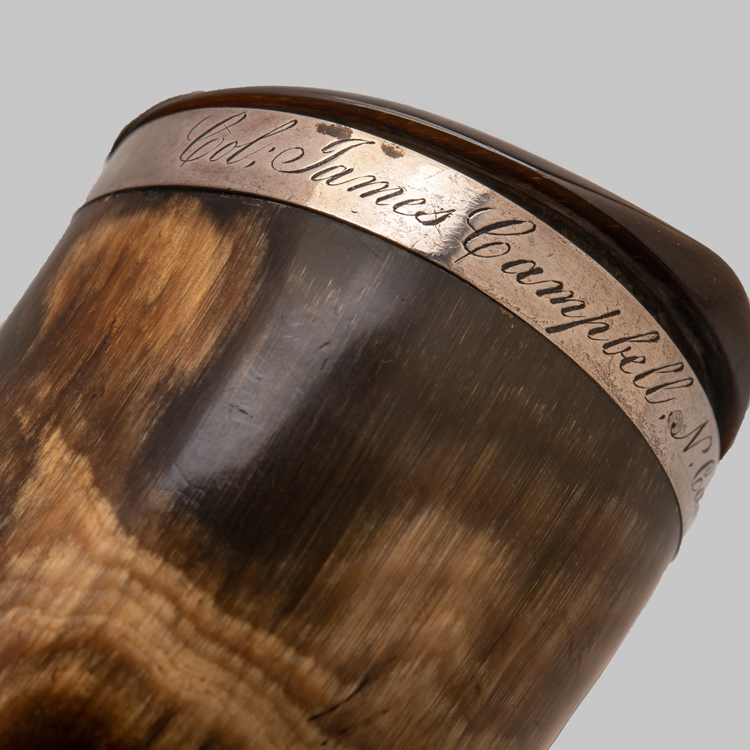
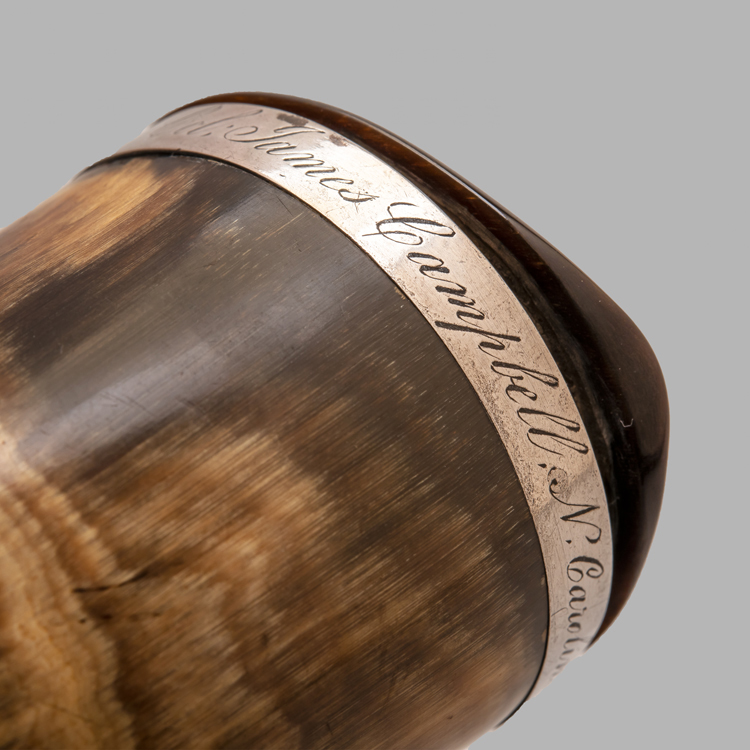
The mull is an excellent example of the ubiquitous Scottish snuff mull in which a ram or cow horn is artificially curved using heat and the larger end capped with a hinged lid. The term “snuff mull” has its origins in the manner in which Scottish Highlanders pronounced the word “mill,” the name of the tool used for pulverizing tobacco into snuff for inhaling. The form became popular among Scots in the mid eighteenth century and remained virtually unchanged for over a hundred years. This example is mounted with a silver rim band, elegantly shaped silver hinge, and rectangular silver monogram plate on the lid. It is engraved “Col. James Campbell, N. Carolina 1820.”
From the first decades of the eighteenth century the American South and Scotland have been inextricably linked by people and tobacco. In particular, North Carolina became home for an estimated 15,000 Scots between 1740 and 1770, especially after the Battle of Culloden in 1746 when England disbanded the Highlander clans and offered pardons if they emigrated to America. The tobacco trade bound together southern planters, enslaved African laborers, Glasgow merchants, and rebellious Highlanders. Enterprising merchants in Glasgow were quick to capture most of the European tobacco market and nearly monopolized it until the American Revolution. From those Glaswegian storehouses the ingestion of snuff was promoted throughout the Scottish Highlands. The addiction of Highlanders to snuff-taking must have become notorious, for outside Scotland a Highlander became a common visual icon for shop-signs denoting a tobacconist.
The man commemorated on the snuff mull under consideration, James Campbell, was a Highlander. His clan was originally from Argyl but in the eighteenth century they had been forcibly and widely dispersed. By the early nineteenth century his father, Robert, was living in the lowland seat of Clan Campbell in Clackmannanshire, Scotland, and James had emigrated to America where he settled in Rockingham County, North Carolina.
Further research may reveal more about James Campbell’s birth and when he left Scotland. At this time the earliest known documentation for him is the 1810 United States Census in which he is recorded as the head of household in Rockingham County and enslaving five individuals. During the War of 1812 he was commissioned as a major in the North Carolina militia and positioned at Norfolk, Virginia. In 1818 Campbell was named an agent for the State Bank of North Carolina in Leaksville, Rockingham County (now incorporated into the county seat of Eden). This is first instance of “Colonel” being given to him as a title. The 1820 census records him in Leaksville with a white boy under the age of ten, a free African American girl under the age of fourteen, and three enslaved people (a boy and girl both under the age of fourteen and a young woman aged fourteen to twenty-five). Further research might also provide a clearer understanding of the relationships between the individuals in this household.
In May 1821 James Campbell married Sophia W. Spencer of Charlotte County, Virginia. He died eight months after his marriage, in January 1822. Demonstrating Campbell’s continued strong ties to Scotland and his Scottish identity, the only record of his death is an announcement published in Blackwood’s Edinburgh Magazine. Unknown at this time is what happened to Campbell’s wife or the free and enslaved people in his household.
John Bivins Jr., The Furniture of Coastal North Carolina (Winston-Salem, NC: Museum of Early Southern Decorative Arts, 1988), 36–37.
Blackwood’s Edinburgh Magazine, Vol. 12 (July–December 1822): 250.
Carrie L. Broughton, comp., Marriages and Death Notices from the Raleigh Register and North Carolina Gazette, 1799–1825 (Raleigh: North Carolina State Library, n.d.), 103.
Mattoon M. Curtis, The Book of Snuff and Snuff Boxes (New York: Liveright Publishing, 1935), 80–83.