Work Table
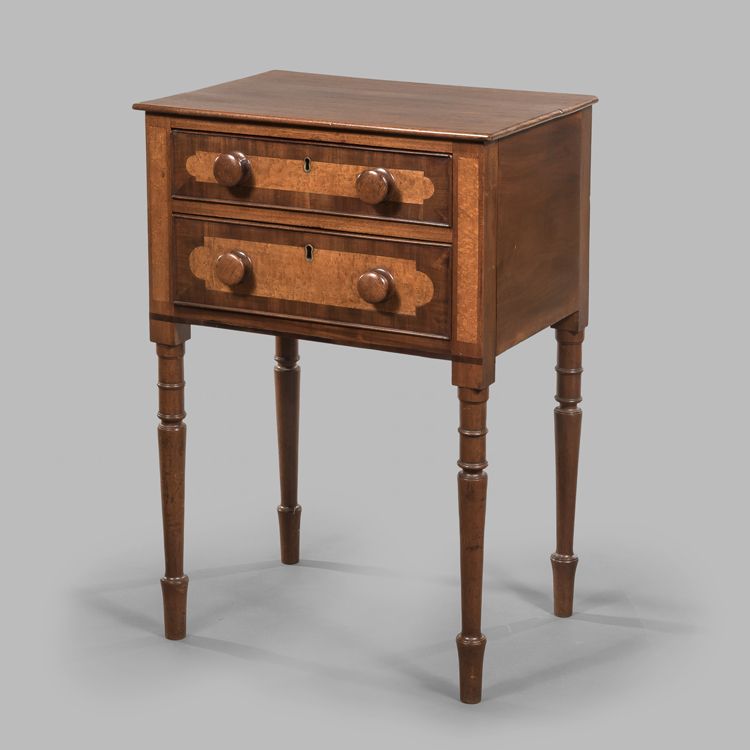
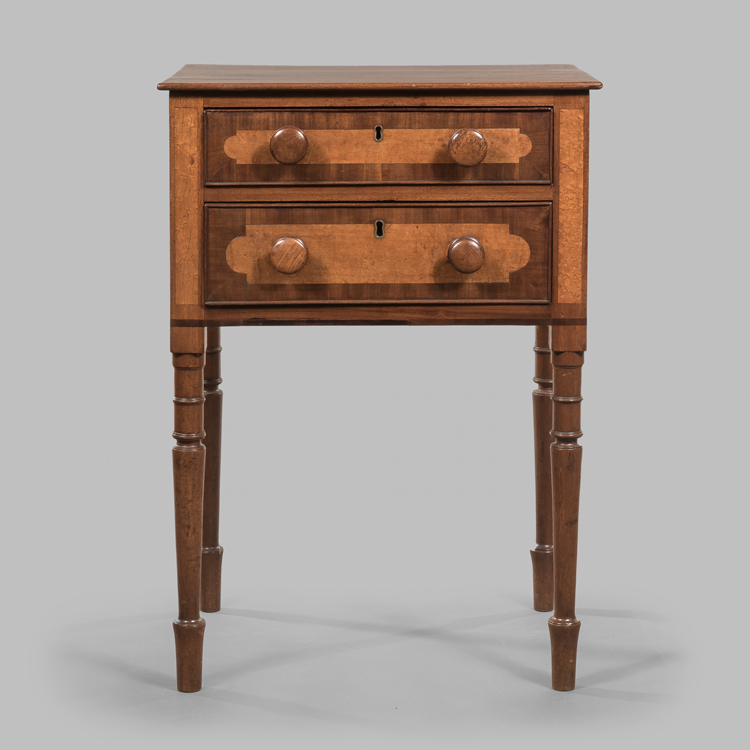
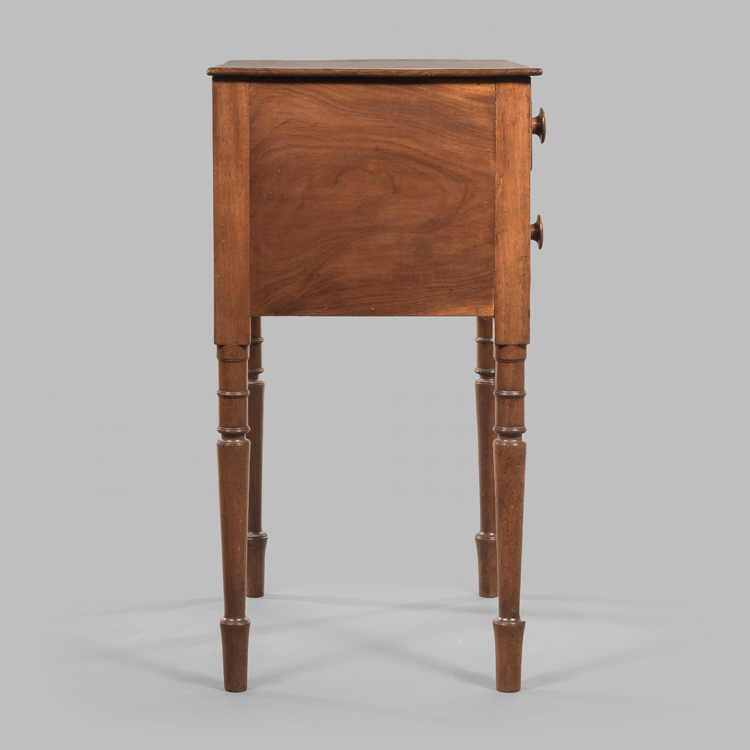
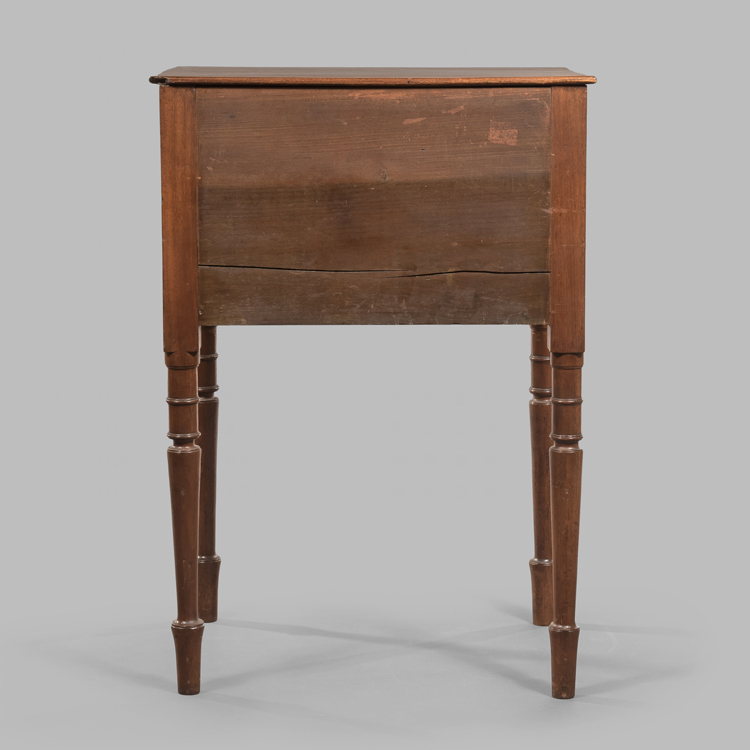
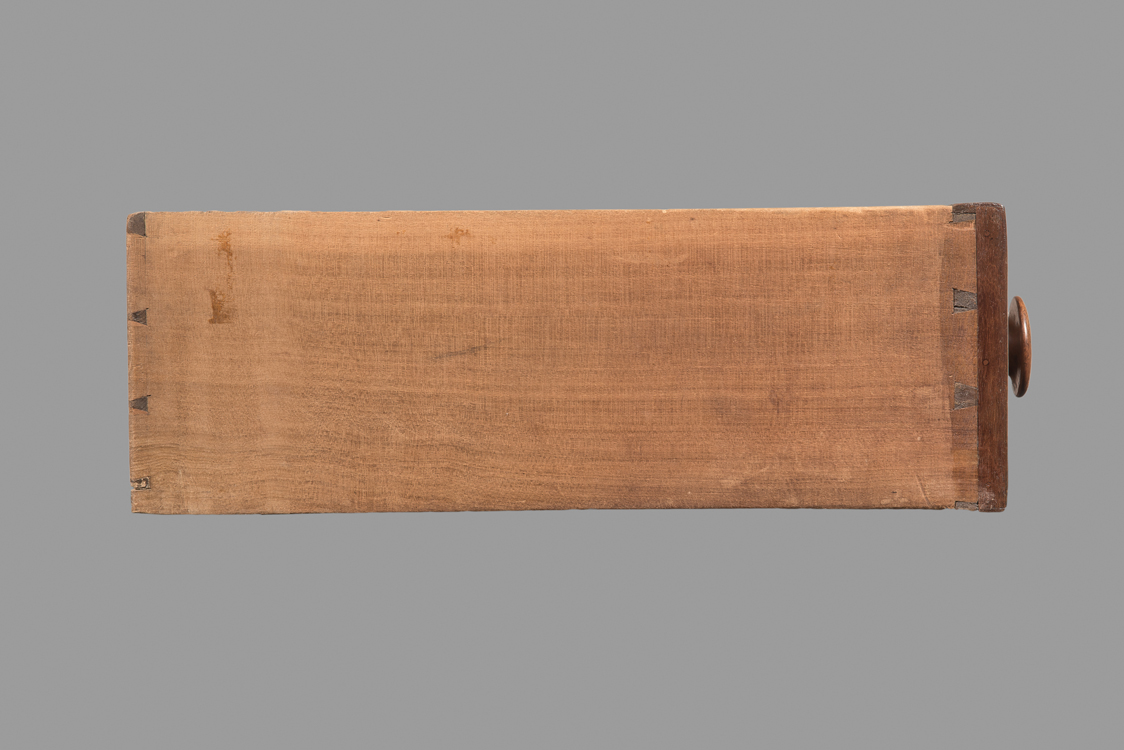
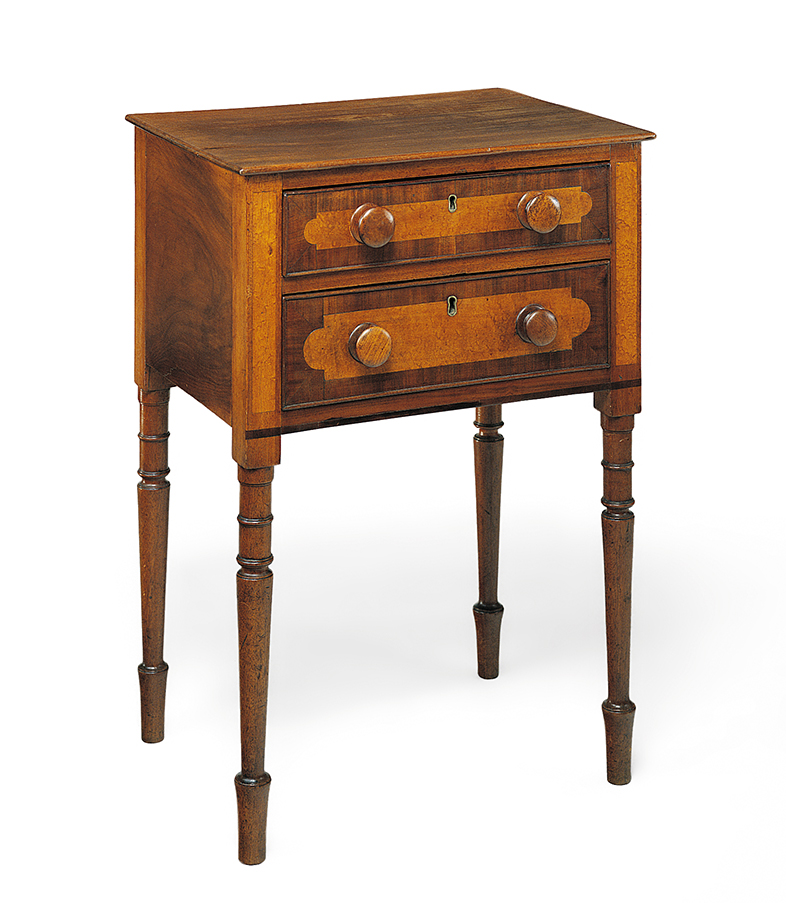
WOODS: mahogany with mahogany and maple veneer; tulip poplar drawer sides, back, front case, drawer supports, and case back; yellow pine drawer bottoms and stiles.
STYLE: The decoration on the drawers with panels of lightwood maple veneer is unusual in the South, but it provides the same decorative effect as the contrasting satinwood veneers frequently seen on Charleston’s neoclassical furniture. The turnings of the legs are identical to two other two-drawer mahogany work tables found near Charleston and Camden, South Carolina. This unique leg turning sequence is also identical to a stage-top sideboard found near Blythewood, outside of Columbia, South Carolina. These four pieces constitute a distinct furniture group from piedmont South Carolina. While the group’s retrieval histories point to the area surrounding Columbia and Camden, the stage-top sideboard was directly inspired by the Scottish cabinetmakers working in Charleston during the early nineteenth century. As John Bivins and Brad Rauschenberg wrote in Furniture of Charleston, p. 726, “there is little doubt that this cabinetmaker moved to the piedmont from Charleston.” (See MRF 5551, 8869, 9367)
ATTRIBUTION: The discovery of the stage-top sideboard outside of Columbia and work tables outside of Camden suggest that the maker of this furniture group was William D. Parker (1775-1819). Born in London, Parker came to the United States in 1802. In 1806, the Columbia, South Carolina, newspaper noted his partnership with John Parr in the Columbia cabinetmaking firm of Parr & Parker. In 1808, he became a U.S. citizen stating that he was originally from London but “hath resided in the city of Charleston, the Town of Columbia, & Town of Camden, and for several months previously in the City of New York, following the craft or trade of a cabinetmaker.” When Parker wrote his will in 1819, he described himself as “William D. Parker of Camden, cabinetmaker.”
Parker’s probate inventory listed all of the cabinetmaking tools and materials needed to fabricate the four pieces in this group. Parker owned stocks of mahogany, walnut, pine, poplar, sweet gum, and, most importantly, maple. His equipment included a chest of tools, five work benches, two veneering saws, three boxes of veneers, a turning lathe, patterns, and spare table legs. The list of unsold furniture in his shop at the time of his death included three sideboard tops at $11.00 and three work tables for $36.00.
In 1860, Ephatha and her family are listed next to Burwell Boykin (1811-1861) of Mount Pleasant Plantation. Boykin’s family owned one of the other mahogany work tables with two drawers and identically turned legs that can be attributed to the Camden cabinetmaker, William D. Parker (1775-1819). The Boykin family’s table was probably owned by Burwell’s mother, Mary (Whitatker) Boykin (1772-1833). (MRF 8869)
RELATED OBJECTS: The work table descended in the Ellerbe family along with a desk and bookcase made by William Little (MESDA acc. 3264) and a portrait miniature of Ephatha’s husband, Dr. William Crawford Ellerbe (MESDA acc. 3076).