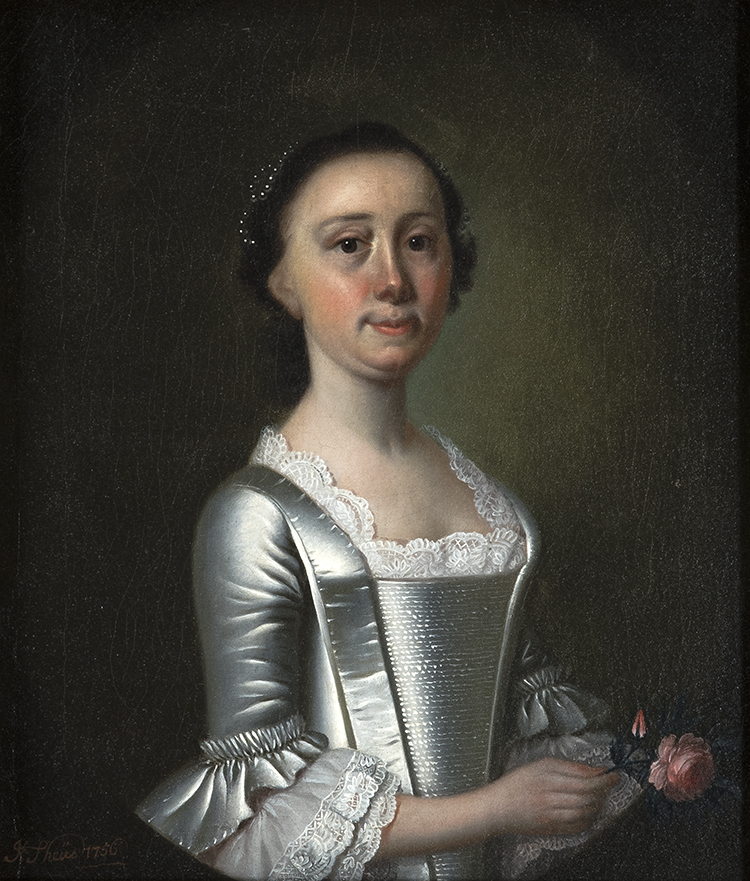
Sarah Proctor (Daniell) Wilson
Sarah was descended from Landgrave Robert Daniell, who came to South Carolina from Barbados about 1679 and was Deputy Governor of South Carolina from 1716 to 1717.
ARTIST: Jeremiah Theus (1716-1774) was born in Switzerland and immigrated to South Carolina with his family when he was nineteen. His father, Simon Theus, received a land grant for 250 acres on the Edisto River in Orangeburg, South Carolina.
Jeremiah Theus was in Charleston and working as an artist by 1740 when he placed an advertisement in the South Carolina Gazette. He wrote that “all Gentlemen and Ladies may have their Pictures drawn, likewise Landskips of all sizes, Crests and Coats of Arms for Coaches and Chaises. Likewise for the Conveniency of those who live in the Country, he is willing to wait on them at their respective Plantations.” Over the next three decades Theus would establish himself as the painter of choice for the Lowcountry elite. It is estimated that more than 170 portraits by Theus survive.
Like most eighteenth-century artists, Theus sometimes relied on English mezzotints to inspire the poses and costume of his sitters. There are a number of works, for example, that use a variation of the dress worn by Maria the Countess of Coventry in a mezzotint by Richard Houston after a painting by Francis Cotes. An example of this print is in the National Portrait Gallery of the United Kingdom. (NPG UK acc. D34175). However, these same mezzotints were also an important mechanism by which London fashion was transmitted to Charleston. The refinement of dress and pose in Theus’s sitters was a reflection of their status in the larger 18th century material world.
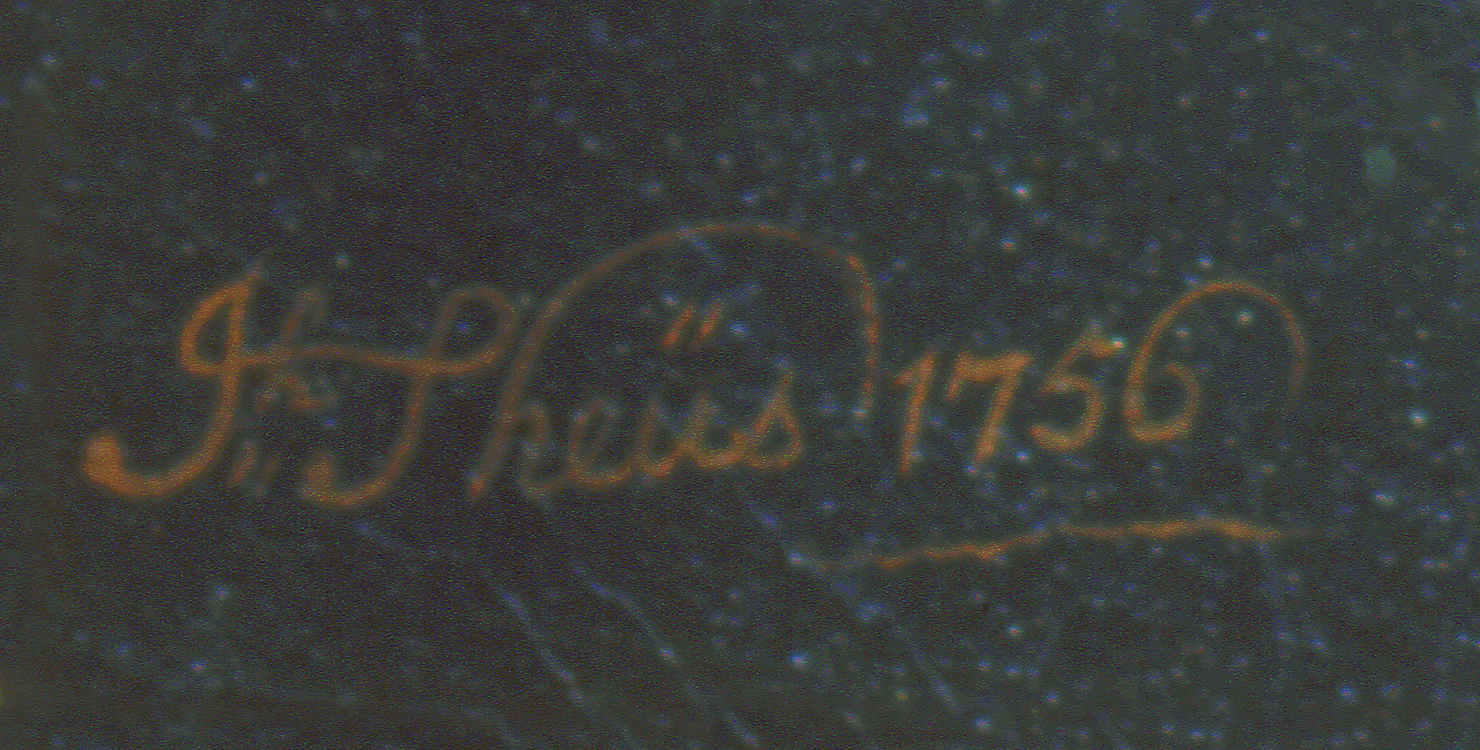
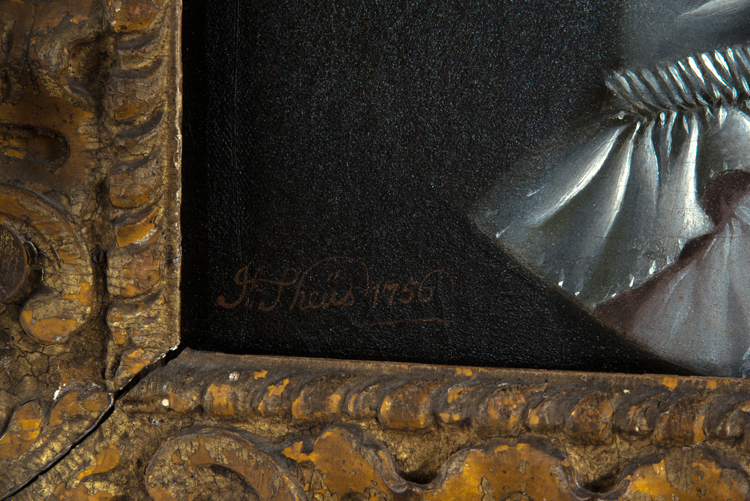
This is one of very few paintings by Theus that is signed and dated. The artist’s signature is visible on the lower left corner of the canvas.
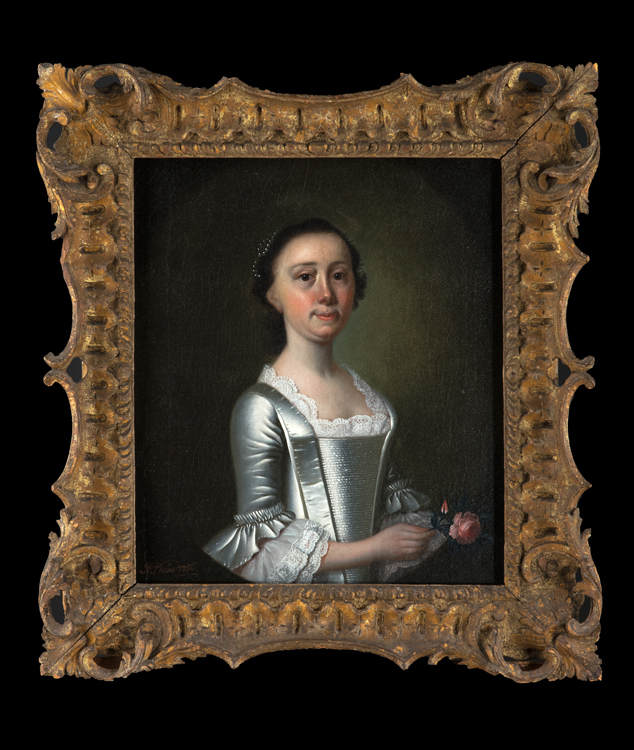
FRAME: This portrait survives in its original carved and gilded frame. The frame was originally fitted for glass.
RELATED WORKS: MESDA has five portraits by Theus: Sarah Proctor (Daniell) Willson (MESDA acc. 2024.52); Elias Ball III (MESDA acc. 2739); Humphrey Sommers” (MESDA acc. 3974); Hannah Dart” (MESDA acc. 4087); and Ann (Theus) Lee, the artist’s daughter (MESDA acc. 1179).
REFERENCES: Margaret Simons Middleton, “Jeremiah Theus: Colonial Artist of Charles Town” (Columbia, South Carolina: University of South Carolina Press, 1991)
Carolyn J. Weekley, “Painters and Paintings of the Early American South” (Williamsburg, Virginia: Colonial Williamsburg and the Yale University Press, 2013)
DESCRIPTION: Painting, oil on canvas, waist-length portrait of a lady wearing a gray satin dress with gray stomacher in front and white lace at neck and sleeves, her hair is pulled tightly back, a loop of pearls in it on the left side of the portrait. Her right hand holds a pink rose.
Like other colonial artists, Theus used English mezzotints for both costume and pose in his portraits. There are a number of works, for example, that use a variation of the dress worn by Frances Cotes in the mezzotint of Richard Houston’s painting. Although his style portrays a stiffness of pose, his popularity may have relied on his depiction of sumptuous attire. As Flexner notes, “He was a painter without dash and inspiration or any natural ability, except as a colorist, but he had learned his lessons in the Old World well enough to turn out portraits that made a handsome show of elegance.”