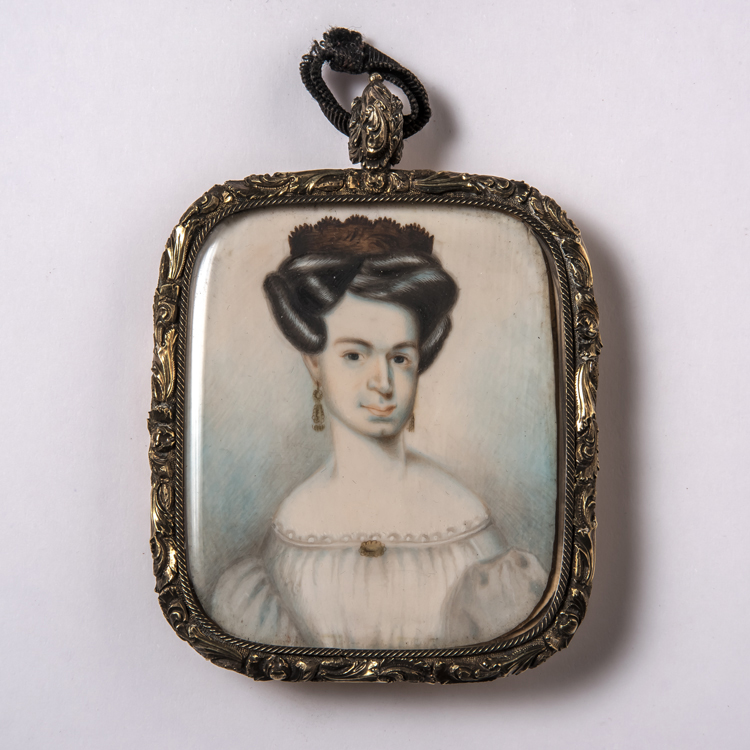
Sarah Jane (Abbott) Rembert
Unframed: HOA: 2 11/16″; WOA: 2 1/8″
ARTIST: Benjamin Bynum (circa 1811-before 1850) was the son of Turner (1777-1824) and Elizabeth (Miller) Bynum (1781-1851), who married in Charleston, South Carolina, in 1799 and moved to Columbia in 1810. In 1835 Benjamin is listed as a portrait painter in Greenville, South Carolina, and in 1836 he married Sarah O’Bannon of Barnwell. The following year he advertised in Milledgeville, Georgia: “Benjamin Bynum tenders his professional services to the citizens of Milledgeville and its vicinity. Having studied under one of the most celebrated artists of his country, together with 8 years experience, he hopes to share a portion of the patronage extended to Southern artists.” Bynum also worked in Athens, Georgia, where his sister Elizabeth (Bynum) Chase and her husband, Albon Chase, a prominent newspaper publisher and manufacturer, lived.
INSCRIPTION: Signed on the backing paper: B. Bynum Pinxt / Athens GA / June 6th / 1839.
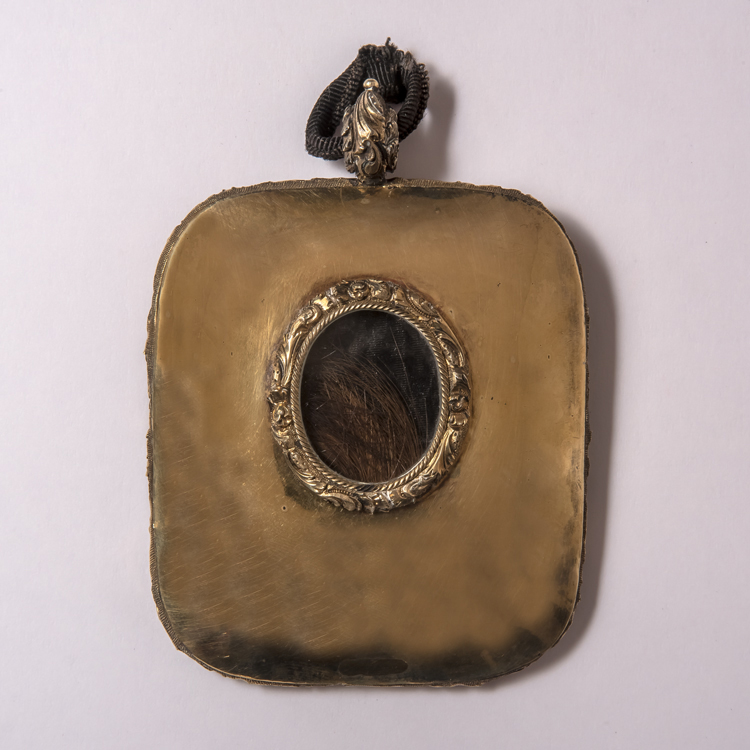
DESCRIPTION: Watercolor on ivory, portrait miniature of Sarah Jane Abbott Rembert. This portrait features a woman with dark upswept hair, chin slightly turned (proper) left, wearing a brown scalloped comb in her hair, gold chandelier earrings, and a central brooch on her dress. Her painted face has undertones of peach and blue-green but overall her skin tone is very fair. Her shoulders are rounded and slopedownward in her off-white dress with lace trim and puffy sleeves sitting low across her shoulders. The dress has undertones of blue. The background is light at the top with shades of blue and gray filtering down behind the portrait. The miniature is set in the original rectangular frame with cast foliate border, the reverse with aperture containing a lock of brown hair, which has moved and is no longer centered under glass.
“Itinerant artists had been passing through Georgia and advertising in local newspapers since the Georgia Gazette had been established in 1763. Benjamin Bynum, boasting illustrious training and eight years experience, spent several years in the Georgia piedmont. His advertisement in the 26 September 1837 issue of the Georgia Journal in Milledgeville is typical of those placed by artists seeking patronage from wealthy planters: ‘Benjamin Bynum tenders his professional services to the citizens of Milledgeville and its vicinity. Having studied under one of the most celebrated artists of his country, together with 8 years experience, he hopes to share a portion of the patronage extended to Southern artists. B.B. will in all cases give satisfaction as regards a likeness and a fine picture. / Room at the States Rights Hotel / Milledgeville, Sept. 26.'” (Smith, pp.165-166)