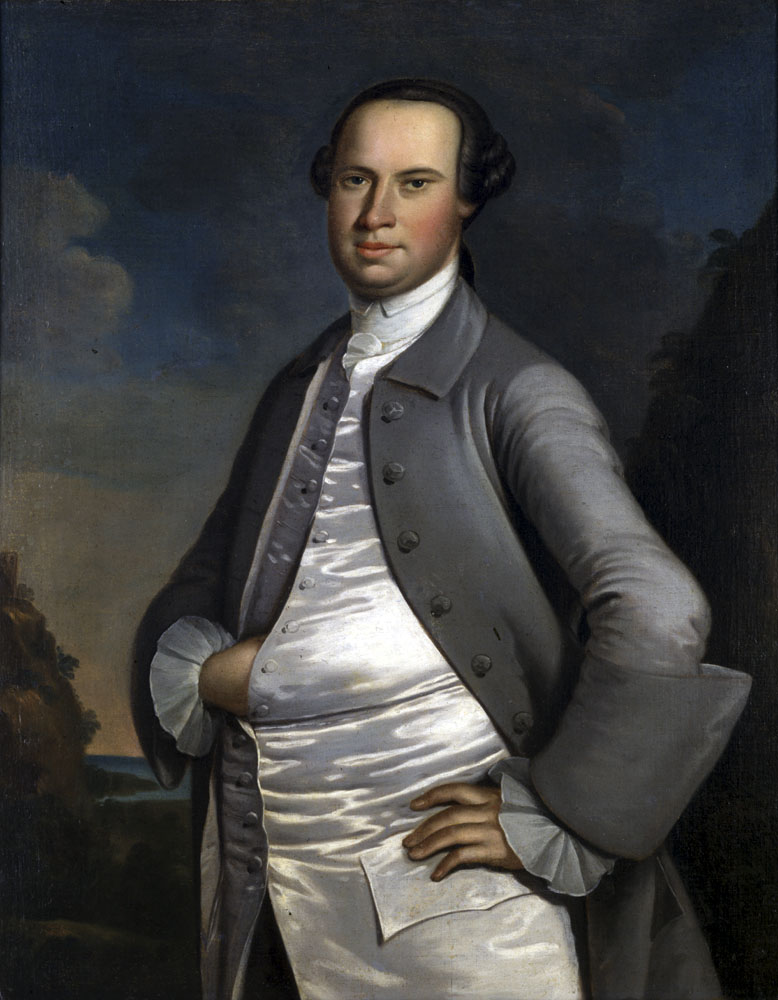
Samuel Chew
ARTIST: John Hesselius (1728-1778) was one of the major American-born artists working in the Middle Colonies and the South in the third quarter of the eighteenth century. The son of Gustavus Hesselius (1682-1755), a Swedish painter who came to America in 1711, John was probably born in Philadelphia. His earliest signed work is dated 1750. It is thought to depict Millicent Conway Gordon (b.1725) of Lancaster County, Virginia. It is in the collection of the Virginia Historical Society (1984.4). Hesselius latest signed work dates to 1777.
During his career, Hesselius traveled extensively in Virginia, Maryland, Delaware, Pennsylvania, and possibly in New Jersey. His work seems to have been confined to portraits. All known examples are in oil on canvas, and there is little reason to suspect that he deviated from this practice. He worked exclusively in the late English Baroque and English Rococo traditions of painting, and his style shows the influence of Robert Feke and John Wollaston more strongly than that of his father.
Hesselius married Mary Young Woodward, the widow of Henry Woodward, in 1763, and after that date his energies were divided between his art and the management of his plantation near Annapolis, Maryland. He was also active in the religious affairs of St. Anne’s Parish in Anne Arundel County, Maryland. His interests appear to have been many, and as an artist and landowner he associated with most of the leading citizens of the colony. Hesselius contributed to American painting, and he extended and modified the English tradition of painting in the Colonies.
FRAME: Original carved and gilded wooden frame.
DESCRIPTION: Painting, oil on canvas, of gentleman standing with his right hand on his hip and his left hand tucked in his vest front. He has dark hair and eyes, and a complexion of good color. He wears a gray coat with a falling collar and very wide cuffs, a white satin vest, a white cravat and sleeve ruffles. Landscape view, lower right, shows patch of blue water and trees.