Sampler
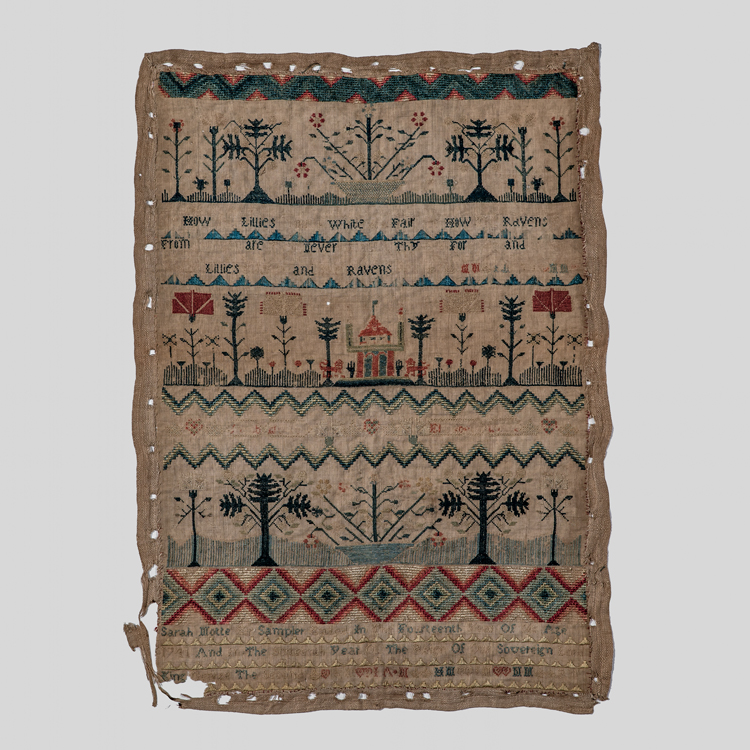
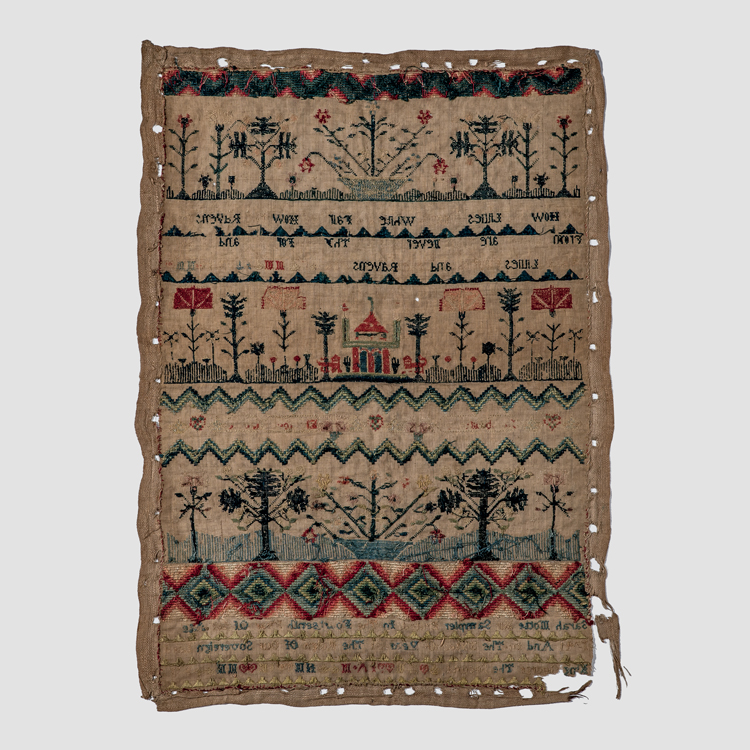
Thirty-five years before the American Revolution, Sarah Katherine Motte (1728-1760) stitched a needlework sampler in the colony of South Carolina. Inscribed insilk threads on her work is Sarah Motte Her Sampler Ended in the Fourteenth Year
of Her Age 1741 And In The Sixteenth Year Of The Reign Of Our Sovereign Lord King George The Second. Sarah was born in Charleston to Jacob Motte (1700-1770) and his wife Elizabeth Martin Motte (1710-1757). Sarah’s father, Jacob,
achieved success and wealth as a merchant in Charleston, with a store and wharf located on Tradd Street. Jacob Motte held numerous public positions, most notably Public Treasurer, succeeding Gabriel Manigault in 1743. Sarah and her siblings were members of Charleston’s elite society marrying into important families such as the Draytons, Moultries, Hugers, and Brewtons. Sarah’s own marriage
was recorded in the South Carolina Gazette on 10 May, 1746, “Late Thursday night, Capt. Thomas Shubrick, a wealthy and eminent merchant of this town, was married to Miss Sarah Motte, a beautiful and accomplished young lady, with a
handsome fortune.”
During the American Revolution the Motte family distinguished themselves as Patriots. Sarah, and much of her family is buried at St. Philip’s Church. Sarah Motte’s sampler is the second oldest surviving sampler from South Carolina.
It is the oldest sampler in the MESDA Collection. Closely
following it is the sampler of Elizabeth Hext, dated 1743.
The Motte and Hext samplers together tell an interesting story. The two works are similar in form and composition, with Sarah Motte’s work being much more
ambitious. A stylized folly guarded by English lions and a sentry anchors Sarah’s work with towering flowers and trees on either side. Two linear bands feature
baskets flanked by flowering trees. A central message adorns the Motte sampler: See how the Lillies flourish white and fair See how the ravens fed from Heaven are Then never distrust thy God for cloth and bread whilst Lillies flourish and ravens
fed. This same message is also included on the Elizabeth Hext sampler. Other similar features include strong geometric bands stitched in silk with vivid reds, teal greens and golds. The names of the girls’ parents are cross stitched inside eyelet
stitched borders with an eyelet heart joining them. Flat stitched sawtooth bands adorn both samplers, some featuring a distinctive stepped variation. Initials of identified family members are present within their works as well as English
crowns. The similarities are evidence of a common school or teacher associated with the samplers.
Mary Hext has long been considered the most likely teacher of Elizabeth Hext. Mary was the wife of John Hext, a mariner, who died in 1742. She first advertised her school in the South Carolina Gazette nine days after a devastating fire spread
through Charleston in November of 1740. The familial relationship between Elizabeth Hext and Mary Hext provided the natural connection between the two. In addition, the initials “MH” are included on Elizabeth’s sampler.
The similarities between Sarah Motte and Elizabeth Hext’s samplers suggests that Sarah was also a student of Mary Hext. This connection makes Sarah’s work the earliest colonial South Carolina sampler that can be attributed to a specific teacher
and school. In addition to stylistic connections, there is also a family connection between the Motte and Hext families: in 1765 Martha Motte (Sarah’s sister) married John Sanford Dart, the stepson of Mary Hext. It is likely Mary Hext retired from teaching upon her marriage to wealthy merchant John Dart in 1746.
As provided by the family and seller, and confirmed through
genealogical research, the work descended from Sarah Motte
(sampler maker) to daughter Hannah Shubrick (1759-1788),
to daughter Maria Miles Hayward (1784-1862), to son Dr.
Henry Edward Drayton (1823-1862), to daughter Emily
Heyward Drayton (1860—1952), to daughter Edith Moore
Taylor Patterson (1880-1974), to son Albert Mansfield
Patterson III (1910-1984), to his wife Mary Douthat Salman Patterson (1912-
2002), to daughter Edith Taylor Patterson Cates (b. 1948). The sampler then was sold and acquired by a private dealer before being acquired by MESDA.