Sampler
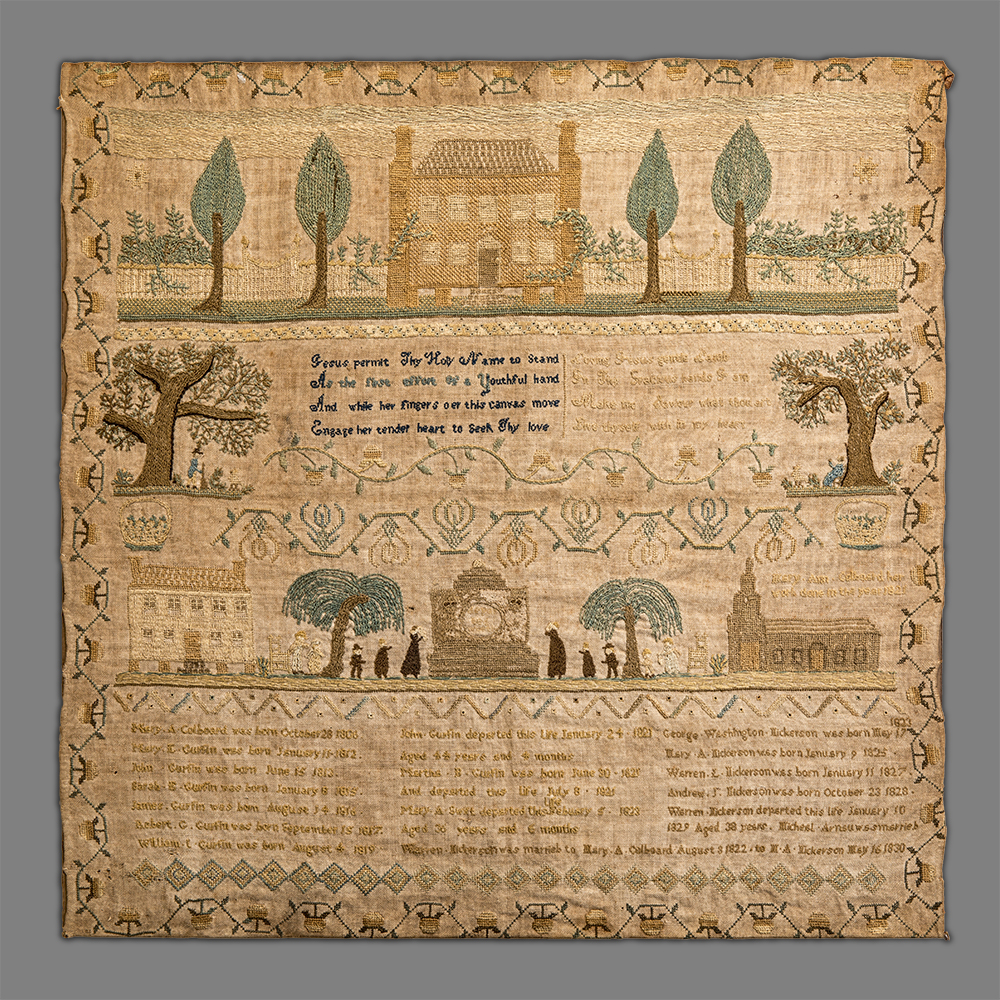
Mary Ann (Colboard) Nickerson Arnau (1806-1858) was born on October 26, 1806 to William and Mary Ann Colboard. Her father may have been the “boat man” or “mariner” recorded in Charleston city directories for 1807 and 1809. William died when Mary Ann was a young girl and her mother remarried three times: first to a Mr. White, and then to John Gurfin, and finally to James B. Swift. On October 16, 1816 Mary Ann was baptized at St. Philips Church alongside her stepsister, Sarah Eleanor Gurfin. Sarah Eleanor Gurfin and her older sister Mary Eliza Gurfin were both born deaf and mute. When their father, John Gurfin, a rigger, died by drowning, he left a large blended family. According to the records of the Charleston Orphan House, John’s death left the family destitute and “exposed to the contagion of evil society, from which they ought to be rescued.” After much deliberation, the Orphan House accepted the two deaf girls. In 1829 the sisters were sent—at public expense—to a school for the deaf in Philadelphia. Eight years later the sisters returned to Charleston. The story of the Gurfin sisters provides a rare glimpse into the world of the disabled in the antebellum South and is considered at length in Susan L. King’s article “Mary and Sarah Gurfin: Antebellum Charleston’s Response to the Needs of Two Deaf-and-Dumb Sisters,” published in the January 1997 issue of the South Carolina Historical Magazine. Sarah Eleanor and Mary Eliza Gurfin’s names both appear with their birth dates on this needlework. Since the needlework was stitched the same year as their father’s death, they may also be two of the figures dressed in mourning at the tomb in the center of the composition.
Mary Ann, the artist, married shopkeeper and grocer William Nickerson in 1822 at St. Philips Church, the year after the needlework was completed. Along with the births of their four children, she recorded on the needlework Nickerson’s death in 1829, as well as her marriage the following year to the blacksmith Michael Arnau. Mary Ann (Colboard) Nickerson Arnau died in Charleston on May 31, 1858.
This needlework is a rare record of Charleston’s large but often overlooked working class – a family that included a mariner, a rigger, a grocer, and a blacksmith.