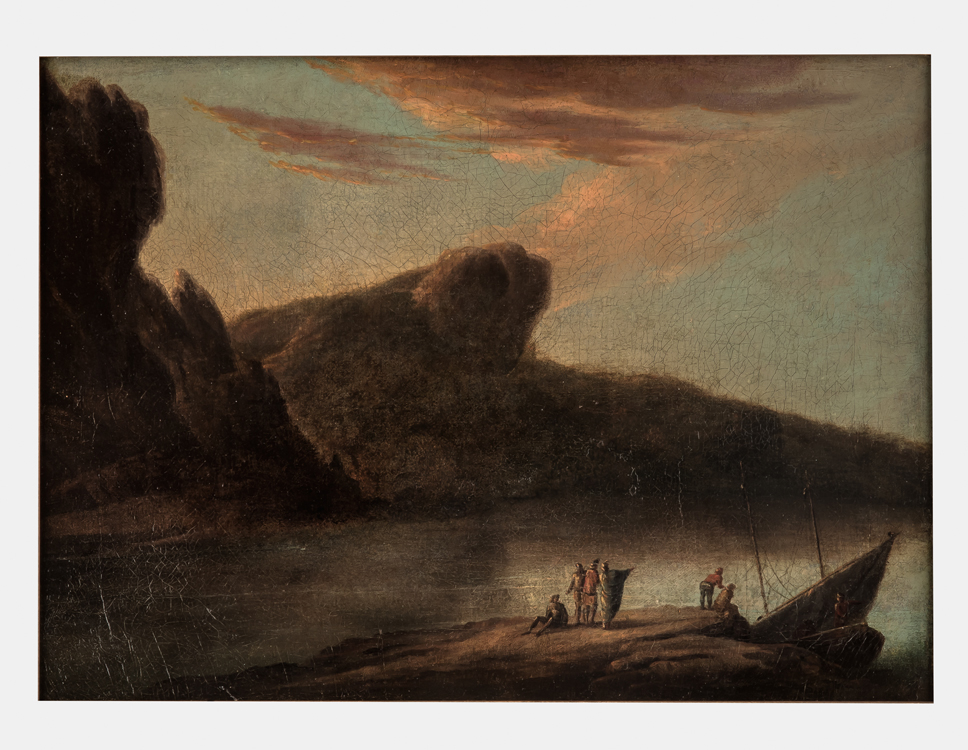
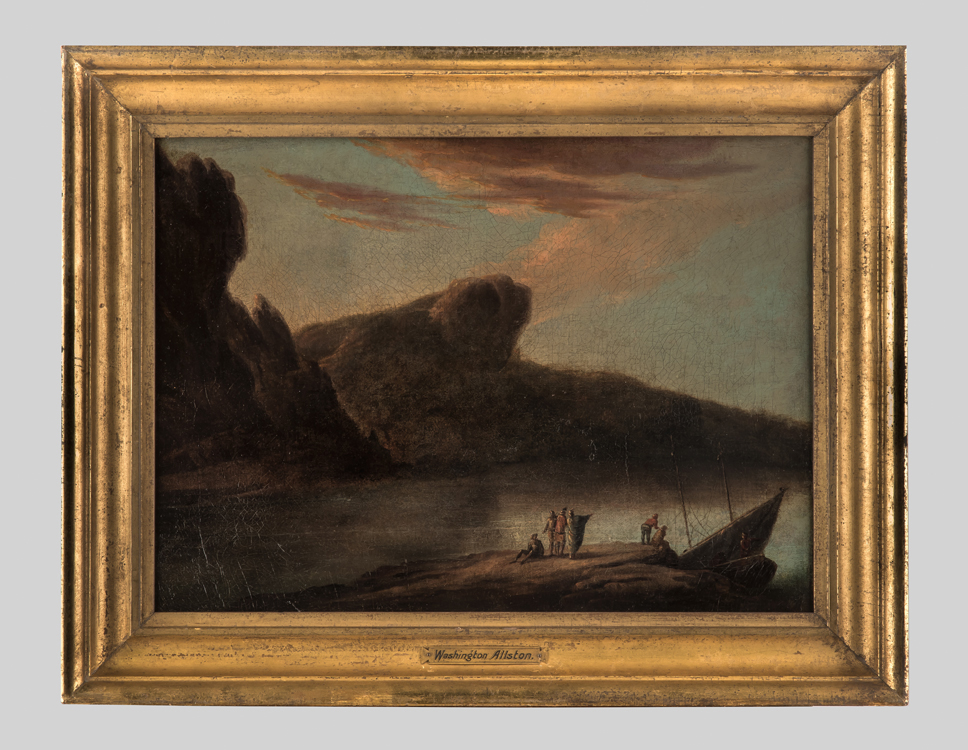
Rocky Coast with Banditti
Washington Allston was a native of Georgetown, South Carolina. He was the son of rice planter Captain William Allston (d.1781) and Rachel (Moore) Allston (1757-1839). Named for George Washington, his father died in 1781 following the Battle of Cowpens in the American Revolution. His mother remarried Dr. Henry Collins Flagg, the son of a wealthy Newport, Rhode Island, merchant.
At the age of twelve Washington Allston was sent to Newport, Rhode Island, where he was educated at Robert Rogers’ classical school and then Harvard College. Following graduation from Harvard he returned briefly to Charleston, South Carolina, and then, in the company of miniaturist Edward Greene Malbone (1777-1807), sailed for London.
Allston was admitted to the Royal Academy in 1801. He exhibited in its 1802 and 1803 exhibition at Somerset House. This work was one of his entries into the 1802 exhibition of the Royal Academy at Somerset House in London. He was a student of American-born Benjamin West (1738-1820), then the president. Under West he learned the technique of dead coloring with underpaint in a hue quite different from the end result, and then building upon this with thin glazes of transparent color until the desired shade was reached. The end result was a greater resonance that with the direct application of mixed color.
Following two years in London, Allston embarked on the Grant Tour, spending significant time in both Paris and Rome.
About 1808 Allston returned to America and married Ann Channing (1788-1815) whom he first met as a student in Newport. During this period he painted a portrait of his mother now in the collection of the Redwood Library and Athenaeum (RLA acc. PA.002). MESDA owns an earlier portrait of his mother by Henry Benbridge (1743-1812).
In 1811 the young couple set sail for England where Allston hoped to resume his engagement with the Royal Academy and its president Benjamin West. Accompanying them was Samuel Finley Breese Morse (1791-1872), whom Allston had taken on as a student. Allston was elected an associate member of the Royal Academy in 1818. He returned to America that same year.
Allston spent the majority of his mature career in Boston, Massachusetts. In 1830, Fifteen years after the death of his first wife Ann Channing, he married Martha Remington Dana (1784-1862). Allston continued to paint and exhibit his work. He also wrote poetry, a novel, and a volume on painting. His work is defined by its romantic tone and strong use of color and contrast. His biographer Edgar P. Richardson hall called Allston the first full-scale romantic artist in America.
DESCRIPTION: Painting, oil on canvas, showing a view of a rocky point with seven men by a small sail boat, with water and a high rocky promenade in the background. Blue sky and clouds are lighted by the evening sun-like light.
STYLE: The painting illustrates the artists tendency towards romaniticism.
RELATED WORKS: Miniature by sister Mary Allston (MESDA 3620) and portrait of mother Rachel Moore Allston (MESDA 2023.11).
CONSERVATION: This painting is currently undergoing conservation.
FRAME: Antique but not original gold frame.
Allston employed religious themes from 1811 until 1818. West had already used many of these themes; however, Allston did his best to render his works in an original form, rather than as copies of his teacher’s style or format. Allston was very proud of his English training, and he wrote: “I shall hope to preserve my claims as one of the British School.” He was elected an associate member to the Royal Academy in 1818, just after he left for America, where he lived in the north. Sadly, he received little recognition in America upon his return from England. Allston’s biographer, Edgar P. Richardson, credits the artist as being the first full-scale romantic artist in America.