Robert Rankin
ARTIST: Charles Balthazar Julien Fevret de Saint-Memin (1770-1852) was born in Dijon, France. Originally trained for a military career, the outbreak of the French Revolution forced his family to free France. They traveled first to Switzerland, then to America in 1793, where his family joined a sizable French refugee community.
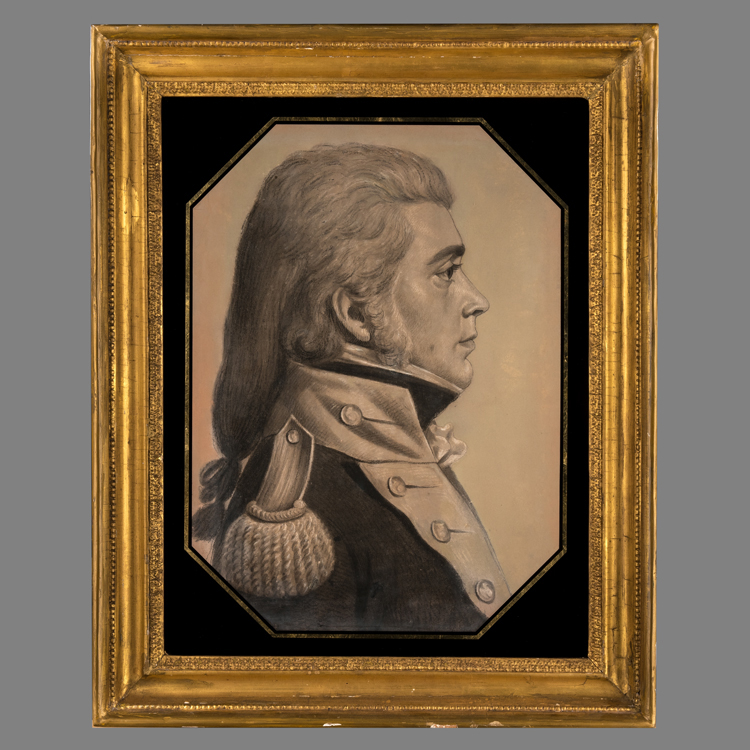
He began painting landscapes in 1793 to assist his impoverished parents. Later he turned to portraiture, using a French invention, called a physiognotrace to produce accurate life sized profiles. St. Memin then embellished these profiles to produce attractive portraits of his sitters. He often finished by giving the entire work a colored wash produced by a thin gouache layer. Surviving advertisements and receipts suggest for the original drawing in a gilt frame with painted églomisé glass mat, Saint-Memin received $6 for men and $8 for women. For an additional fee he would also produce a small engraved copperplate version and supply the plate and twelve prints.
Saint-Memin worked in several areas along the Atlantic Coast. From 1793 to 1798 he was in New York City. 1798-1804 saw him in Burlington, New Jersey and Philadelphia. Until 1809 he worked in Baltimore, Annapolis, Washington, Richmond, and Charleston. In 1810, after a brief trip to France, he returned to New York. In 1814 Saint-Memin was finally able to return to France. Home again, he served as director of the Beaux Arts Museum until his death in 1852.
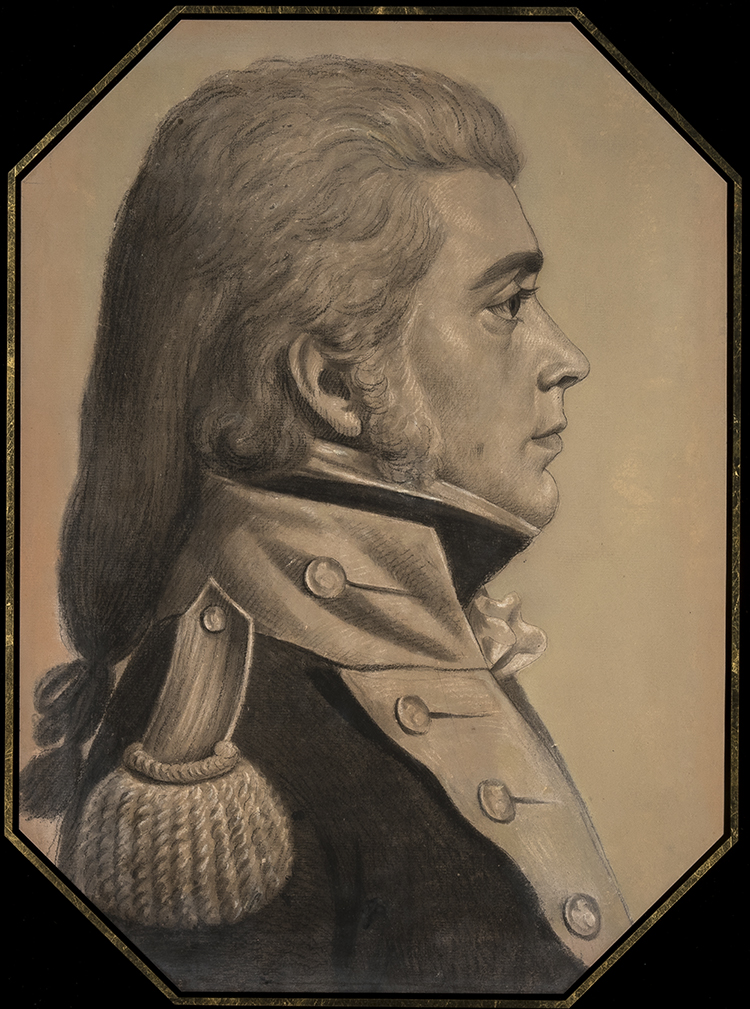
DESCRIPTION: Charcoal drawing, profile of man, facing right, on faded pink paper. The gentleman wears the uniform of an officer, a dark coat with light facings with buttons at the outside of long buttonholes on the lapel and collar, and epaulets of gold bullion. A black inner collar is over a white stock. The man’s hair is graying and is tied in a knot at the back with a black ribbon.