Robert Hanson Harrison
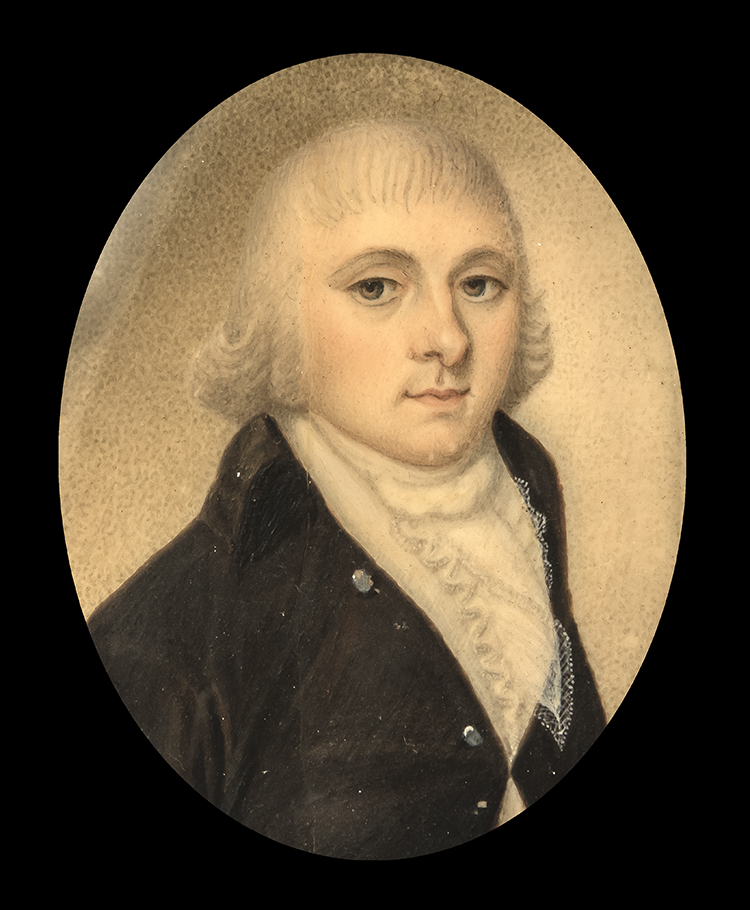
Hanson was married to Sarah Ann Johnston. After the Revolution, he was appointed Chief Justice of Maryland, and Washington appointed him one of the original Justices for the U.S. Supreme Court. He declined the appointment due to poor health and died on April 2, 1790. This miniature must have been done very shortly after Henri’s arrival in the United States.
ARTIST: Peter (Pierre) Henri (1760-1822) was born in Paris, the son of Pierre and Henriette Henri. He left France with his uncle and, following a shipwreck, settled on the island of Hispaniola. At his uncle’s death in 1788 he went to New York, where he advertised as “A Miniature Painter Lately Arrived from France…[who] draws Likenesses… at the lowest price, and engages the painting to be equal to any in Europe” (New York Daily Advertiser, 3 May, 1788). A year later he was in Philadelphia, willing to paint miniatures for “Four Pounds, which is about the sixth part of the price that I was generally paid before an extraordinary misfortune I experienced a few months ago.” (Pennsylvania Packet, 23 January 1789)
In Philadelphia he married Elizabeth Osborne, the daughter of Captain Peter Osborne. Following his marriage, he continued to work as an itinerant artist, traveling to Alexandria and Richmond, Virginia, Baltimore, Maryland, Charleston, South Carolina, and New Orleans, Louisiana.
Peter Henri’s work contains a number of recognizable characteristics. For example, he tended to give his subjects overly large heads with strongly delineated large round eyes and curling mouth. The skin tones are pale, backgrounds are neutral shades. The hair and background are executed with a short, regular hatch which is often decorative in effect. The subject is placed high in the picture and the initials “PH” and date are placed in the lower right corner.
Henri’s best known work is a portrait of the artist’s family in the collection of the Metropolitan Museum of Art (MMA 2000.25).
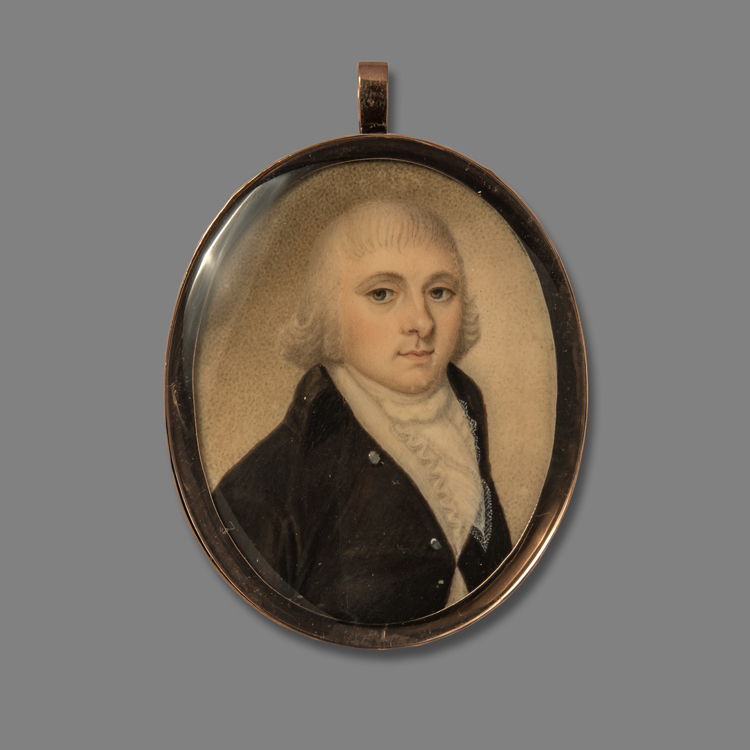
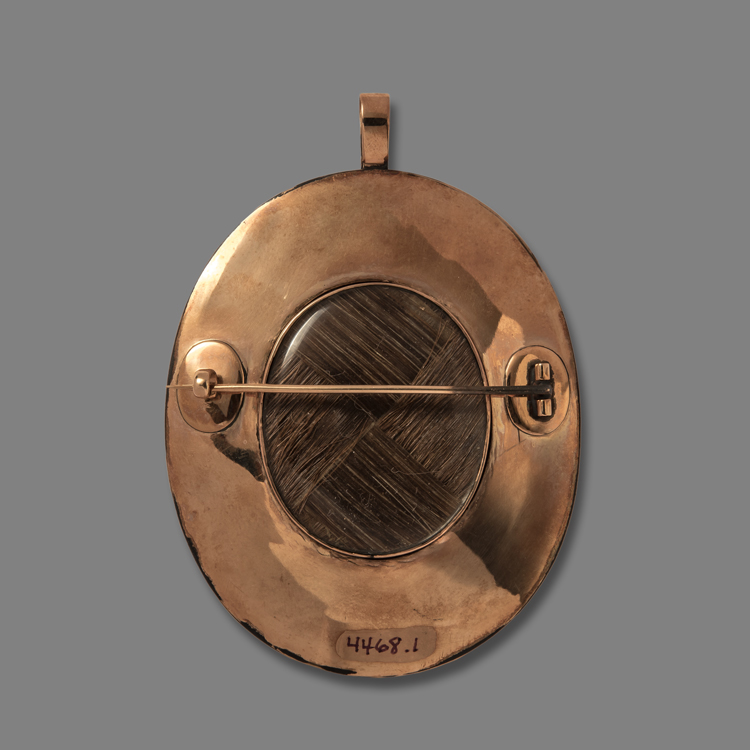
DESCRIPTION: Miniature watercolor on ivory in an oval copper frame with a stick-pin on the back and a loop at the top so that it can be worn as a pin or necklace. On the back is plaited hair enclosed in a glass case. The painting is of a gray haired man wearing a dark suit and white cravat. The ivory is split.