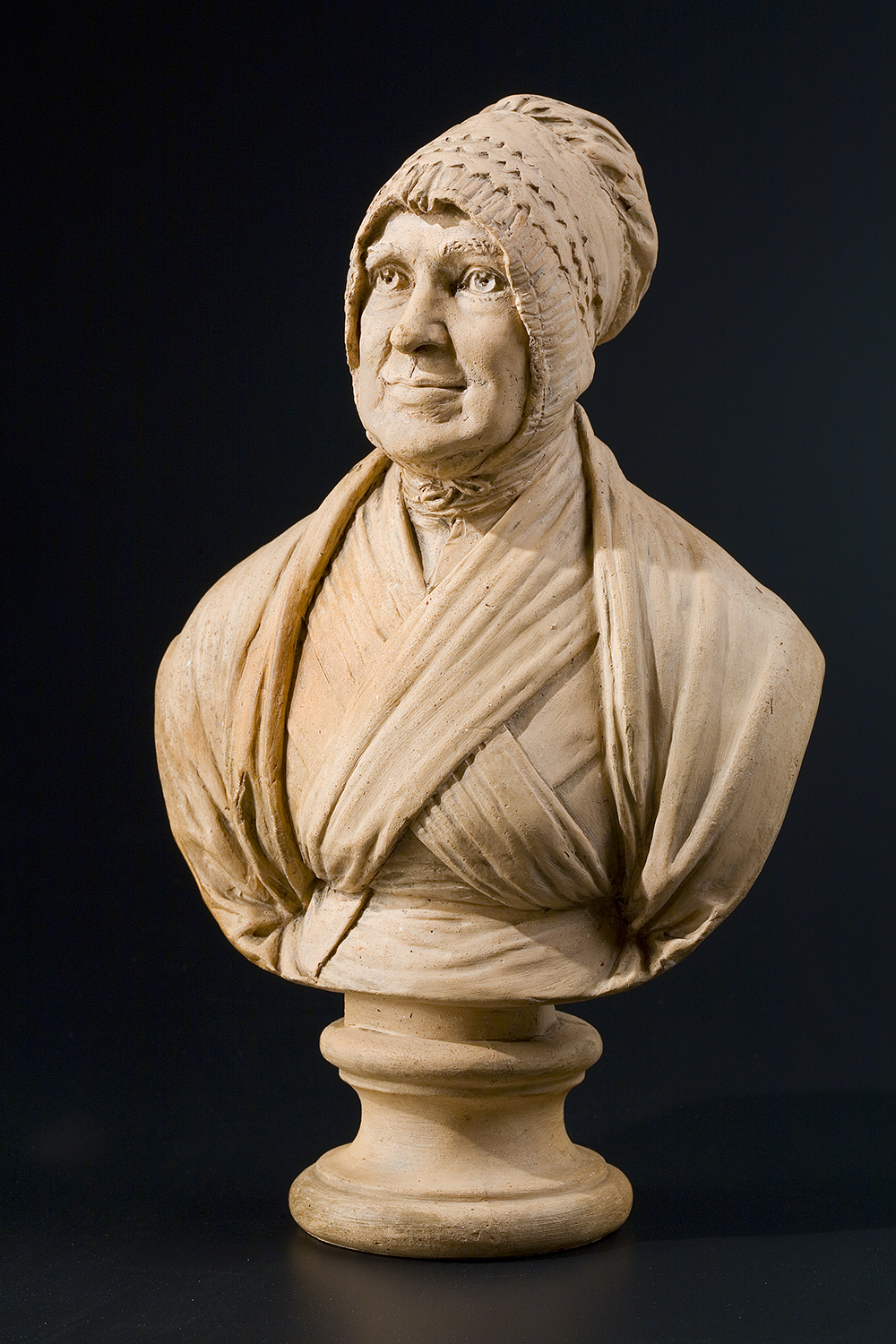
Rebecca Elizabeth (Tucker) Coles
Extensive family account books at the University of Virginia suggest that the main house at Eniscorthy was under regular renovation. A pair of Mutual Assurance Society policies document Eniscorthy as it stood in 1799 and 1810. The central portion of the house was a two-story frame house with a piazza on one side and a small porch on the other. In 1799 a one-story wooden wing accessed by a covered passage was located to one side of the house. By 1810 that wing had been enlarged and a second wing was added on the other side of the house to balance it. The house’s facade measured more than 150 feet long. A neighbor of Thomas Jefferson’s, the Coles patronized some of the same craftsmen. Unfortunately the Eniscorthy burned in 1839.
The family also patronized some of the same artists favored by Jefferson. Sons Isaac A. Coles (1779-1841) and John Coles III (1774-1848) both sat for Charles Balthazar Julian Fevret de Saint-Memin (1770-1852). Isaac, John III, Walter Coles (1772-1854), and their widowed mother Rebecca, all sat for the English sculptor William J. Coffee.
ARTIST: William J. Coffee (1774-1846) was an English sculptor, still life, and portrait painter. Born in Lambeth, London, as a young man he was employed at Coade’s Artificial Stone as a chore boy and kiln man. Coffee proved himself a skilled modeler and subsequently worked for several pottery firms including the Derby Porcelain Factory in Derby and Sir Nigel Gresley’s factory at Staffordshire. Between 1808 and 1816 his terra cotta sculptures of animals were exhibited at the Royal Academy of Arts in London.
In 1816 he arrived in America. His earliest American work is a bust of Hugh Williamson (1735-1819) in the collection of the New York Historical Society (NYHS acc. X.58) In 1817 he exhibited two terra cotta animals and several paintings at The American Academy. That year he corresponded with Thomas Jefferson and journeyed South to Monticello where he sculpted busts for Jefferson and a number of his Albemarle county friends. Coffee likely returned to New York with the completed but unfired busts. Once in his New York studio he fired them in his kiln and took a mold to produce plaster copies as required.
Listed as a sculptor and portrait painter in the New York directories between 1821 and 1826, Coffee continued to travel for commissions, including an 1821 trip to Charleston, South Carolina, where he executed a bust of General Charles Cotesworth Pinckney (1746-1825). In 1827 he moved his studio north to Albany, New York where it remained until his death in 1843.
REFERENCES:
Elizabeth Langhorne, et al, “A Virginia Family and Its Plantation Houses” (Charlottesville, Virginia: University of Virginia Press, 1987)
Bradford L. Rauschenberg, “William J. Coffee Sculptor-Painter–His Southern Experience”, The MESDA Journal, Vol. 4, No. 2 (November 1978) https://archive.org/details/journalofearlyso0402muse
George C. Groce and David H. Wallace. THE NEW-YORK HISTORICAL SOCIETY’S DICTIONARY OF ARTISTS IN AMERICA: 1564-1860. New Haven, CT: Yale University Press, 1957.