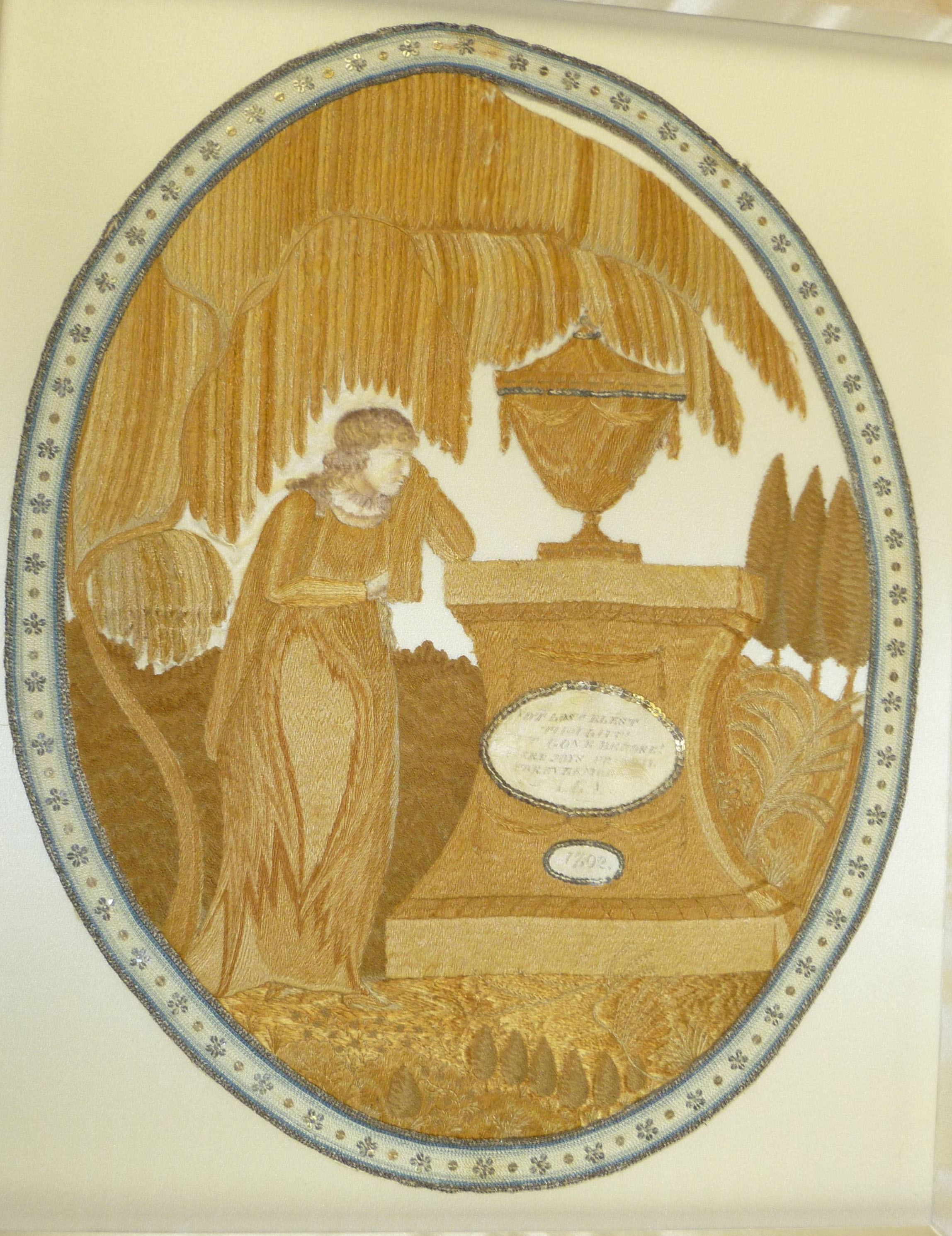
Mourning Embroidery
Artist/Maker
Vierling, Mary Rosina (attr.)
Place Made
Salem North Carolina United States of America
Date Made
1800-1810
Medium
silk thread –watercolor –ink
Dimensions
LOA 15 5/8; WOA 11 3/4
Accession Number
2924
Description
DESCRIPTION: Silk and watercolor on silk; embroidery done on cream-colored silk; picture surrounded by an oval knit “frame” done with black, shades of blue, and white thread, with sequins sewn on in a flower dot pattern all the way around. Figure in picture is a woman leaning on a pedestle topped with an urn. Woman’s head is drawn in ink. Inscription on pedestle: NOT LOST BLEST/THOUGHT!/BUT GONE BEFORE/WHERE JOYS PREVAIL/FOR EVERMORE/A.E.V./1792.
Mary Rosina Vierling (1791-1825) was the daughter of Salem’s doctor, Samuel Benjamin Vierling, and his first wife, Anna Elizabeth. Although she was born in Salem, Mary Rosina was educated in Bethlehem, Pennsylvania (started school there in 1799). She was a teacher at the Bethlehem Seminbary between 1807 and 1811 when she married Owen Rice. She died in 1817. Similarities highlight the sharing of techniques between Salem and the northern Moravian girls’ schools. The framing of the central scene by a woven tape decorated with sequins (or “spangles” as they are called in the records) relates this embroidery to others made at the girls’ school in Bethlehem.
History
HISTORY: Descended in the Vierling family; made in memory of Anna Elisabeth Vieling who died in Salem in 1792 at the age of 22.”Because this piece relates to some Bethelehem mourning embroideries, it is possible that Anna Elisabeth’s only daughter made it while she was a student at the girls school in Bethlehem. Not only do we find the usual variety of stitches, the painted head, and the written verse, but also metallic threads and sequins–now tarnished–were used to dramatic advantage, as they would have added glittering highlights and unusual texture. This piece exemplifies the usual classical mourning scene of the grieving woman leaning over the tomb, which is surmounted by a classical urn. Large weeping willow branches and cypress trees fill much of the background. Most of the foreground is occupied by the pedestal, urn, and female figure. Aside from the small cypress trees and the shading of colors, there is little attempt to produce a realistic scene, but rather to achieve a sense of immortality. Evidently, although the Moravians then, as now, believed in equality even in death (as represented by the flat stones in the graveyard), they had accepted the pictorial symbolism of death and grief which had become popular in the Neoclassical period.” (Bivins & Welshimer, p.55-56.)
Credit Line
Gift of Mr. and Mrs. W. Ledoux Siewers