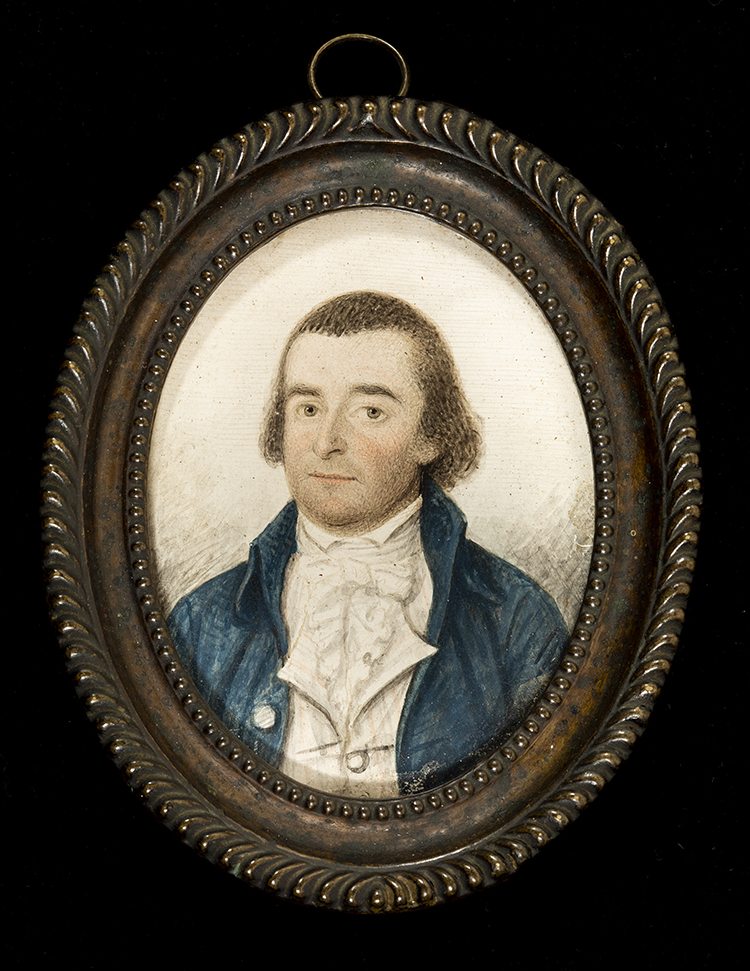
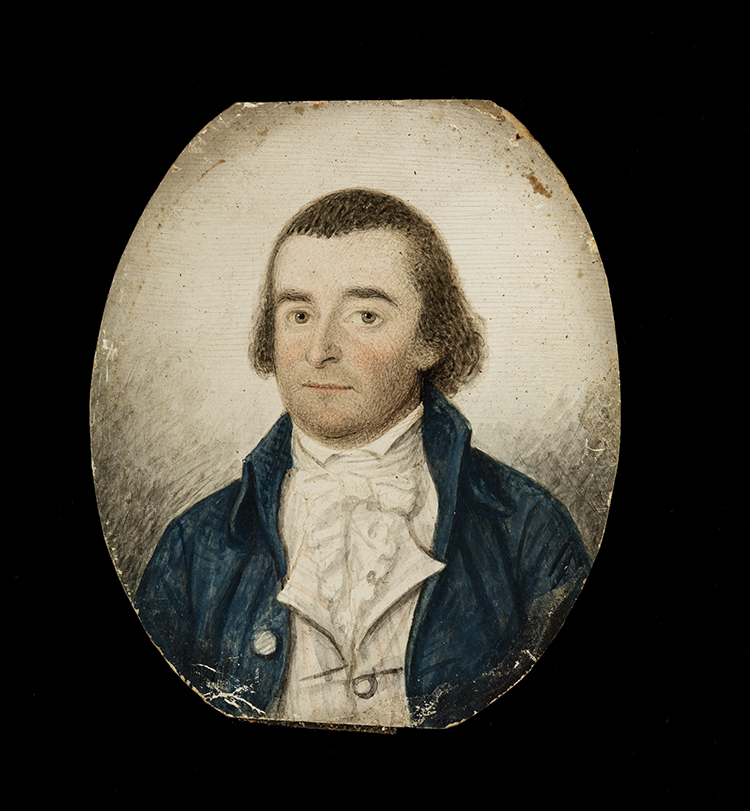
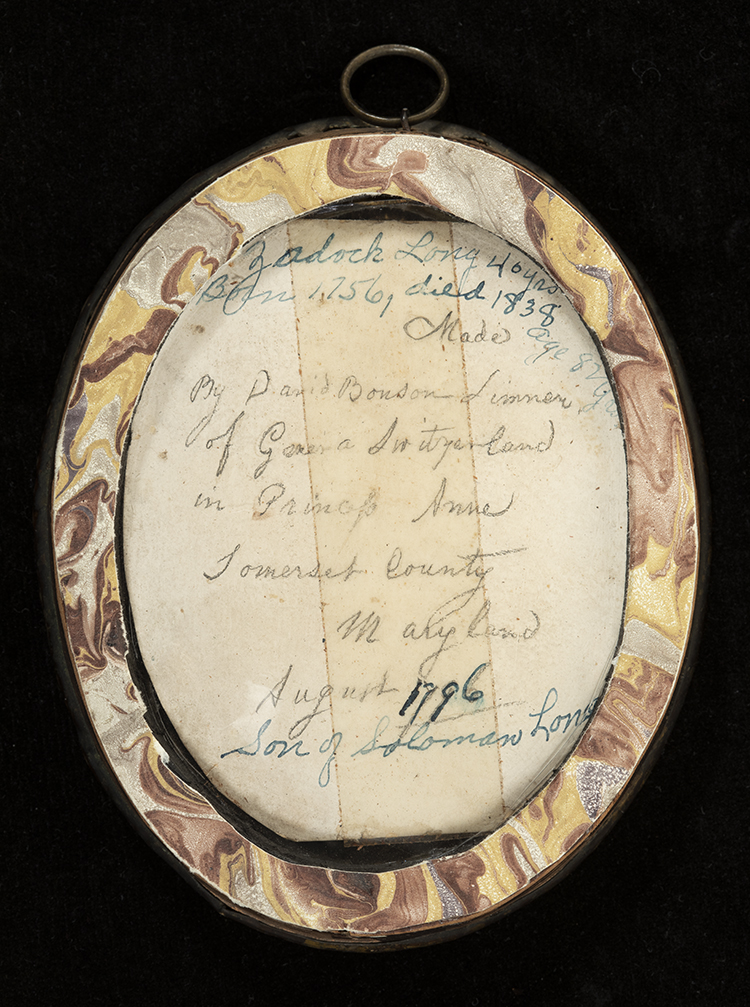
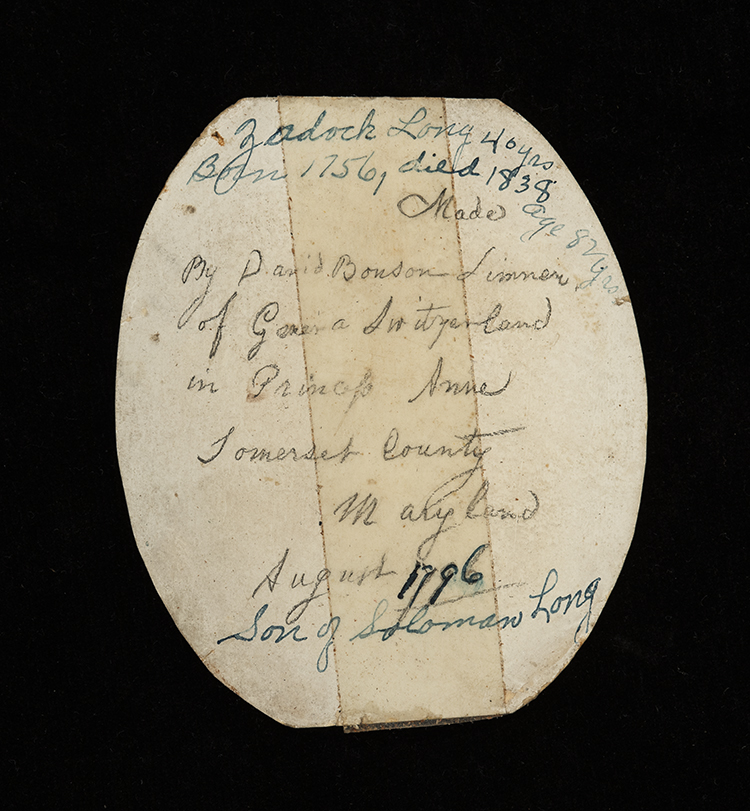
Portrait of Zadock Long
ARTIST: David Boudon was born in Geneva in 1748, where he apprenticed with the German engraver Jean-Daniel Dupré and took classes at Geneva’s school for the arts. After brief periods in France and Italy, the artist emigrated to the United States. He arrived in Charleston in 1794 or 1795. By 1795, Boudon was painting small likenesses with watercolor on ivory and vellum in Georgia. Journeying along the Atlantic coast and eventually into the Ohio River Valley, advertisements by the artist track his movements as an itinerant craftsman through North and South Carolina, Baltimore, Washington, Virginia, and Philadelphia, to Chillicothe, Ohio, and finally, Kentucky.
SITTER: Zadock Long (1756-1831), of Somerset County, Maryland. The son of Soloman and Margaret Maddox Long, Zadock’s 1796 portrait was likely done about the time that he began leasing the Washington Inn in Princess Anne, Somerset, MD. In 1797, he purchased the tavern from John Done.
Boudon is known primarily as a miniaturist, working mostly in silverpoint on vellum, although some of his works are watercolor on ivory. His style, with its thin color wash over a linear image, reflects his early training as an engraver. According to his own advertisements, he considered himself more as a drafstman or “limner” rather than a painter. (See Nancy E. Richards, “A Most Perfect Resemblance at Moderate Prices: The Miniatures of David Boudon.” (Winterthur Portfolio 9, pp 77-102)