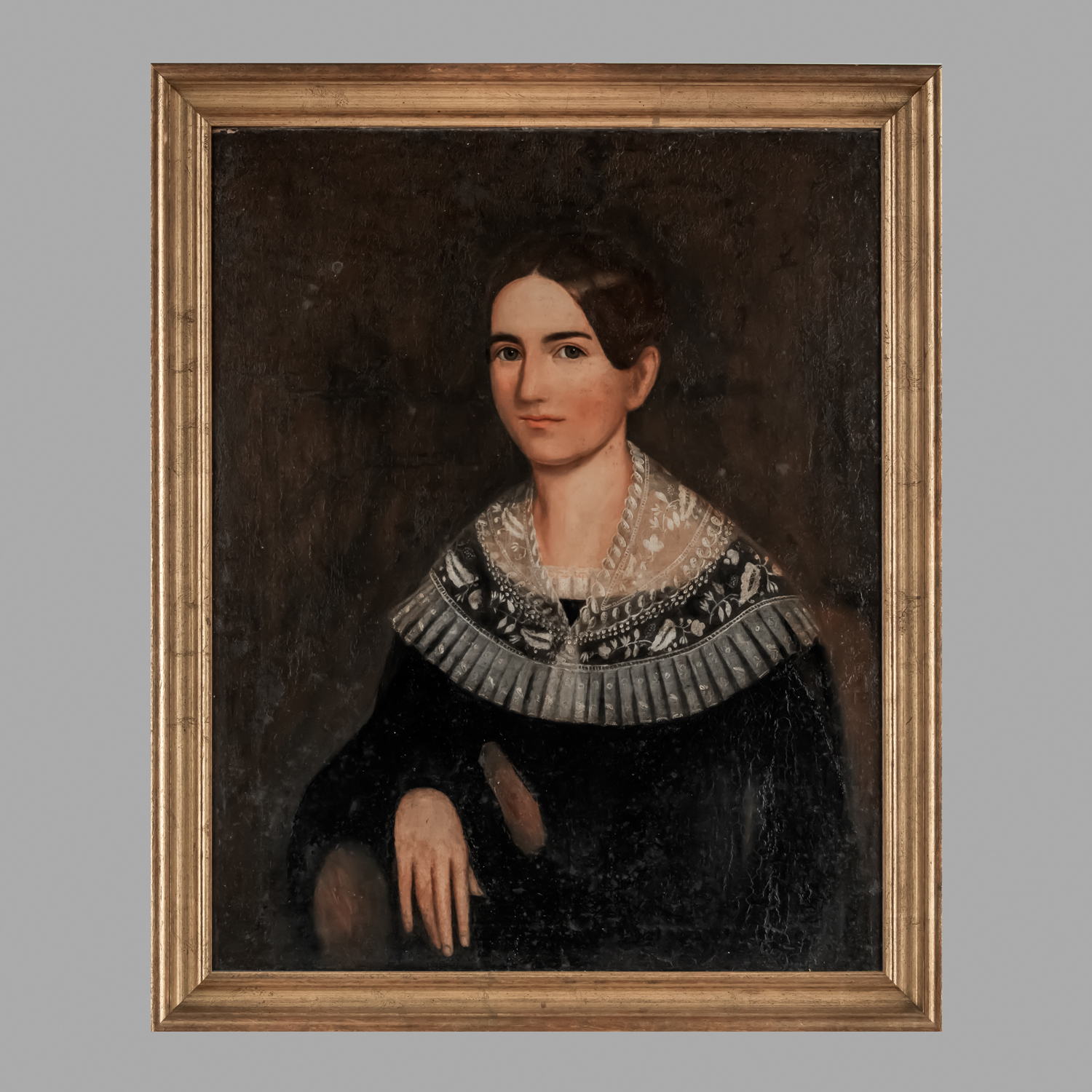
Portrait of unknown woman
ARTIST: Joel Haywood Tatum was born in Huntsville, Alabama in 1822. His father, James, moved the family from North Carolina to Davidson, Tennessee, before settling in Huntsville, Alabama prior to Joel’s birth. Little is currently known about Tatum’s artistic training. A 1849 Macon, Georgia article reported that “Mr. Tatum is wholly untraveled and self taught of the nicer and more professional parts of the art.” Three months earlier, a newspaper in Aberdeen Mississippi printed a letter from a resident of Mobile that offers that Tatum “has been engaged in the refined and beautiful avocation of portrait painting for the last six or eight years.”
This portrait of an unknown woman was likely created during the earliest years of Tatum’s career. It is signed and dated 1841 (though the inscription has been replicated by a later restorer). This 1841 date, if it was correctly transcribed, places it within the period where Tatum worked in Alabama. Its technique compares favorably to Tatum’s other known 1841 paintings of Alabamians Sarah and Thomas Martin of Oakville. By March 1848, Tatum had moved to Aberdeen, Mississippi, where he established a painting studio and advertised it in the local papers.
Once in Mississippi, Tatum turned his brush to an ambitious set of three religious scenes, each measuring 8 x 10 feet. In 1849, he took the paintings on a tour through the southeast and attracted significant popular interest. Rather than return to Mississippi or Alabama after the tour, however, Tatum seems to have continued north. In September 1849, he advertised a studio in Washington, D.C., but by 1850 he had removed to Baltimore. There, he advocated for government sponsorship of his experimentation with electromagnetic engines.
It seems Mr. Tatum had a knack for more than painting: he submitted applications for several inventions over his lifetime, from brush manufacturing techniques to an improved candle wick, to better methods of candle production, to a patent for creating photographic prints on canvas (which later authors noted worked quite poorly). From Baltimore, he ultimately landed in New York City before applying for a passport to England in 1860. Perhaps he sensed that trouble was brewing on the home front. By removing to London, Tatum successfully avoided entanglement in the Civil War.
According to the diary of diplomat Benjamin Moran, Tatum did not support secession, at least publicly. Moran wrote, in 1862 that “Joel H. Tatum, a queer looking dark haired, pale faced native of Alabama interested me to – day. He is an artist, has a slow way of moving about, talks well, is observant, and 40. He is a Union man & seems to keep his own secrets.” While in London, Tatum also flexed his literary muscles. His 1863 poem “A Wild Violet” reveals a certain homesickness for his Alabama roots:
Sweet harbinger of Spring
I love thee- pretty thing
Thou sendest mem’ry back
O’er life’s now weary track
To smiling childhood’s morning joys again
In Alabama’s bright and sunny plain.
Presumably, Tatum took full advantage of his time abroad to build his artistic skills, but additional research is needed to understand his experience. Tatum’s later career was once again in the American south, especially in Mississippi and Baldwin County, Alabama. In 1881, at the age of 60, he married Francis Binford in Madison County, Alabama. Tatum died two years later.