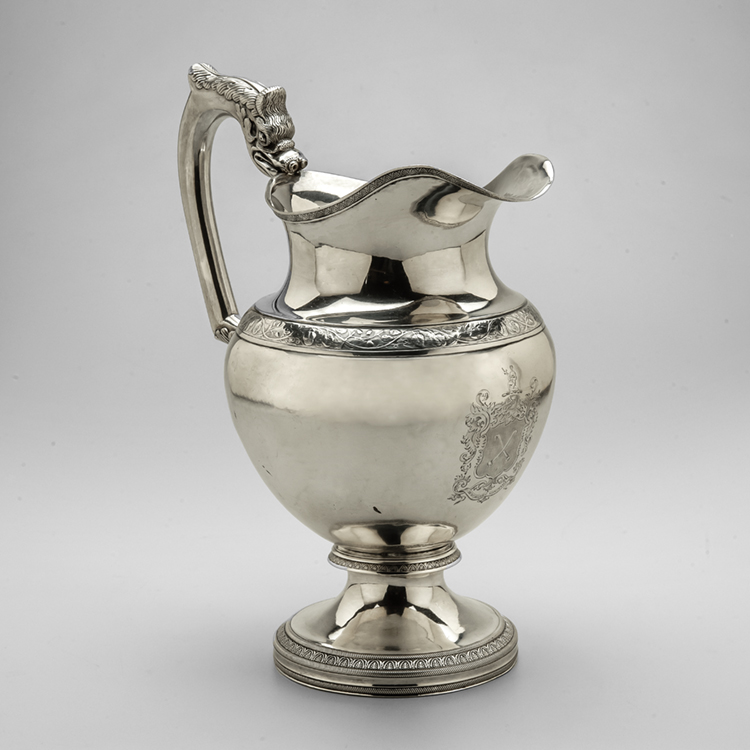
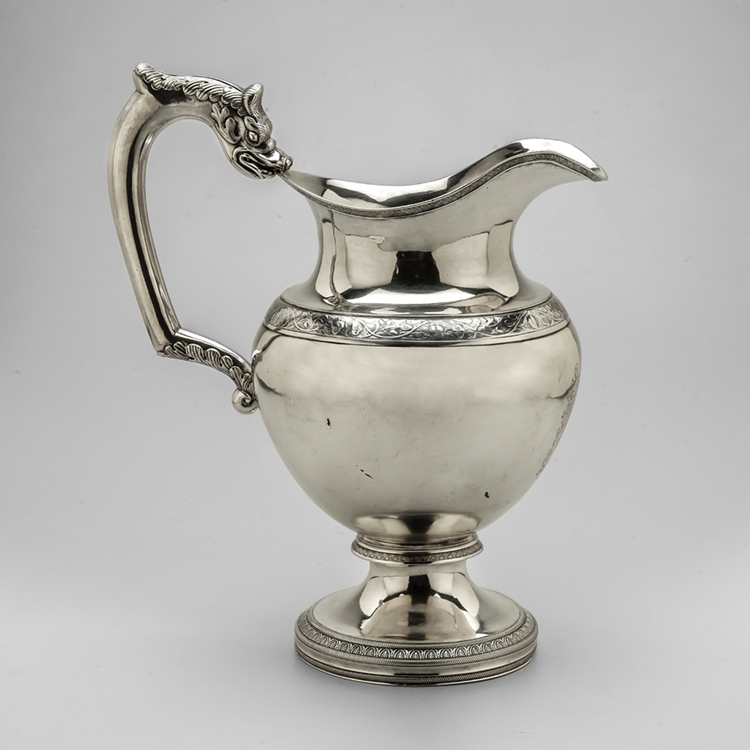
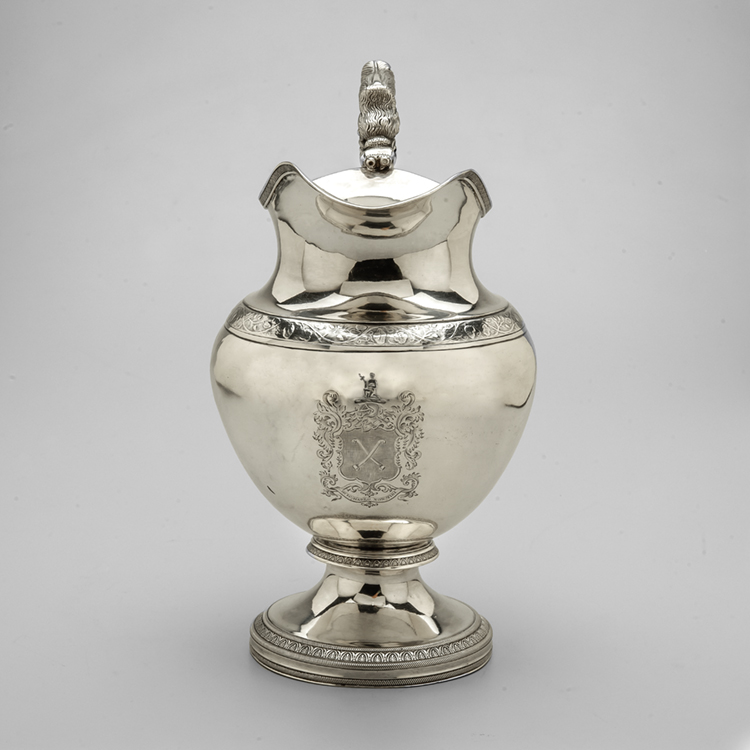
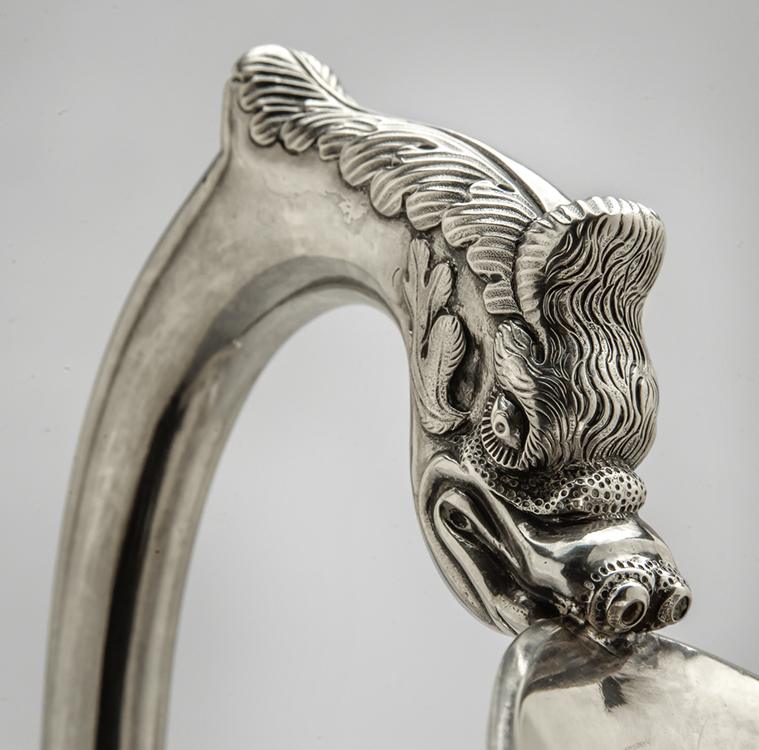
Pitcher
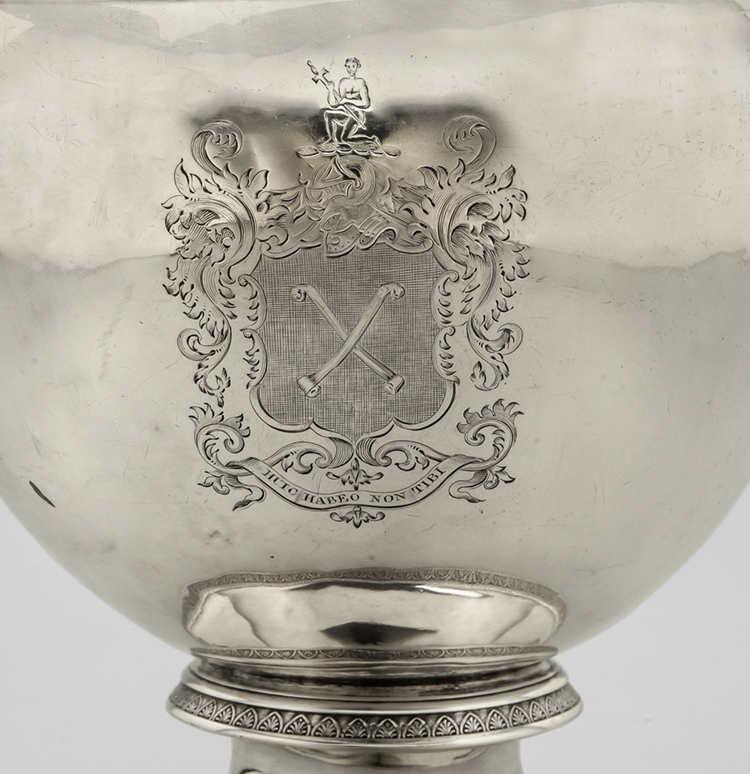
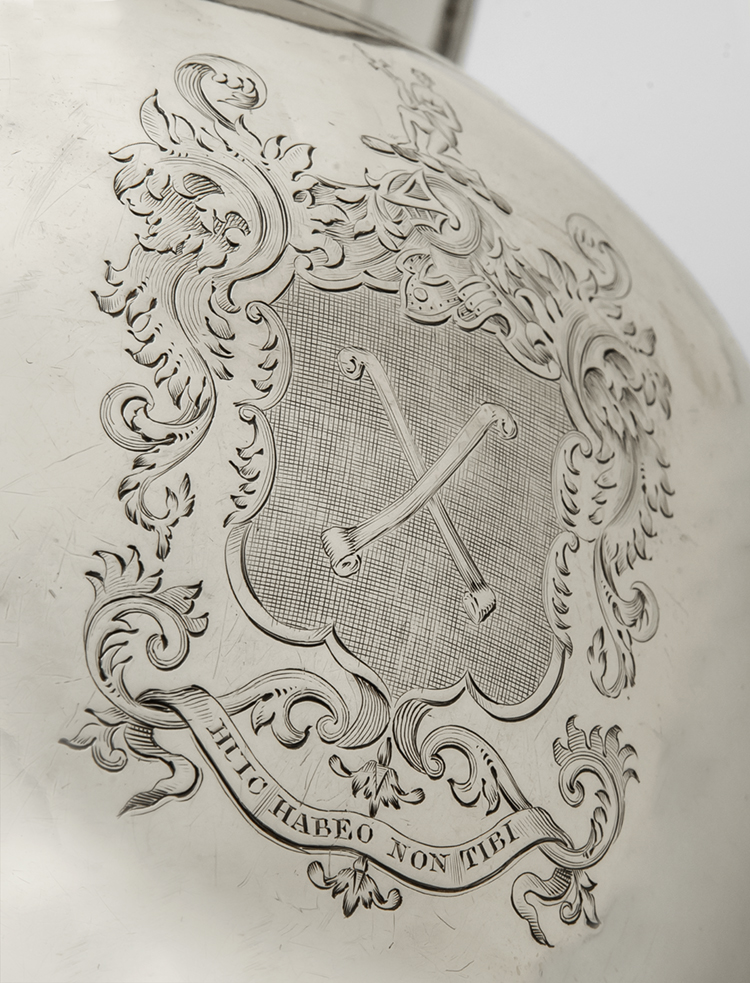
INSCRIPTION: Engraved on side of the body with the Newton family armorial in a shield and motto “HUIC HABEO NON TIBI”, most likely made for Thomas Newton (1768-1847) of Norfolk, Virginia.
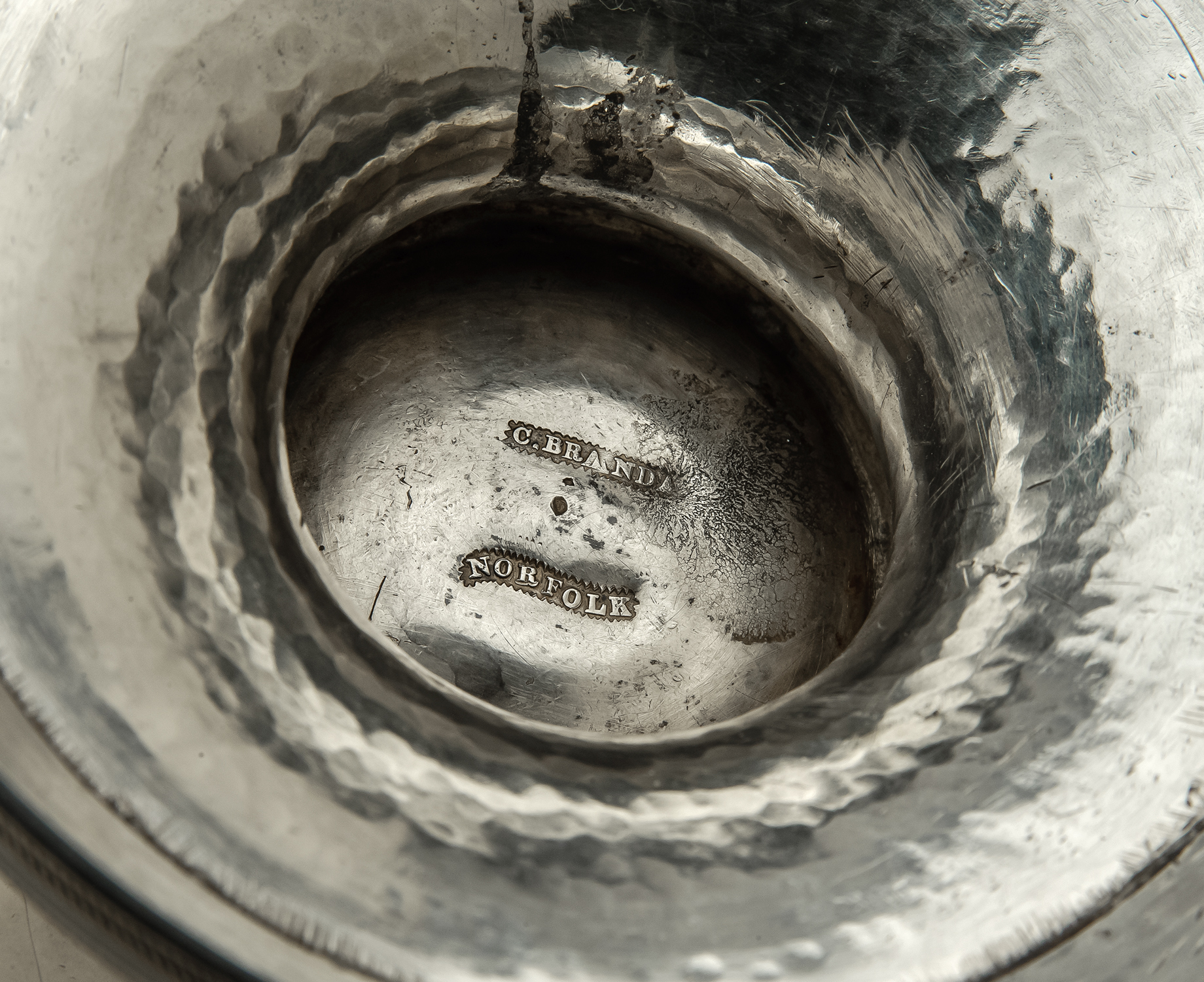
MARK: Struck on bottom of base with an intaglio “C.BRANDA” mark in a serrated rectangle reserve and an intaglio banner-shaped “NORFOLK” mark in a serrated conforming reserve.
MAKER: Charles Branda (d.c.1840) was born in France and emigrated to Norfolk, Virginia by 1811. His advertisements from that year reveal that he had already been in the city for some time. His shop at 98 Main Street provided the services of an engraver, copperplate printer and merchant of jewelry. In August 1814 he sold his copperplate press and moved to Philadelphia. Branda worked in Philadelphia until 1818 when he returned to Norfolk, a relocation that brought about a flurry of long advertisements in Norfolk listing the wares his shop offered and the continuation of his copperplate printing business. The extent of which Branda sold imported silver ware versus that from his own bench is unknown, but he consistently advertised for old gold and silver. He advertised as a jeweler and engraver in Norfolk through the 1820s. The last instance of Branda in the historical record is the 1830 Federal Census when he is recorded on Bermuda Street in Norfolk with his wife Mary, their children, and two enslaved females age twenty-four to thirty-five. His death date is unknown, but Branda probably died between 1830 and 1850 because Mary Branda is recorded in the federal census of that year as living alone with their son Adolphus, a clerk aged twenty-five. See Catherine B. Hollan, “Virginia Silversmiths, Jewelers, Watch- and Clockmakers, 1607-1860: Their Lives and Marks” (McLean, VA: Hollan Press, 2010).
FORM: Silver pitchers in Colonial America were most often small cream pitchers in the rococo fashion that were used as part of the tea ceremony to serve milk. Large wide-mouthed pitchers in the neoclassical and empire styles became popular after the American Revolution. Such pitchers were used to serve water or wine and provided silversmiths with abundant flat surface area for engraving everything from simple monograms to armorials to lengthy presentations. The term “pitcher” is most commonly used in the United States and can be applied to any container with a spout for pouring liquids. In other English-speaking countries, the term “jug” is use more prevalently. A “ewer” is a vase-shaped, handled pitcher, often decorated, with a base and flaring spout.