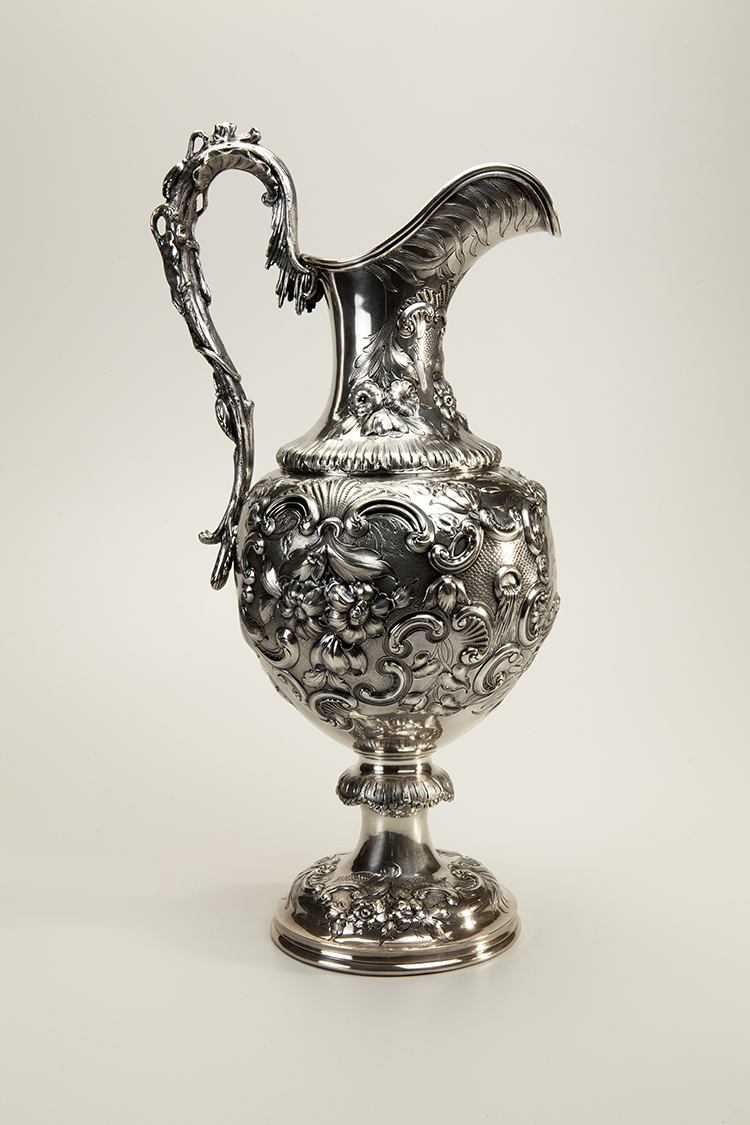
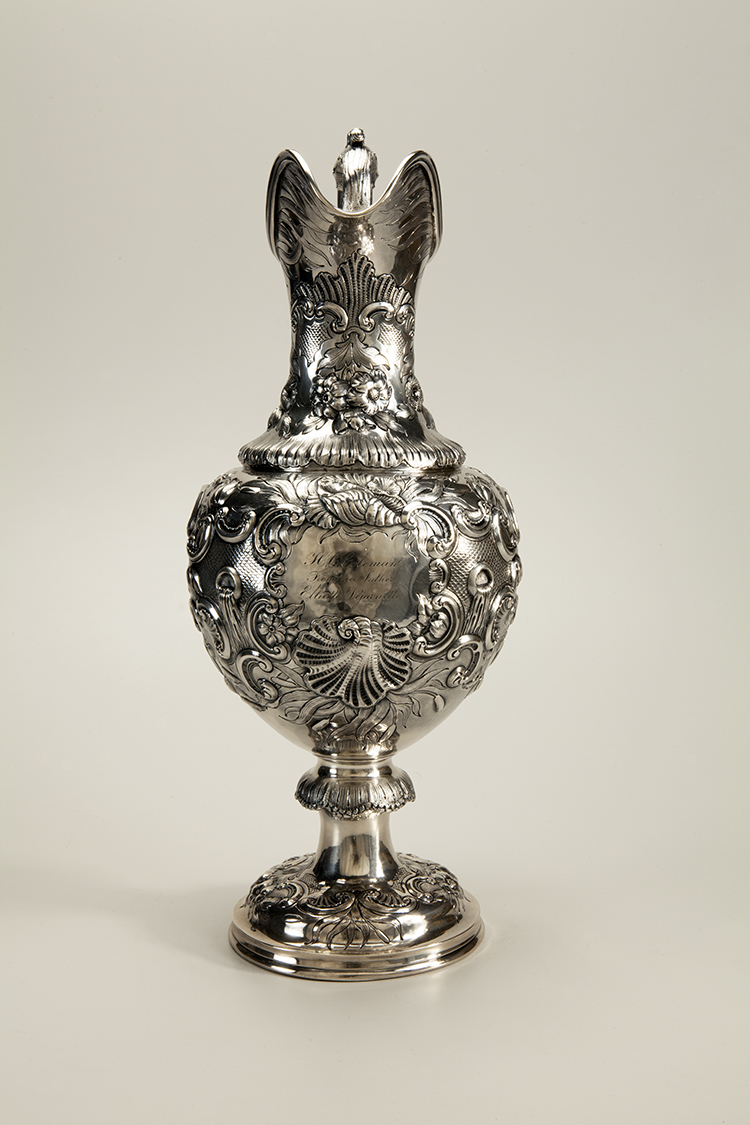
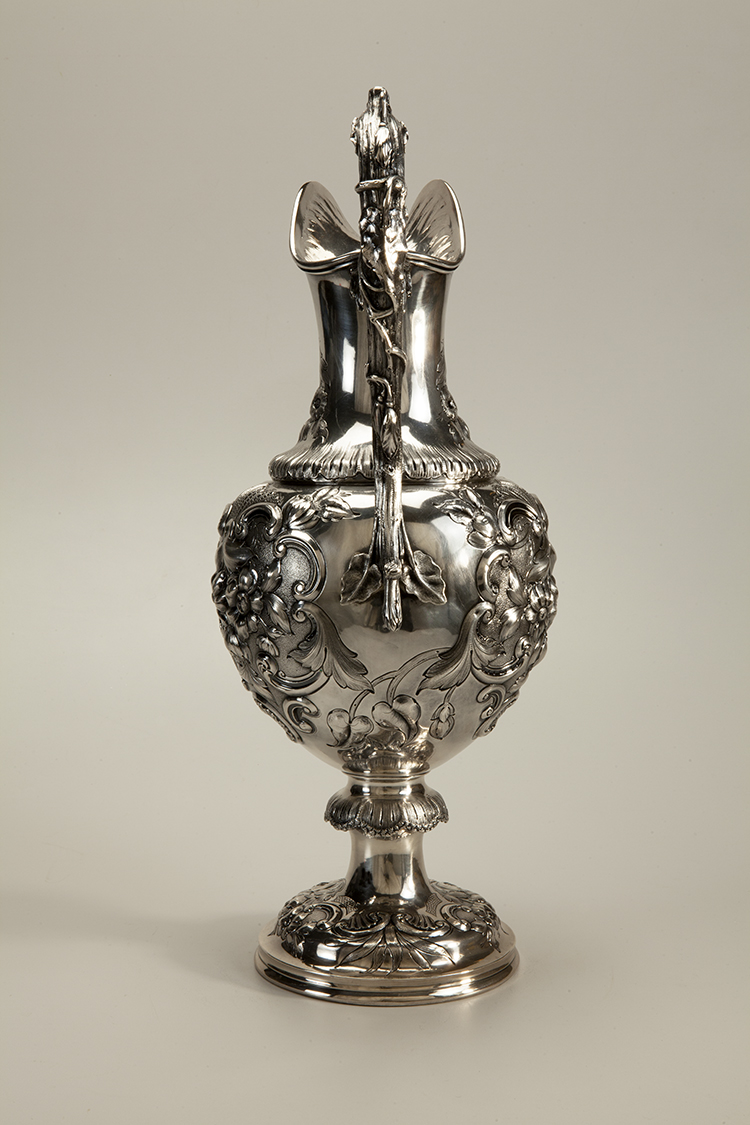
Pitcher
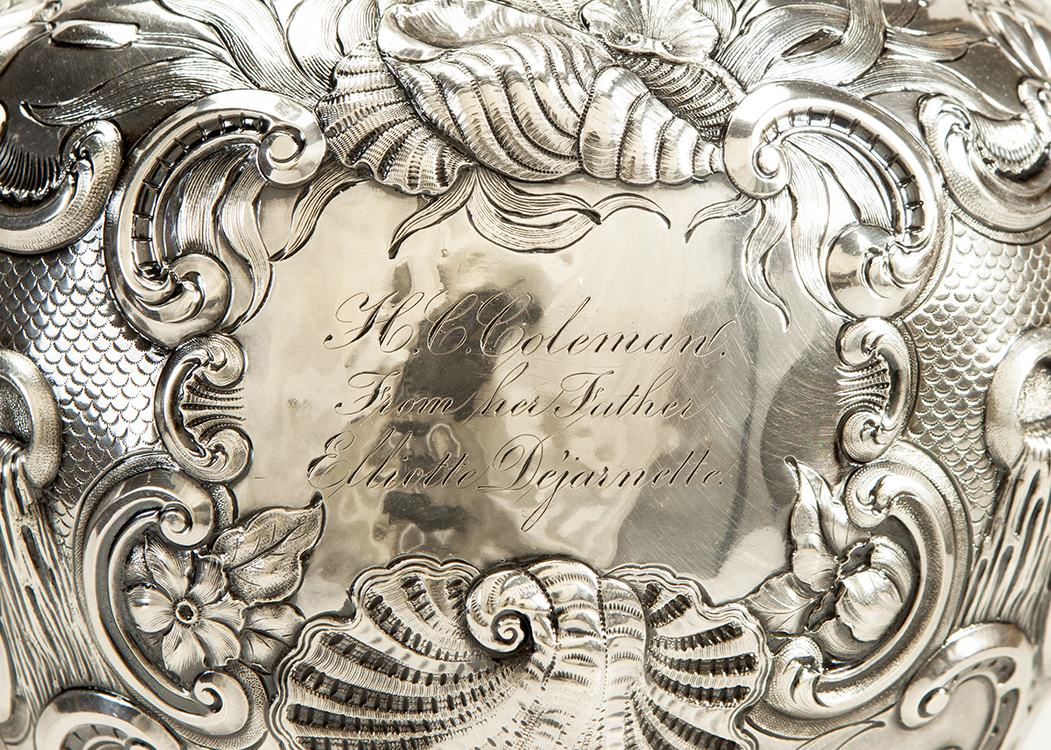
INSCRIPTION: Engraved in script lettering “H.C. Coleman. / From her Father / Elliotte Dejarnette” in the cartouche located on the side of the body opposite the handle for Huldah C, DeJarnette Coleman (1827-1887).
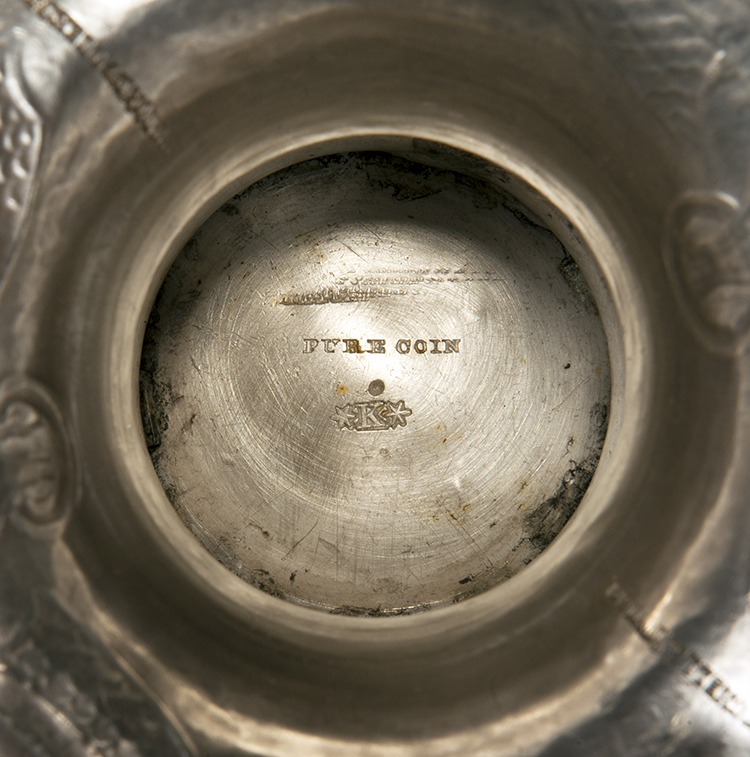
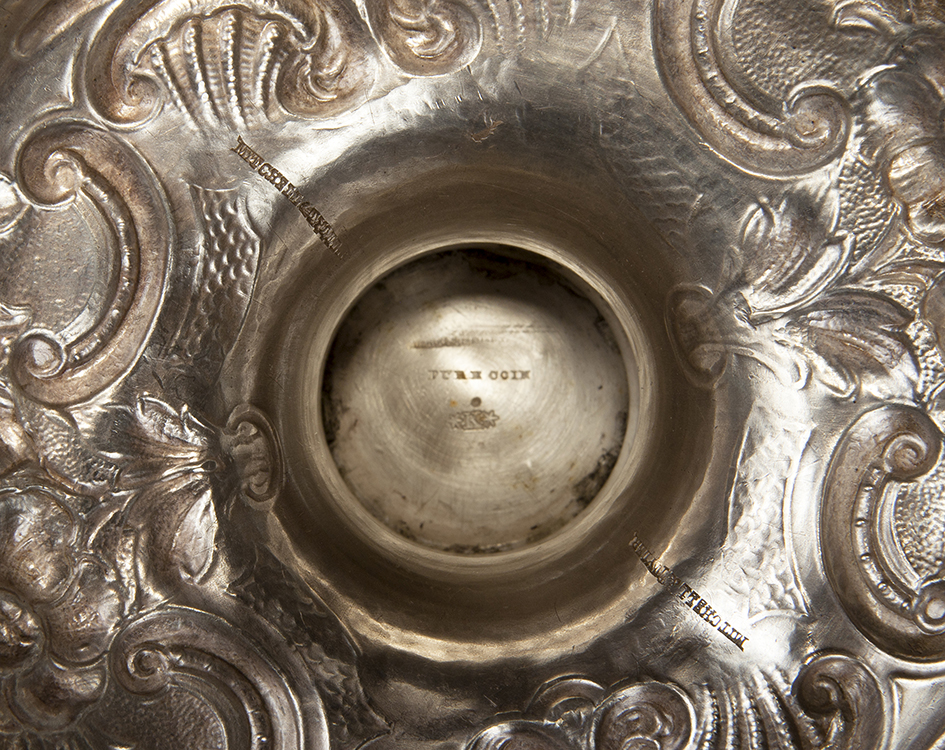
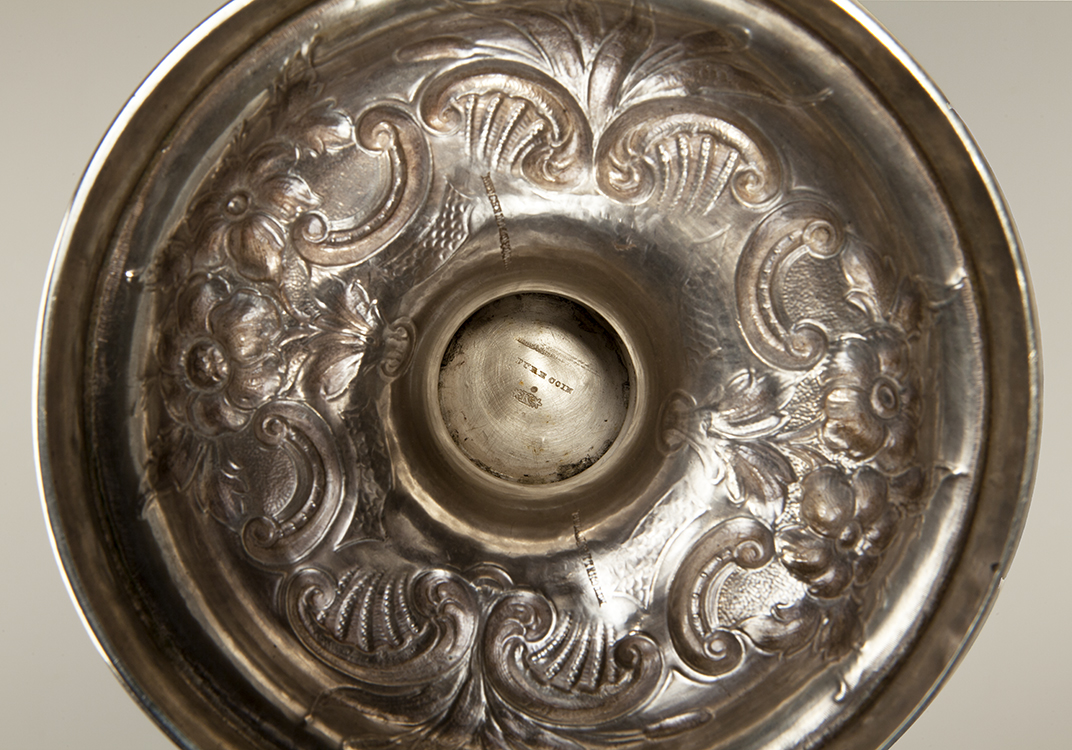
MARK: Struck three times with an incuse “MITCHELL & TYLER” mark, twice on underside of the base and once again very faintly on the underside of the body, as well as manufacturer’s marks for Peter L. Krider on the underside of the body: “*K*” and “PURE COIN” incuse marks.
MAKER: The partnership of Mitchell & Tyler was formed in Richmond, Virginia in October 1845 between Vermont-born Samuel Phillips Mitchell (1815-1866) and Connecticut-born John Henry Tyler (1809-1833). Both men apprenticed in Richmond under Massachusetts-born William Mitchell Jr. (1797-1852), who was Samuel Phillips Mitchell’s older brother, and the partnership purchased the master’s business. William Mitchell Jr. and then Mitchell & Tyler operated one of the largest silverware and jewelry businesses in Richmond with many of the city’s watchmakers and jewelers working in their shops and significant silver hollowares being supplied by large American silver manufacturers in the North. The firm of Mitchell & Tyler advertised often throughout Virginia and as the Civil War approached increased their market in military goods such as swords, guns, epaulettes, buttons, sashes, and other uniform trimmings. Mitchell & Tyler remained in operation throughout the war but dissolved in 1866 due to Mitchell’s poor health. See Catherine B. Hollan, “Virginia Silversmiths, Jewelers, Watch- and Clockmakers, 1607-1860: Their Lives and Marks” (McLean, VA: Hollan Press, 2010).
Peter L. Krider (1821-1895) was born and raised in Philadelphia, Pennsylvania and began his apprenticeship in 1835 under silversmith John Curry (b.c.1798-1868). He finished his apprenticeship with the firm of Robert & William Wilson (in partnership 1825-1846). About 1842 Krider moved to Boston where he worked as a journeyman with Obadiah Rich (1809-1888) and returned to Philadelphia in 1846 to serve as the R & W Wilson shop foreman. Krider first appears under his own name as Krider & Co. in the 1851 Philadelphia city directory. His firm would become one of the city’s most important in the second half of the nineteenth century. Krider specialized in beakers, and partnered with retailers throughout the United States, but also made holloware for prominent local and regional retailers. From 1859 to 1870 he partnered with John W. Biddle (1835-1916) under the business name Krider & Biddle. See Catherine B. Hollan, “Philadelphia Silversmiths and Related Artisans to 1861” (McLean, VA: Hollan Press, 2013).
FORM: Silver pitchers in Colonial America were most often small cream pitchers in the rococo fashion that were used as part of the tea ceremony to serve milk. Large wide-mouthed pitchers in the neoclassical and empire styles became popular after the American Revolution. Such pitchers were used to serve water or wine and provided silversmiths with abundant flat surface area for engraving everything from simple monograms to armorials to lengthy presentations. The term “pitcher” is most commonly used in the United States and can be applied to any container with a spout for pouring liquids. In other English-speaking countries, the term “jug” is use more prevalently. A “ewer” is a vase-shaped, handled pitcher, often decorated, with a base and flaring spout.