Pitcher
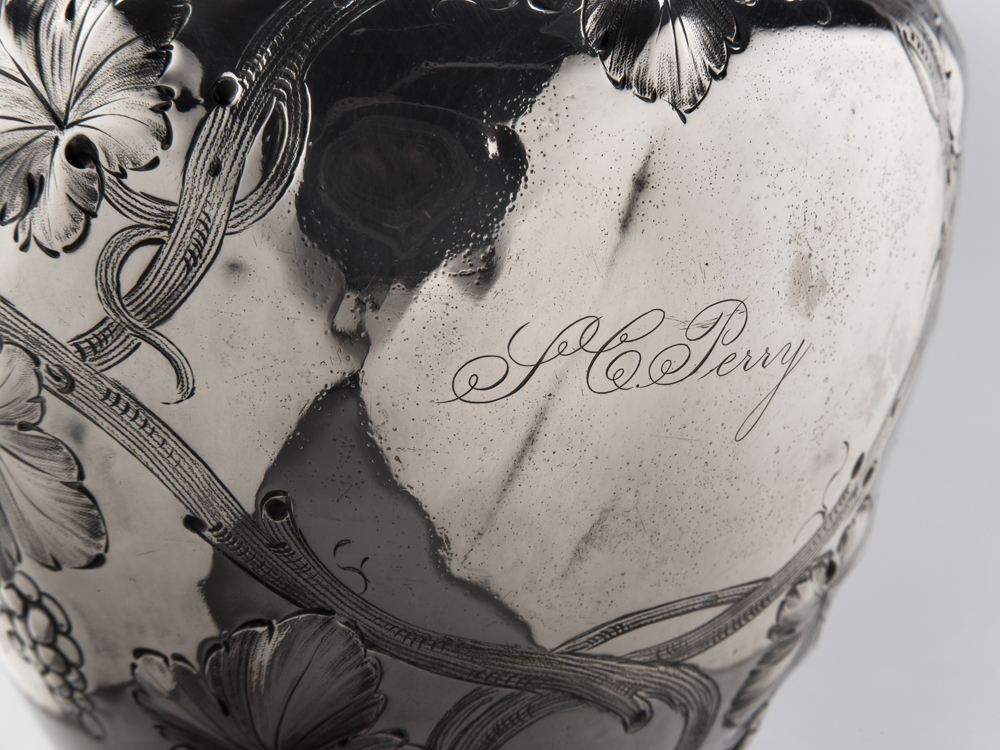
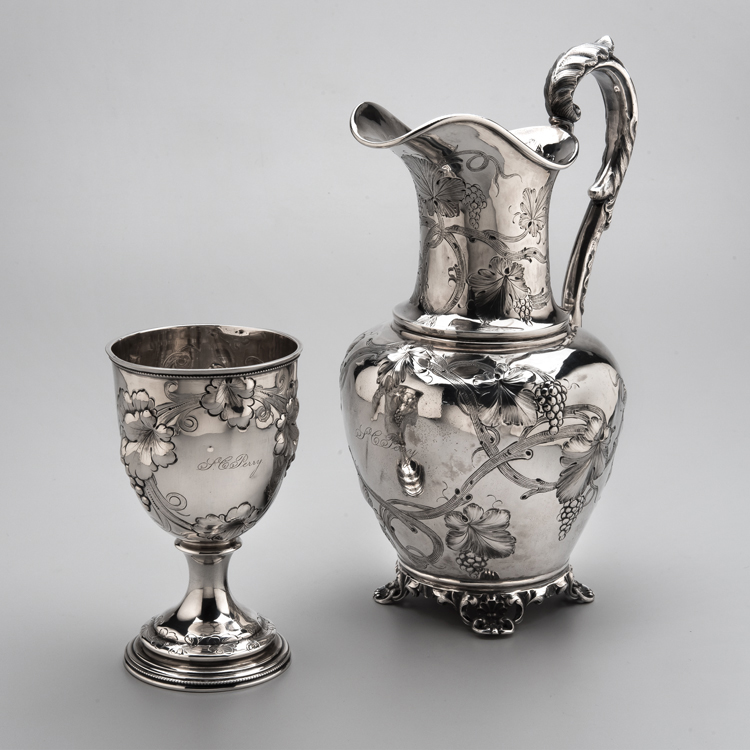
INSCRIPTION: Engraved in a cartouche on side of body opposite handle with “S.C. Perry” in script lettering.
MARK: Struck on underside of body with intaglio “HORTON & RIKEMAN” mark in a rectangular reserve.
MAKER: The partnership of Humphrey P. Horton and Cornelius H. Rikeman operated for only six years, from 1850 until 1856. Both men came to Georgia from the North; Horton from Connecticut and Rikeman from New York City. By 1857 they were advertising independent of one another. See Ashley Callahan and Dale L. Couch, “From Sideboard to Pulpit: Silver in Georgia,” exhibition catalog, November 2005–March 2006, Georgia Museum of Art, University of Georgia, Athens, GA and George Cutten, The Silversmiths of Georgia (Savannah, GA: Pigeonhole Press, 1958).
FORM: Silver pitchers in Colonial America were most often small cream pitchers in the rococo fashion that were used as part of the tea ceremony to serve milk. Large wide-mouthed pitchers in the neoclassical and empire styles became popular after the American Revolution. Such pitchers were used to serve water or wine and provided silversmiths with abundant flat surface area for engraving everything from simple monograms to armorials to lengthy presentations. The term “pitcher” is most commonly used in the United States and can be applied to any container with a spout for pouring liquids. In other English-speaking countries, the term “jug” is use more prevalently. A “ewer” is a vase-shaped, handled pitcher, often decorated, with a base and flaring spout.