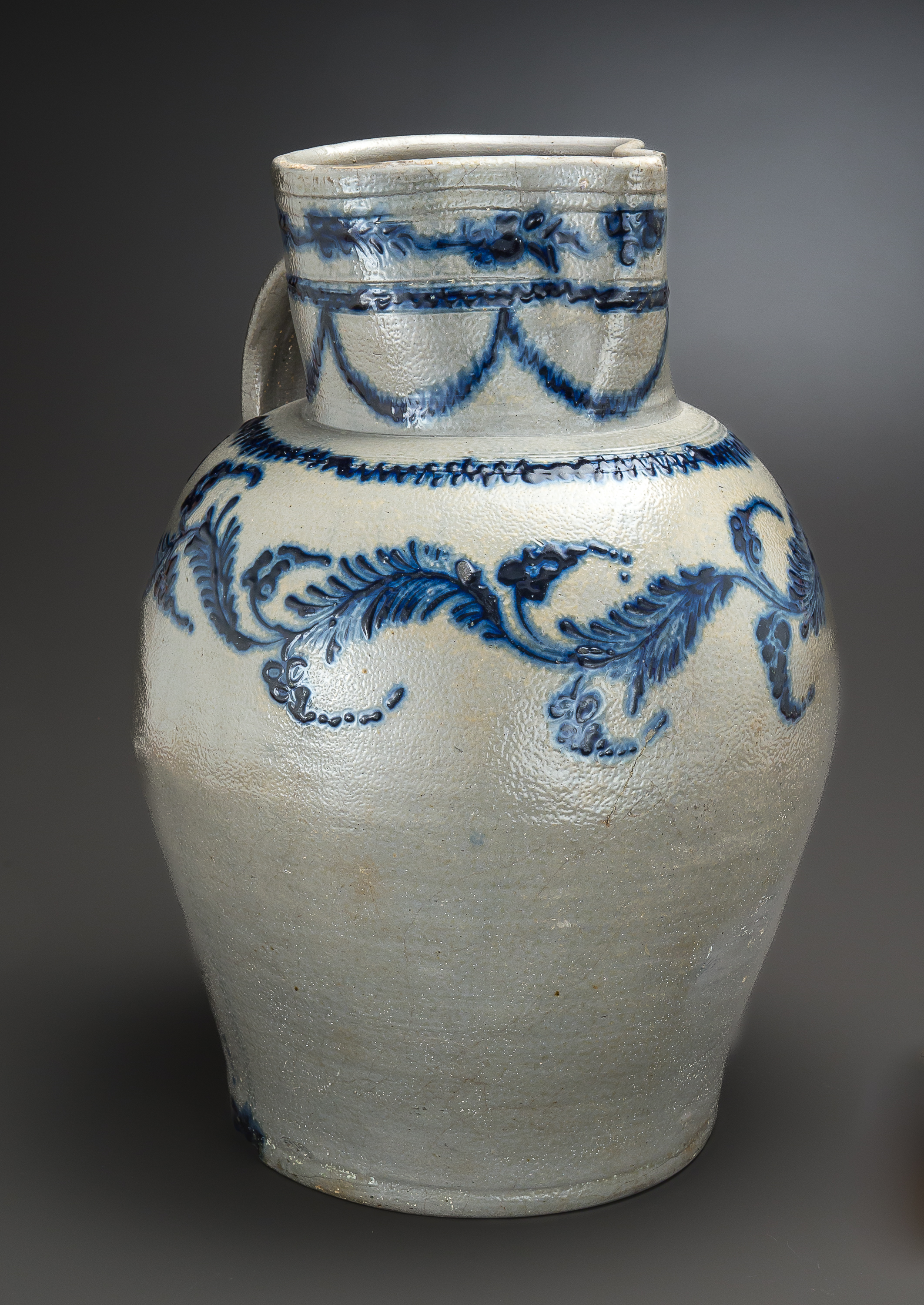
Pitcher
The form is thrown on a pottery wheel, and a pulled handle was applied to the back of the neck after the clay dried slightly. Salt glazing is a technique used by stoneware potters to create the glassy surface. When the pottery kiln reached over 2000 degrees Fahrenheit, salt was introduced to the kiln, creating a vapor. This vapor adhered to the silica in the clay, forming a glass. From the high temperature, the clay is often non-porous, or vitrified. This, combined with the salt glazing, allowed the potters to not have to apply a glaze to the interior of the vessel. It could hold liquids and not seep, unlike earthenware storage vessels.
MAKER: William H. Morgan (1796-1864) belonged to a family of Quaker potters in Baltimore that included his father, Thomas Morgan (c. 1770-1842) and his uncles, William H. Amoss (1782-1857) and Thomas Amoss (1786-1822). Thomas Morgan founded the city’s first stoneware pottery at the corner of Pitt and Green Streets in 1794. The zig-zag line of cobalt blue slip around the neck of this pitcher is a very common Morgan motif.
Kille, John E. “Distinguishing Marks and Flowering Designs: Baltimore’s Utilitarian Stoneware Industry.” CERAMICS IN AMERICA (2005): 93-132.
Zipp, Luke. “Baltimore Stoneware.” ANTIQUES AND FINE ART (Summer 2006): 154-158.