Parlor
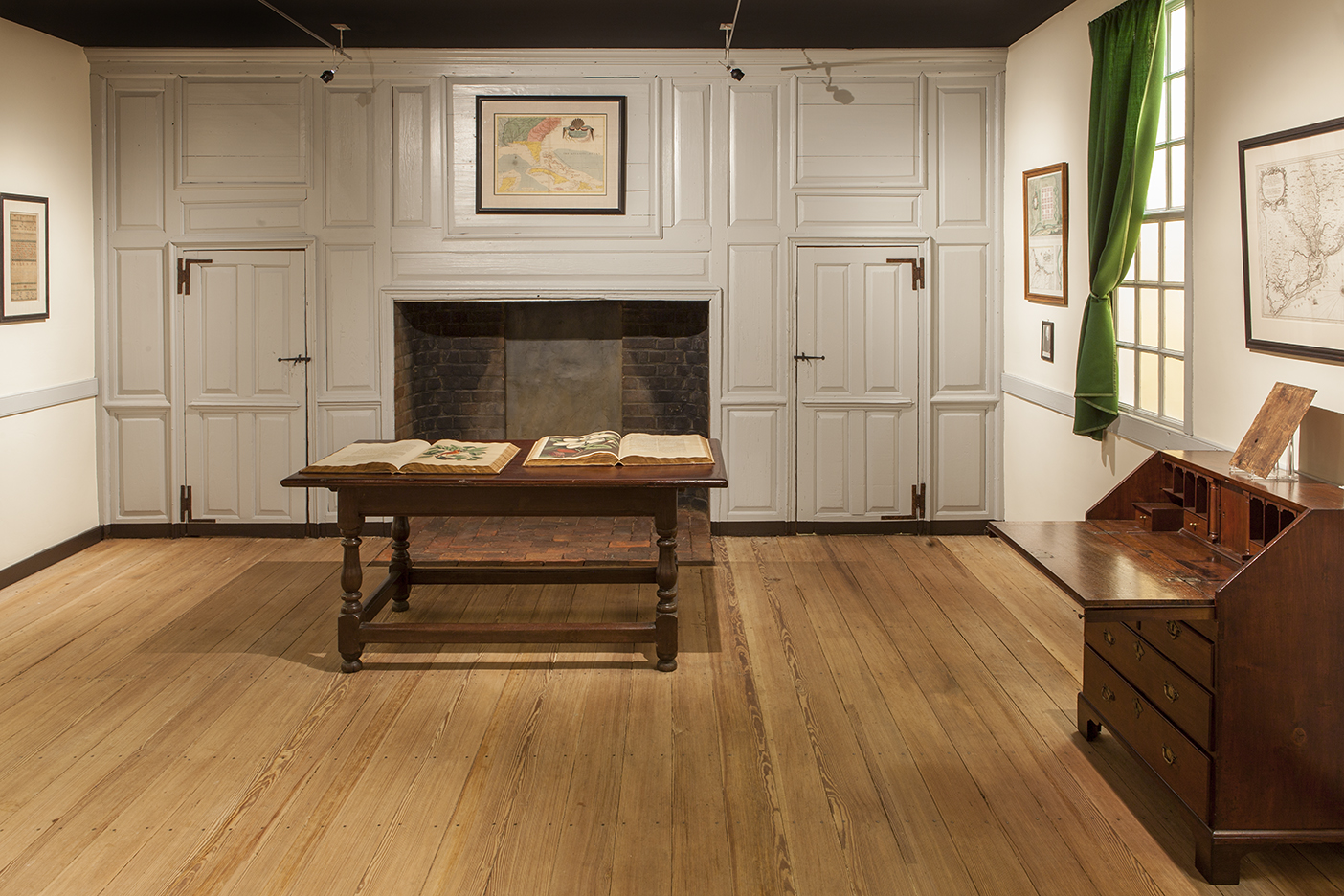
The house was documented before its collapse by Thomas Waterman, Henry Chandlee Forman, and Frances Benjamin Johnston. Sometime before 1950 the house’s brick gable ends collapsed, and a portion of the architectural woodwork from the house was salvaged by Pete Smith of Edenton, North Carolina. These fragments were acquired by Frank Horton and reassembled at MESDA before the museum opened in 1965.
Waterman documented and photographed the house for the Historic American Buildings Survey:www.loc.gov/pictures/collection/hh/item/nc0222/
It was photographed by Frances Benjamin Johnston as part of the Carnegie Survey of the Architecture of the South:
www.loc.gov/item/csas200802742/
Waterman and Johnston’s photographs only depict the house’s exterior; however, subsequent to its installation at MESDA Willis Stallings located three photographs of the house’s interior before its collapse.
Extreme weathering had removed any visible trace of original paint from the woodwork by the time it arrived at MESDA. This led to the erroneous idea that the yellow pine paneling had never been painted. Careful analysis by Susan Buck, however, found traces of early paint and concluded that the room had originally been painted a gray color. Based on Susan’s findings we painted the woodwork Benjamin Moore HC-169 Coventry Gray. Because of the extreme weathering to the wooden surface, MESDA chose to use Benjamin Moore’s alkyd enamel semi-gloss rather than handmade linseed oil paint.