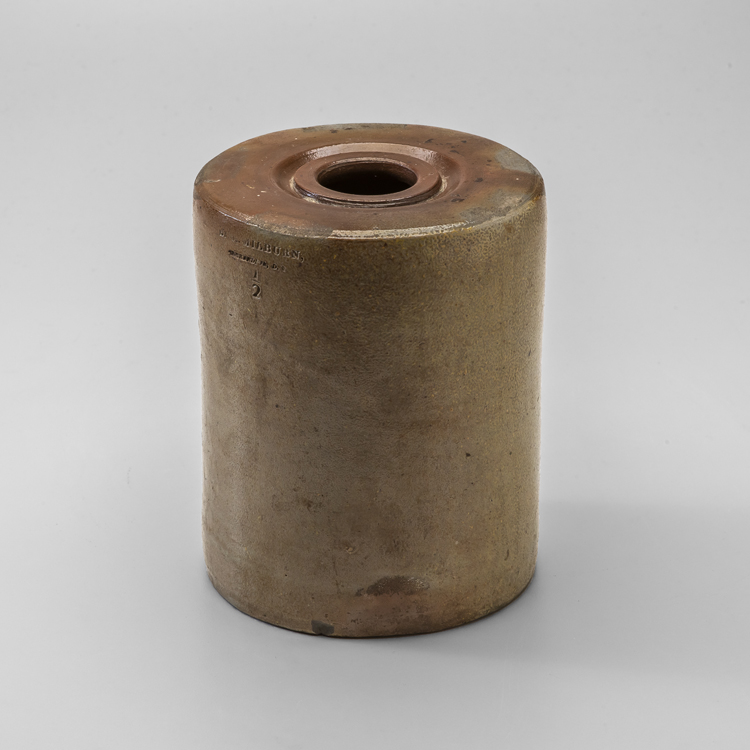
Oyster Jar
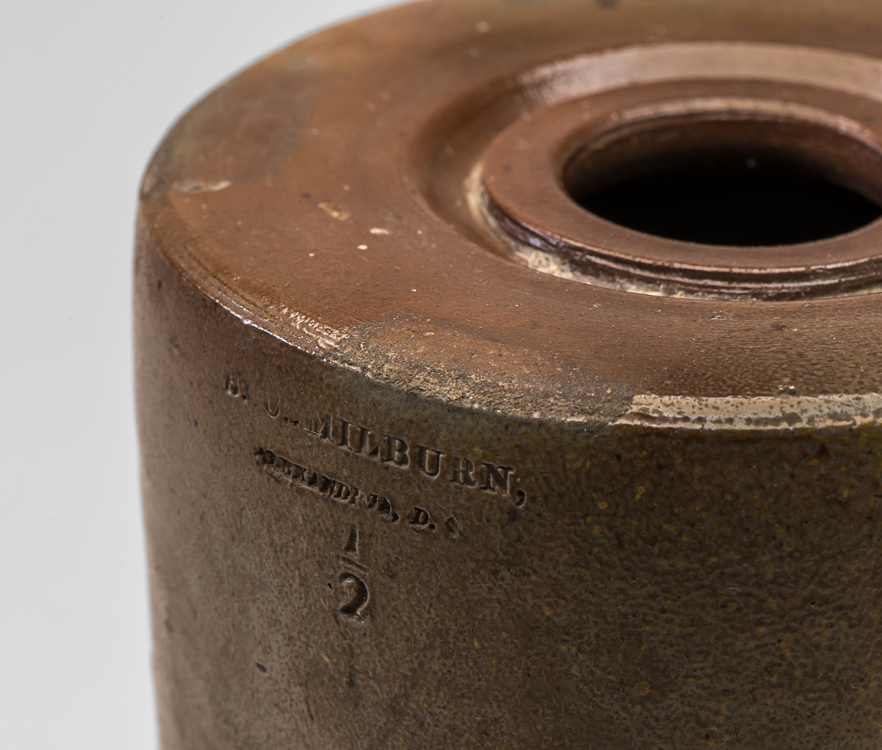
The jar was produced at the Wilkes Street Pottery in Alexandria , D.C. That’s not an error: Alexandria was part of the district until 1847, when the community voted in favor of “retrocession.” Among those who voted to join Virginia was the owner of Wilkes Street Pottery, Benedict Calvert Milburn (1805-1867).
The Wilkes Street Pottery is peppered throughout the MESDA ceramics collection: celebrated craftspeople like John Swan and free Black potter David Jarbour worked there. Jarbour created his iconic tall jar with cobalt decoration there in 1830, 10-15 years prior to the production of the oyster jar. Milburn first appears with the shop in 1831. Until 1841, his wares marked with the name of the china merchant from whom he leased the operation: H.C. Smith. Milburn purchased the Pottery in 1841, and between this year and the retrocession of 1847, he employed the B.C. MILBURN, / ALEXANDRIA, D.C. mark, while simultaneously marking wares with the names of local merchants.
This oyster jar may be the first known example of this flat top form by the pottery. Extensive archaeological and collection studies by Barbara H. Magod (“Ceramics in America” 2013, “MESDA Journal” 1995) identified range of other advertised and surviving object types. Oyster jars are notably absent. It is possible that Milburn refers to this or a similar form as “fruit jars with cork and cement” in his 1859 trade card.
Although best known for stoneware with flamboyant brushed cobalt decoration, operations like the Wilkes Street Pottery also produced unembellished utilitarian forms for special purposes. In this case, the use of the B.C. Milburn mark may have double significance. As early as 1832, B.C. Milburn was a partner in an Alexandria grocery. As Magid observes, we don’t yet know if his work as a merchant and potter overlapped, but is it notable that his son advertised a “family grocery store” in 1865. Perhaps an object like this oyster jar could have bridged the two professions.
PROVENANCE
The oyster jar was recently discovered in the loft of a wash house on Indian Stock Fort Farm in Shenandoah County, Virginia. It was found alongside the large earthenware dough bowl made in New Market, Virginia (MESDA 6114). Both may have descended from the Henkel family through Ida Henkel Painter (1878-1935) . Ida was the great-granddaughter of Dr. Solomon Henkel (1777-1847) and Rebecca Miller Henkel (1780-1854) of New Market through her father, Martin Mowrey Henkel (1857-1906).
Related objects in the MESDA Collection include copperplate engravings of Solomon Henkel’s parents, the Reverend Paul Henkel and his wife Elizabeth (Acc. 5550.4a&b), a fraktur for Siram Peter’s brother, Silon Amos Henkel (Acc. 5853), a profile portrait drawn by Silon Amos Henkel (Acc. 5163), a sideboard with a Henkel line of descent (Acc. 3350), and several examples of printed works by the Henkel Press.