Mug, Cann
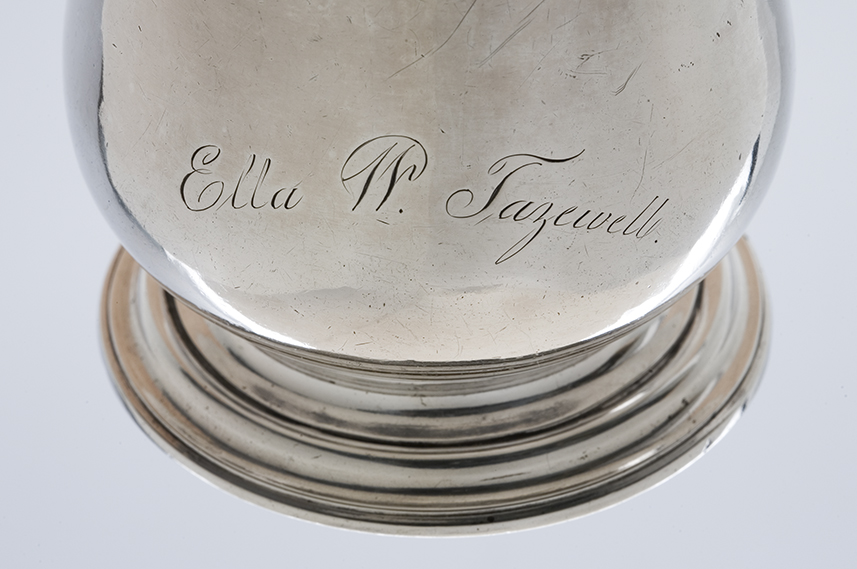
INSCRIPTION: Engraved “Ella W. Tazewell” in script on side of the body for Ella Waller Tazewell (1826-1885) of Norfolk, Virginia.
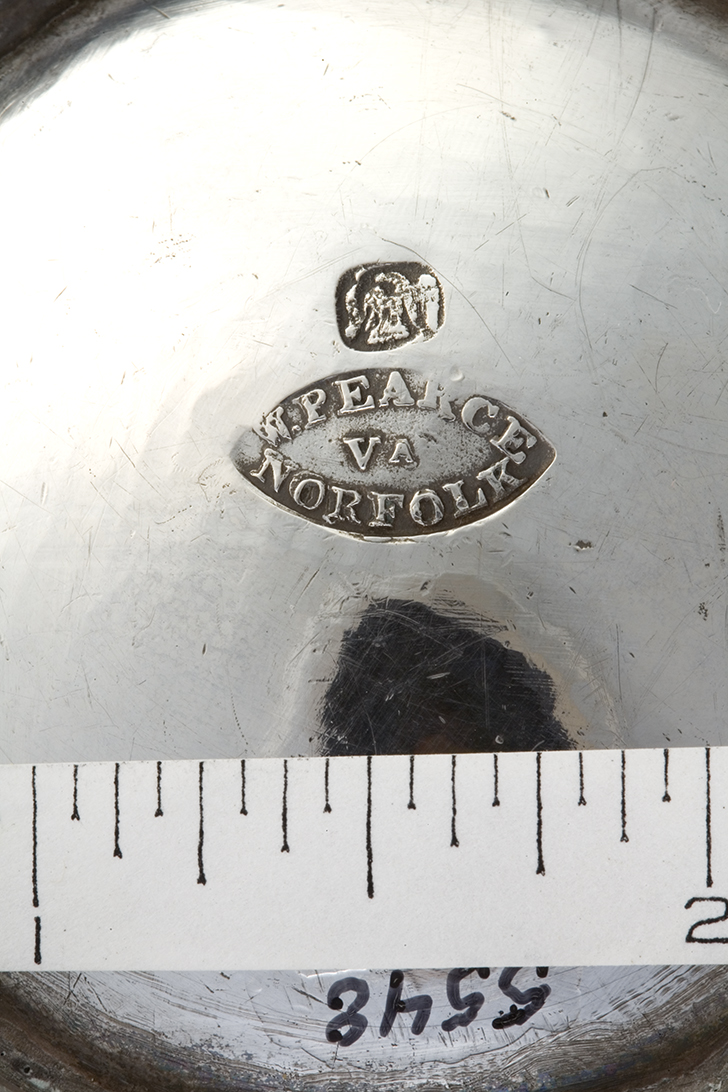
MARK: Struck on underside of body with an intaglio “W. PEARCE / VA / NORFOLK” mark in a pointed oval reserve and an intaglio, open-winged eagle within a conforming reserve struck above, possibly the manufacturer mark for John McMullin (1765-1843) of Philadelphia. Eagle marks are found on silver made in cities throughout America during the Federal period and may have been used by large manufacturers selling their wares to be retailed by other silversmiths and jewelers. Alternatively, eagle marks could simply have served as an informal national mark, similar to the lion’s head, thistle, and harp used, respectively, by British, Scottish, and Irish guild halls. See Catherine B. Hollan, “Eagle Marks on American Silver” (McLean, VA: Hollan Press, 2015), 11-12, 69.
MAKER: Walter Pearce was born in 1805 to Benjamin Pearce (b.1780) and Esther Hazard (1772-1809) of Newport Co., Rhode Island. He was living in Norfolk, Virginia by 1831 when he married Sarah Ann Slack Clarico , the widow of Norfolk silversmith Joseph Clarico (d.1828). The following year Pearce placed a newspaper notice for his own shop on Main Street, advertising jewelry and watches. Pearce and his family moved to Mobile, Alabama by 1844 when he was listed in the city directory as a silversmith with a shop on Water Street. In 1859 he was doing business as Walter Pearce & Co., a firm that remained active in Mobile through the 1867. See Catherine B. Hollan, “Virginia Silversmiths, Jewelers, Watch- and Clockmakers, 1607-1860: Their Lives and Marks” (McLean, VA: Hollan Press, 2010).
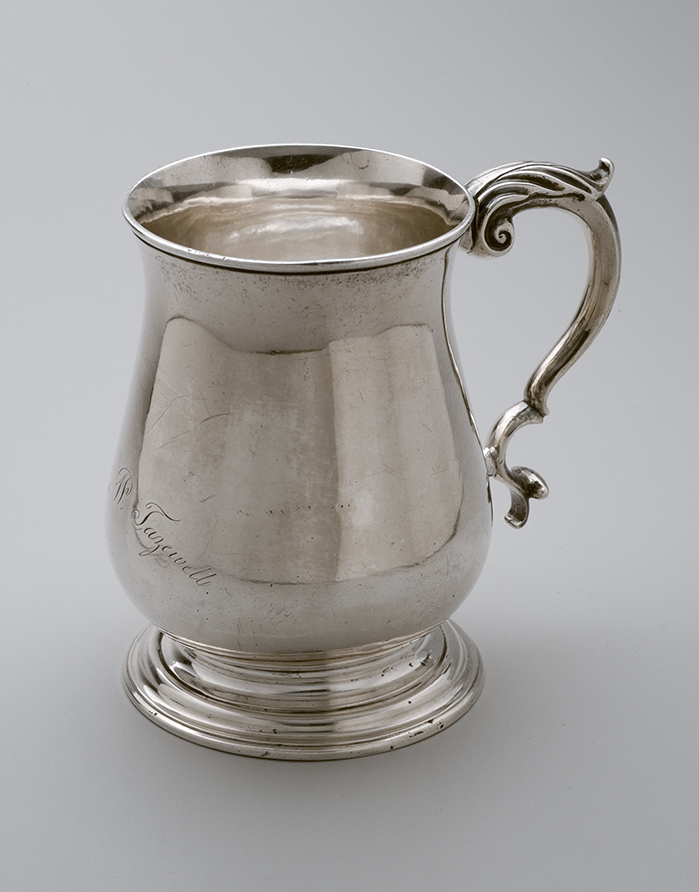
FORM: A “cann” is an eighteenth-century term for a handled drinking vessel that is larger than a cup and features a tulip-shaped body and circular foot. The form is similar in size to a mug, but mugs have straight-sided bodies rather than the tulip shape of a cann. Tankards are differentiated from canns as tankards have lids. The term “cann” lost popularity toward the end of the eighteenth century as handled drinking vessels larger than a cup became called “mugs” regardless of the shape of their bodies.