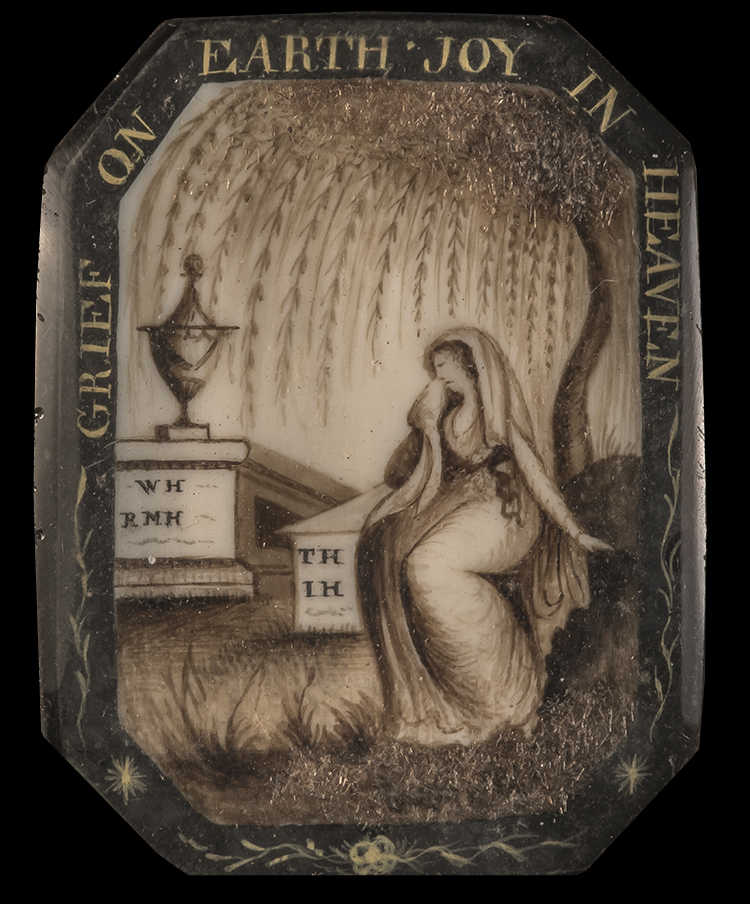
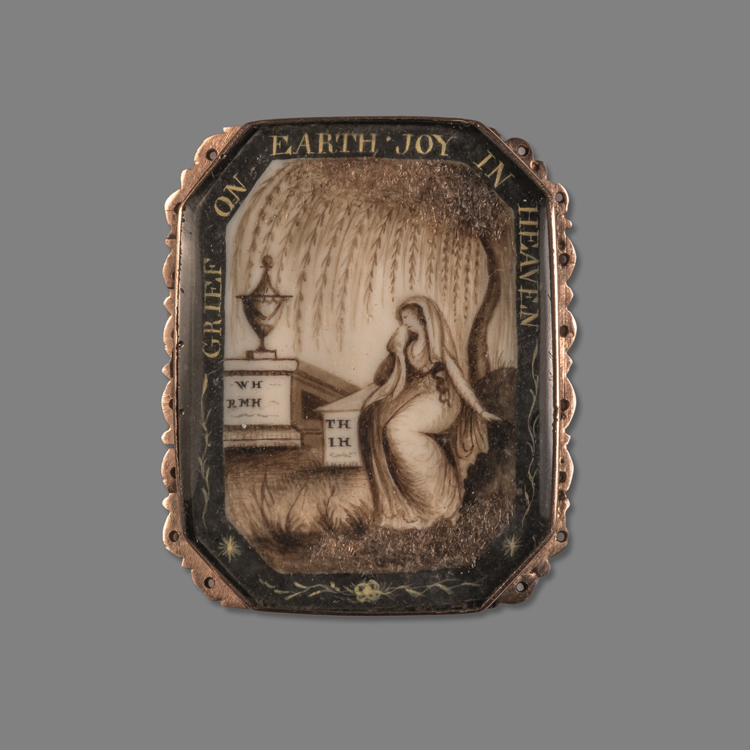
Mourning Clasp
ARTIST: This piece is attributed to the artist Samuel Folwell (1764-1813). Folwell was a miniaturist, silhouettist, engraver, and hair worker, who first appears in America in 1788. In 1793 Folwell first opened a drawing school for young ladies in Philadelphia. There he probably collaborated with his wife Ann Elizabeth (Gebler) Folwell (1773-1824). Betty Ring has noted the preeminence of the Folwell school in Philadelphia during the 1790s.
To supplement his income, Samuel Folwell traveled up and down the coast—from New Hampshire to Georgia—selling needlework picture patterns and painting miniatures. The pose of the figures, their facial features, and certain background details relate to some of the surviving needlework and watercolor pieces from the Folwell school.
RELATED OBJECTS: One of a pair of mourning clasps made for Ann (Moodie) Houstoun. The other clasp commemorates Ann’s parents Thomas (1719-1777) and Jean (McKenzie) Moodie (1727-1761) and her mother-in-law, Lady Priscilla (Dunbar) Houstoun (1711-1775).
MESDA also owns a miniature portrait of Ann (Moodie) Houstoun by Esther “Hetty” (Sage) Benbridge (MESDA acc. 3353.2) and a miniature of her husband Sir George Houstoun attributed to the British artist George Engelheart (MESDA acc. 3353.1).
Together, MESDA’s four Houstoun-family miniatures tell the three-generation story of an important early Georgia family, from the founding generation to their grandchildren. Thematically, they demonstrate the role of marriage and death in early American family life, and present a compelling woman’s story about the life of Lady Ann (Moodie) Houstoun.
The Museum also owns another work by Folwell, a mourning miniature for Peter Epes Doswell of Nottoway County, Virginia (MESDA acc. 3187.2).