Medal
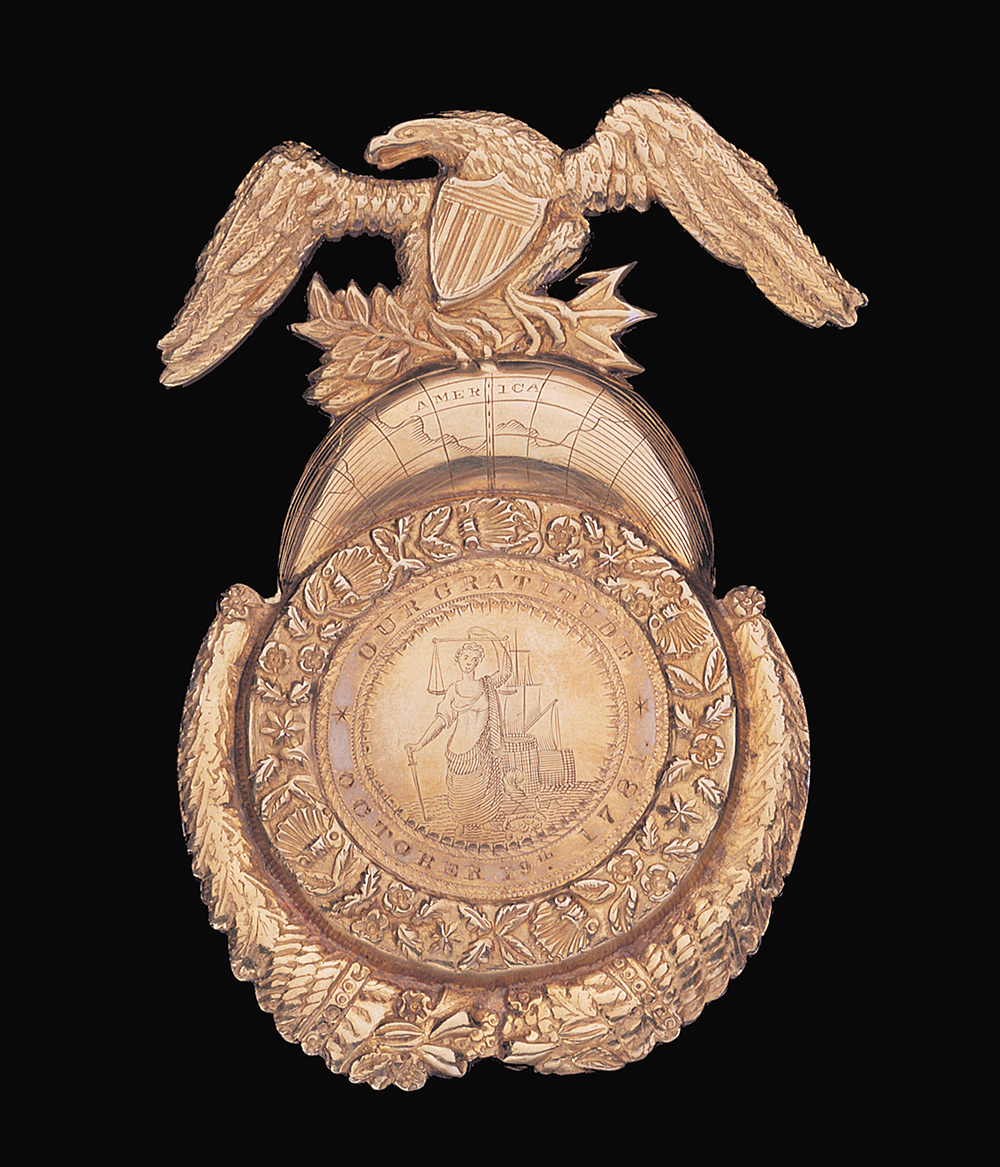
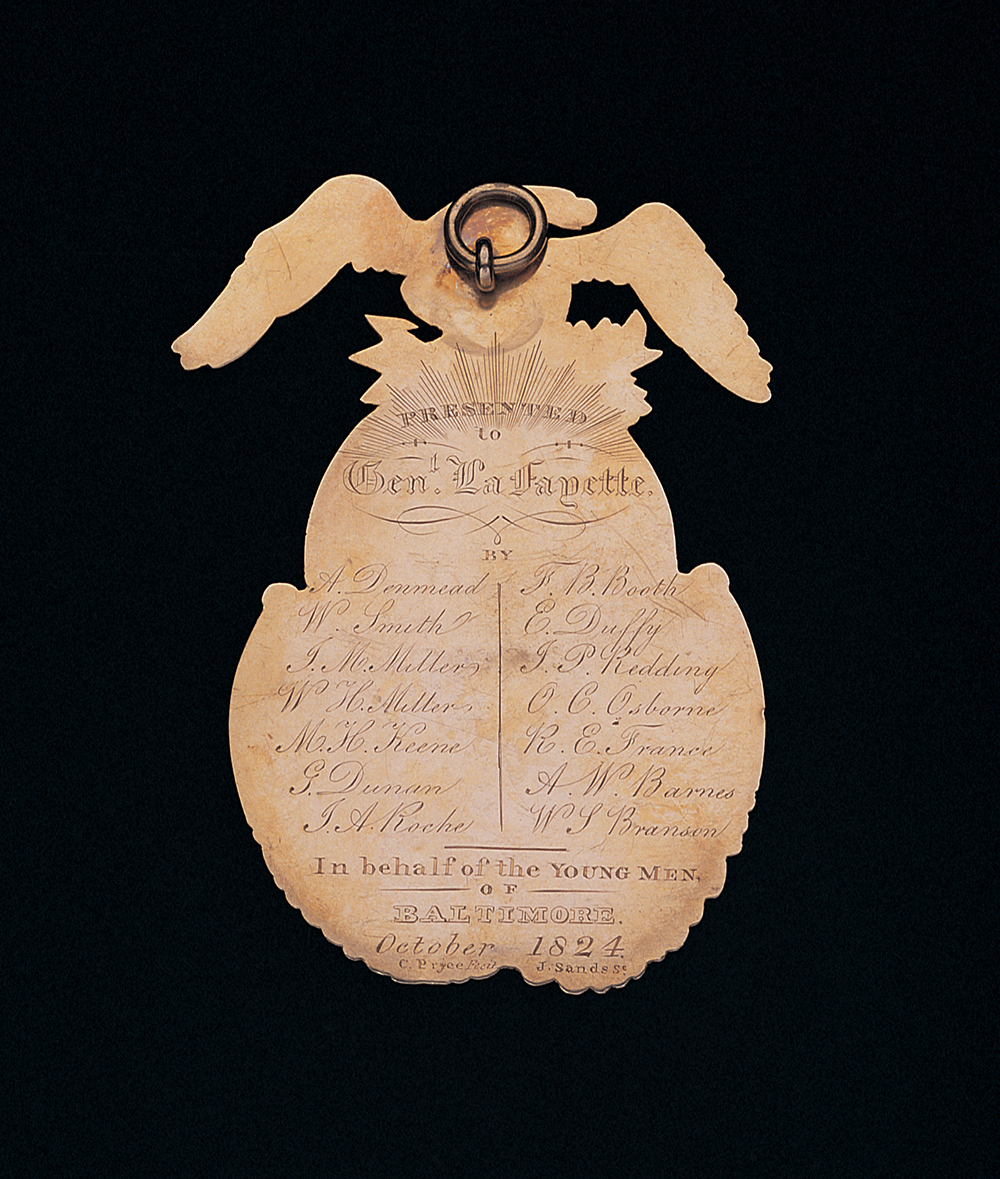
INSCRIPTION: Engraved on reverse: “Presented to / Genl. Lafayette / by / A. Denmead / W. Smith / T.M. Miller / W.H. Miller / M.H. Keene / G. Dunan / T.A. Roche / F.B. Booth / E. Duffy / T.P. Redding / O.C. Osborne / R.E. France / A.W. Barnes / W.S. Branson / In behalf of the YOUNG MEN / OF / BALTIMORE / October 1824 / C. Pryce Fecit / J. Sands Sc.” Engraved on face: “Our Gratitude / October 19th, 1781.”
MARK: Engraved at bottom on reverse: “C. Pryce Fecit / J. Sands Sc.”
CONTEXT: This medal was presented to General Lafayette (1757-1834) on 11 October 1824, during his visit to Baltimore. Lafayette revisited the United States in 1824-1825 and was greeted as one of the last living heroes of the American Revolution. In Baltimore the Marquis de Lafayette was given this extraordinary gold medal, which he wore throughout his visit suspended from a ring on a blue sash. The medal was made by Charles Pryce (w.1824-1834) and engraved by John Sands (w. 1824) and was presented by fourteen men on behalf of the “young men of Baltimore.”
MAKER: Charles Pryce (or Pryse) was working in Baltimore as early as 1824, according to a 23 October account in the Niles Register, which states that the silversmith produced a gold medal presented in Baltimore to General Lafayette. No other documentation links Pryce to that city. An advertisement in the National Intelligencer of Washington for 19 February 1834 states that Pryce “has located himself at his old stand on Pennsylvania Avenue between 12th and 13th streets, where he continues to manufacture all articles in his line, such as richly-chased coffee and tea sets, pitchers, mugs, cans, tumblers, spoons of all descriptions….and would inform the public that he is the ONLY MANUFACTURER of Silver Plate in this district” (Jacob Hall Pleasants and Howard Sill, “Maryland Silversmiths, 1715-1830” [Baltimore, MD: Lord Baltimore Press, 1930], p. 171).
ENGRAVER: John Sands worked as an engraver in Baltimore, Maryland. He engraved copper plates for sheet music, watchpapers, book illustrations, and trade cards. In addition to his work on the medallion given to General Lafayette (MESDA Acc. 2380) he is documented as the engraver of a watchpaper for Frederick, Maryland clockmaker John Fessler (MESDA Object Database file S-9605). Sands married Elizabeth Warner Smick, the widow of jeweler Peter W. Smick, in July 1824. Elizabeth’s father Cuthbert and brothers Charles, Thomas, and John Warner were all master silversmiths in Maryland.