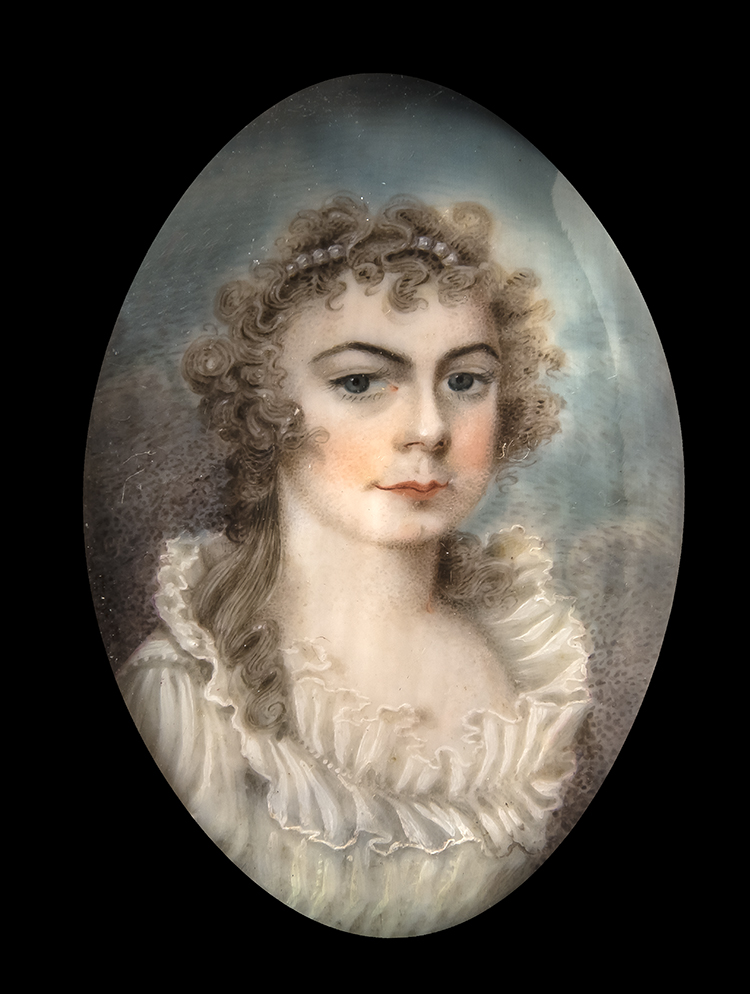
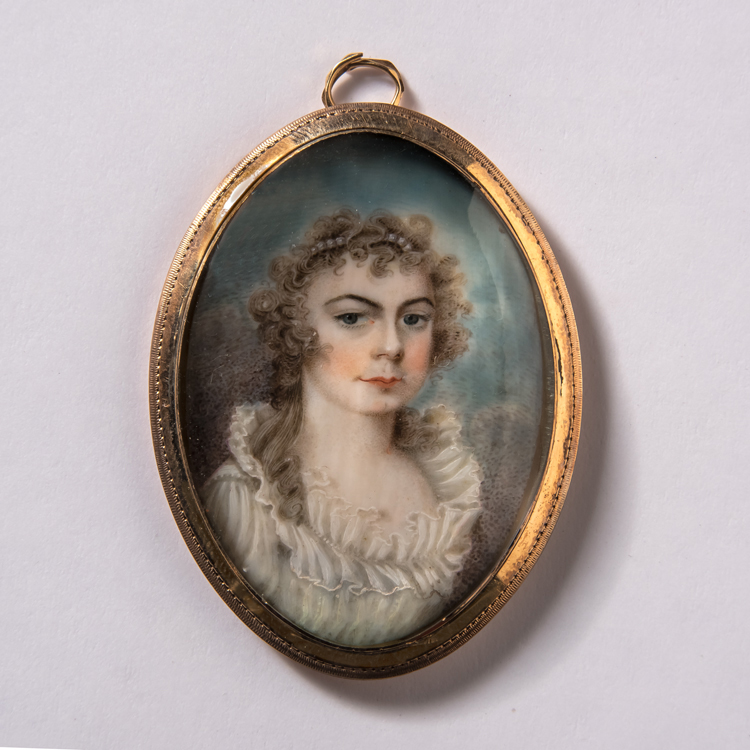
Mary (Goode) Spotswood
Case: HOA: 6 3/8″; WOA: 5 3/4″
A noted Richmond belle, in 1795 Mary Goode married John Spotswood (1774-1835) of “Orange Grove” near Fredericksburg, a great- grandson of Virginia Governor Alexander Spotswood. This portrait could have been painted at the time of her marriage or shortly thereafter. Mary and John Spotswood had seven children including Mary Bland Spotswood (1805-1886) quoted above who married John Estave Lemoine (1798-1872) of Alexandria in whose family this portrait descended.
ARTIST: This portrait miniature is a rare example of a signed miniature by Lawrence Sully (1769-1804), the elder brother of artist Thomas Sully (1783-1872). Lawrence Sully was born in Kilkenny, Ireland to actors Matthew and Sarah Chester Sully. The family moved to Horncastle, England, and then to America, where they briefly settled in Richmond, Virginia. On September 26, 1792, Sully first advertised as a “Miniature Painter (and Student of the Royal Academy, London).” The artist stated that his miniatures were “warranted never to fade.” Though his family would before move on to New York and Charleston, South Carolina. Lawrence chose to remain in Virginia, painting miniatures in Richmond, Norfolk, and Petersburg.
In 1793, Sully married Sarah Annis of Annapolis, Maryland. In 1801, Sully advertised a plan to open a drawing school in Richmond, but he may have moved to Norfolk before achieving this goal. Sully suffered from financial difficulties. Tradition says that he was killed in a fight with some sailors. After his death, his brother Thomas, whom Lawrence had taught and who would eventually surpass him in fame, married his widow Sarah.
REFERENCES:
G. Brown Goode “in the book “Virginia Cousins: A Study of the Ancestry and Posterity of John Goode of Whitby” (Richmond, Virginia: J. W. Randolph & English, 1887)
DESCRIPTION: Watercolor on ivory miniature portrait of a woman with light brown hair and tendrils cascading down her shoulders. She appears to have two pearl encrusted combs in her hair. Dark eyebrows accentuate her dark blue eyes that are almond shaped with heavy lashes. Her cheeks and lips have a peach-pink tone. She is wearing a cream colored dress with a ruffled neck and pearl accents. The background is blue in the upper portion and the lower portion is brown. The ivory portrait is set inside an oval brass frame with scalloped beveled detailing along the edge, and a small ring for hanging.