Martha (Galphin) Milledge

Artist/Maker
Peale, James (attributed)
Place Made
Washington District of Columbia United States of America
Date Made
1800-1810
Medium
gold, ivory, glass, hair –brass
Dimensions
HOA: 3 5/8″; WOA: 2 1/2″
Accession Number
4392
Description
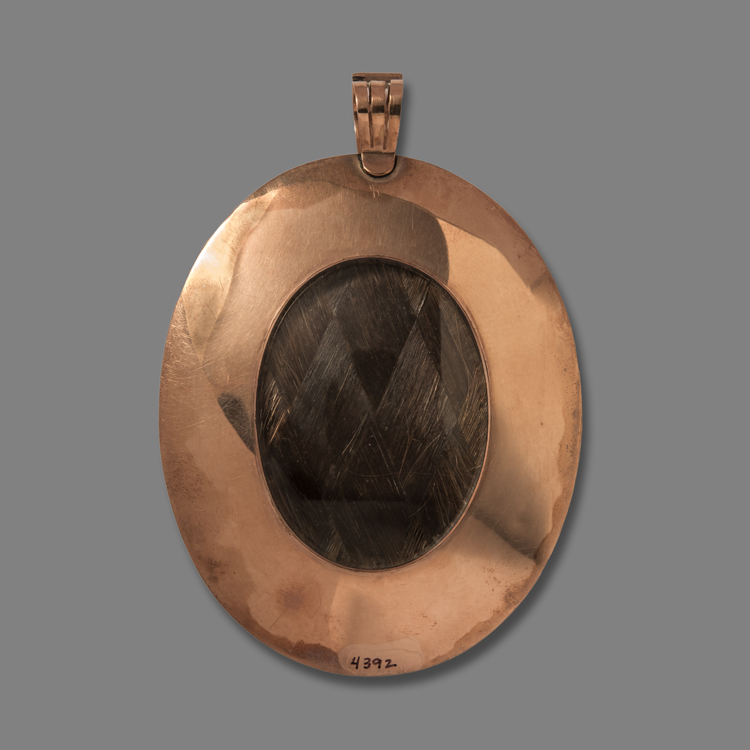
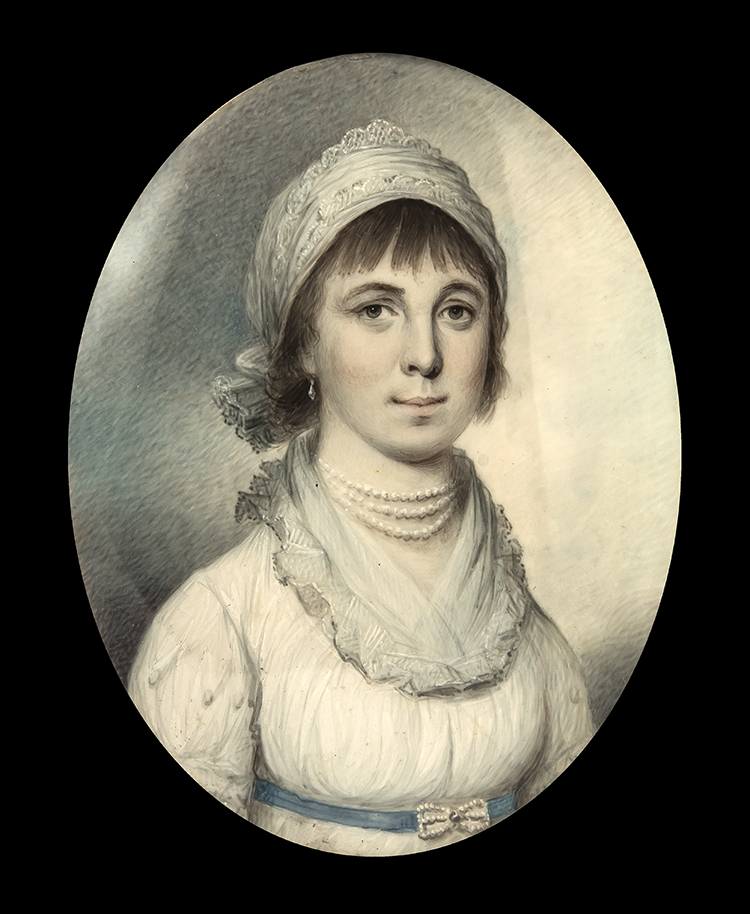
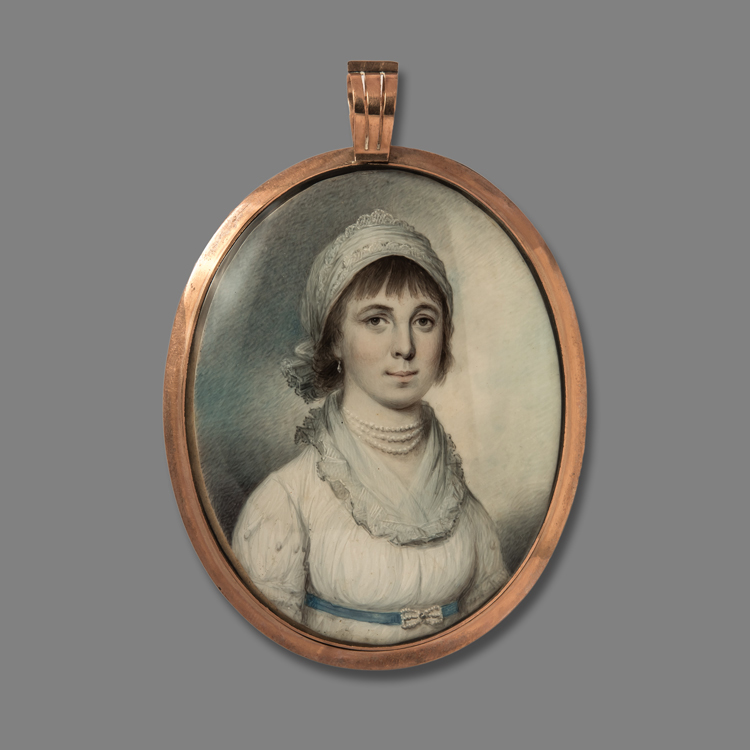
DESCRIPTION: Oval pendant framed miniature of a woman with brown hair and brown eyes facing slightly to the right (three quarters sinister). She is wearing a white lace-trimmed bonnet and dress with lace fichu, three strands of pearls around her neck, a diamond shaped earring visible on her left ear, and a blue belt with pearl bow-shaped buckle. The background is sky blue to her right and white to her left. The miniature is in a gold pendant frame with a pierced ring at the top and a beveled glass inset in the back over a woven brown hair inset.
History
SITTER: Martha (Galphin) Milledge (1764-1811) was the daughter of a well-known Indian trader, George Galphin (1709-1780) and his wife Rachel Dupree. A native of Ireland, Galphin established a trading post at Silver Bluff, South Carolina about 1752, and there he built the first brick house in that region in 1767. Silver Bluff borders the Savannah River, slightly downriver from Augusta. During the Revolutionary War his house was used as a fort and came to be known as Fort Galphin.

Martha Galphin married John Milledge (1757-1818), whose father had been one of the original settlers of Georgia in 1733. Milledge served as a U.S. congressman from Georgia from 1792-1802, governor of Georgia from 1802-1806, and in 1803 the city of Milledgeville was created and named in his honor as the new capitol city of Georgia. John and Martha lived at Overton, their plantation near Augusta. From 1806-1809, John served as a U.S. Senator, but records indicate that Martha’s illness forced his retirement from public life in 1809. They are buried in the Milledge family cemetery outside Augusta.

Martha’s portrait was probably painted by the famous miniaturist James Peale (1749-1831) during her husband’s congressional service in the nation’s capitol.
Artist Biography
ARTIST BIOGRAPHY: The miniature is attributed to James Peale (1749-1831), brother of Charles Willson Peale. After the Revolutionary War, Charles decided to stimulate the market for portraits and divided the painting profession with James. Charles reduced competition by referring miniature commissions to James, and encouraged his own oil portrait commissions by reducing the price for them. James is said to have “painted in the South as well as the Middle States” (Ann Hollingsworth, HEIRLOOMS IN MINATURES, p. 96), but so far there is only documentary evidence that Rembrandt and Raphaelle Peale painted in Charleston, SC. This miniature could have been painted in the Washington, DC area while John Millegde was serving in the Senate. In the MESDA photo files there is at least one miniature of a SC subject, signed and dated by James Peale (PWL).
Credit Line
MESDA Purchase Fund