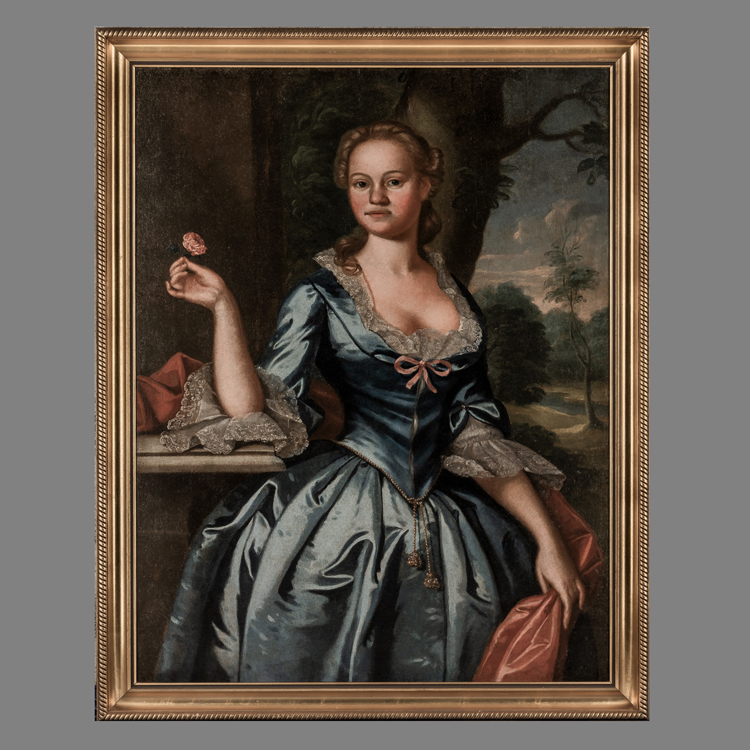
Martha Corbin (1738-1792)
Artist/Maker
Hesselius, John
Place Made
possibly Caroline County Virginia United States of America
Date Made
Circa 1755
Medium
oil on canvas
Dimensions
HOA: 47”; WOA 36”
Accession Number
6104
Description
Portrait of teenage girl in a three-quarter pose head slightly towards left, dress in rococo style with lace around low cut neckline, three quarter sleeves, bows on sleeves and bodice, cord at waist, right arm resting on column and hand holding flower, left hand holding fabric at side, landscape in background.
The subject, Martha Corbin (1738-1792), was the daughter of Leticia Lee and John Corbin of “Portabago,” Caroline County, Virginia. She was the sister of Janie Oakie Corbin and Gawin Corbin, who were also painted by John Hesselius (see MESDA object database S-4670). Martha married John Turberville of “Hickory Hill” in 1769. The couple had many children – the numbers vary – but perhaps as many as 10 before Martha’s death in 1792. Although John remarried, he requested at his death in 1799 that he “may be buried by my dearest wife Mrs. Martha Turberville deceased at the place I have reserved between her grave and the middle walk in my back garden at Hickory Hill.”
History
MRF_4671
Artist Biography
ARTIST: John Hesselius (1728-1778) was one of the major American-born artists woring in the Middle Colonies and the South in the third quarter of the eighteenth century. The son of Gustavus Hesselius, a Swedish painter who came to America in 1711, John was probably born in Philadelphia. His earliest signed work is dated 1750 and is now at Williamsburg. The latest signed work known dates 1777. During his career, Hesselius travelled extensively in Virginia, Maryland, Delaware, Pennsylvania, and possibly in New Jersey. His work seems to have been confined to portraits. All known examples are in oil on canvas, and there is little reason to suspect that he deviated from this practice. He worked exclusively in the late English Baroque and English Rococo traditions of painting, and his style shows the influence of Robert Feke and John Wollaston more strongly than that of his father. Hesselius marrried Mary Young Woodward, the widow of Henry Woodward, in 1763, and after that date his energies were divided between his art and the management of his plantation near Annapolis, Maryland. He was also active in the religious affairs of St. Anne’s Parish in Anne Arundel County, Maryland. His interests appear to have been many, and as an artist and landowner he associated with most of the leading citizens of the colony. Hesselius contributed to American painting, and he extended and modified the English tradition of painting in the Colonies.
Credit Line
Gift of Hudnell and Claire Christopher