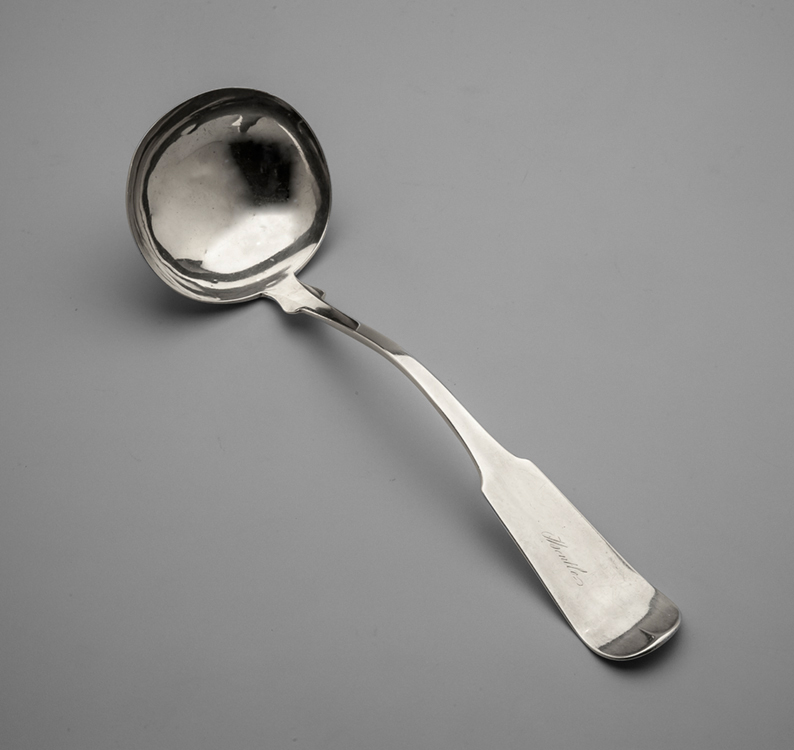
Ladle
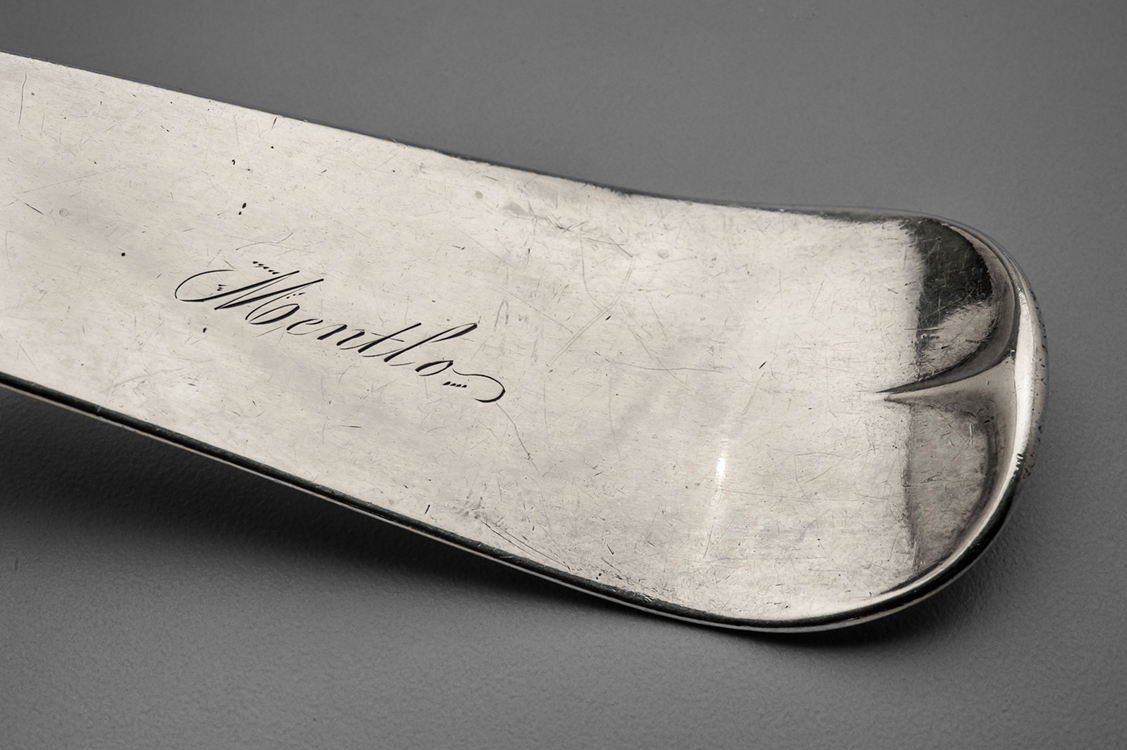
INSCRIPITON: Engraved on face of handle with the name “Mentlo” in script letters.
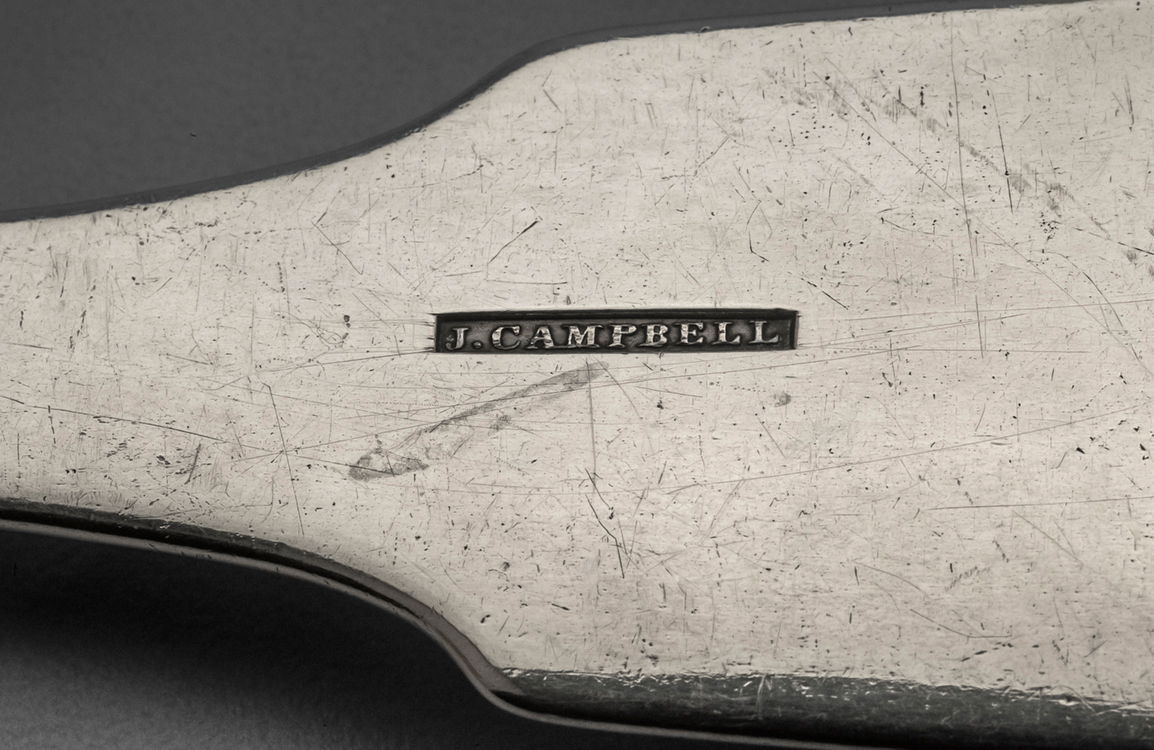
MARK: Struck on reverse of handle with an intaglio “J. CAMPBELL” mark in a rectangular reserve.
MAKER: John Campbell (1803-1875) was born in Scotland and emigrated to the United States as a boy or young man. He began an apprenticeship in 1820 under silversmith John Selph (d.1838) in Fayetteville, North Carolina. By 1827 the men were working together as the firm Selph & Campbell but they dissolved their partnership in 1829. Campbell worked in partnership with Warren Prior (1811-1909) from 1834 until he announced his intent to move to Nashville, Tennessee in 1836. Once he arrived in Nashville, Campbell formed a one-year partnership with John Peabody (1792-1850). That same year, 1836, Campbell was part of a group of nine craftsmen that formed the “Association of the Watch-Makers, Silversmiths & Jewellers of Nashville.” The association established price guidelines for the manufacture and repair of clocks, watches, silver, and jewelery, all recorded in Campbell’s ledger book now at MESDA as part of the Thomas A. Gray Rare Book and Manuscript Collection (call number TAG.096.1). Working independently from 1837 until 1849, Campbell grew his business and advertised his services as a clock and watchmaker and repairer, jeweler, and gold and silversmith. By the end of the 1840s he again began working in partnership, first as Campbell & Stevens (the first name of Stevens is unknown) and then from 1853 to 1855 with the New York-born George Washington Donigan (1824-1864). The 1857 Nashville city directory listed Campbell’s residence but no occupation. The year before he had purchased 206 acres and a house in Franklin, Tennessee, located twenty miles south of Nashville. Campbell died in Franklin at 72 years of age. See Benjamin H. Caldwell Jr., “Tennessee Silversmiths” (Winston-Salem, NC: Museum of Early Southern Decorative Arts, 1988) and George Barton Cutten and Mary Reynolds Peacock, “Silversmiths of North Carolina, 1696-1860”, 2nd rev. ed. (Raleigh: North Carolina Department of Cultural Resources, Division of Archives and History, 1984).
FORM: Large silver ladles were popular for serving punch or soup. Most had plain hemispherical bowls, others were round, and a few had scalloped or shaped bowls. Smaller ladles of silver were most often designated for serving sauces and gravy.