Jug

Artist/Maker
Phoenix Factory
Place Made
Aiken County South Carolina United States of America
Date Made
1840-1842
Medium
stoneware –alkaline-glazed
Dimensions
HOA: 21 1/2″; WOA: 15 1/4″
Accession Number
1054.3
Description
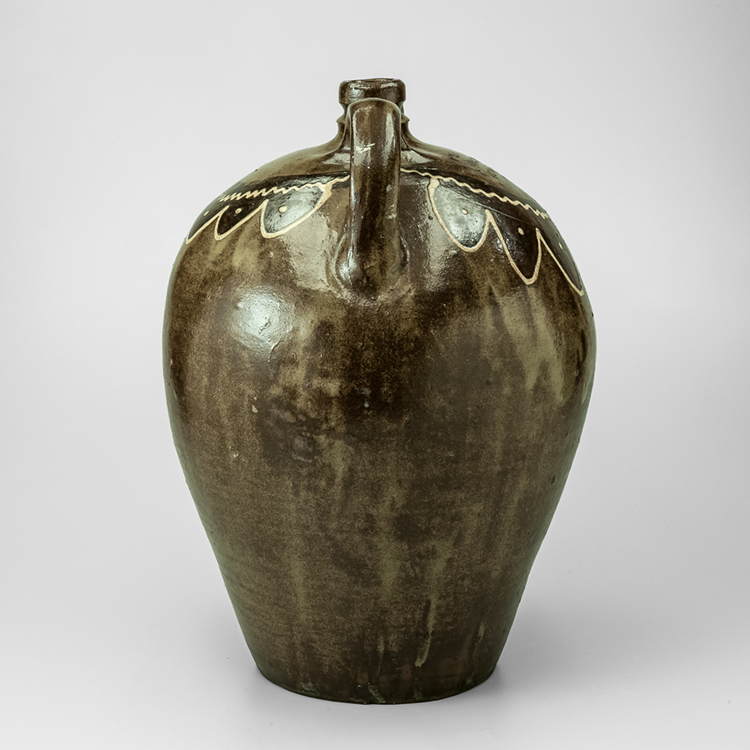
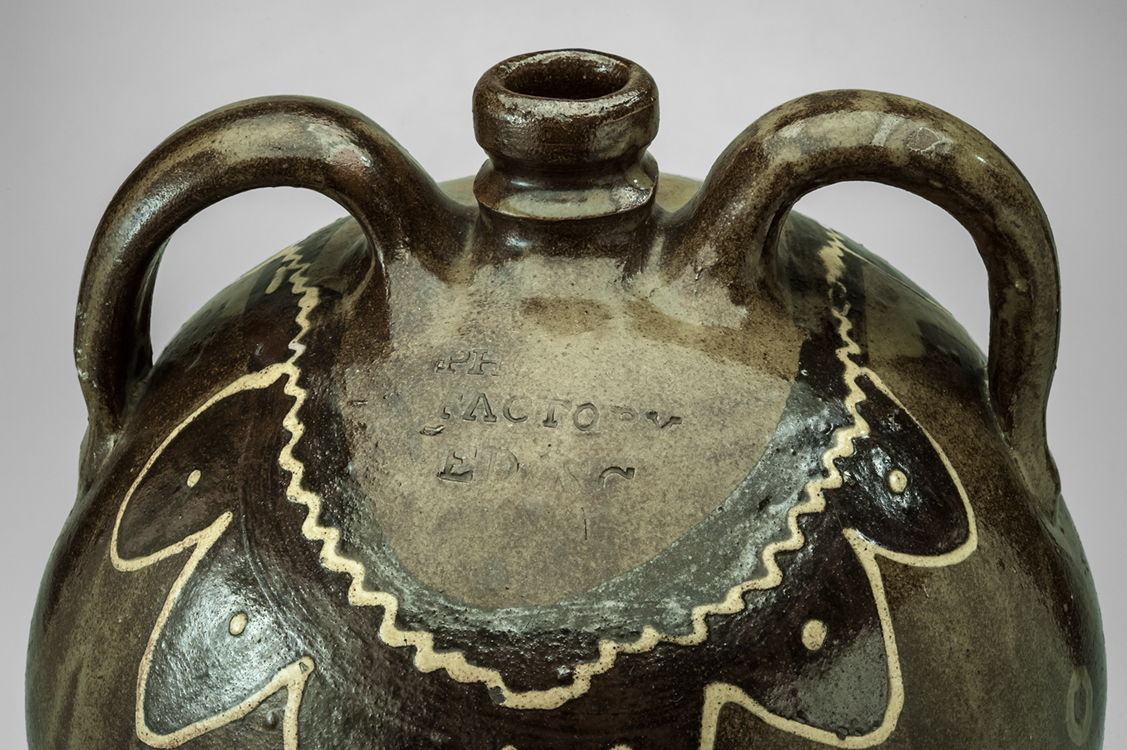
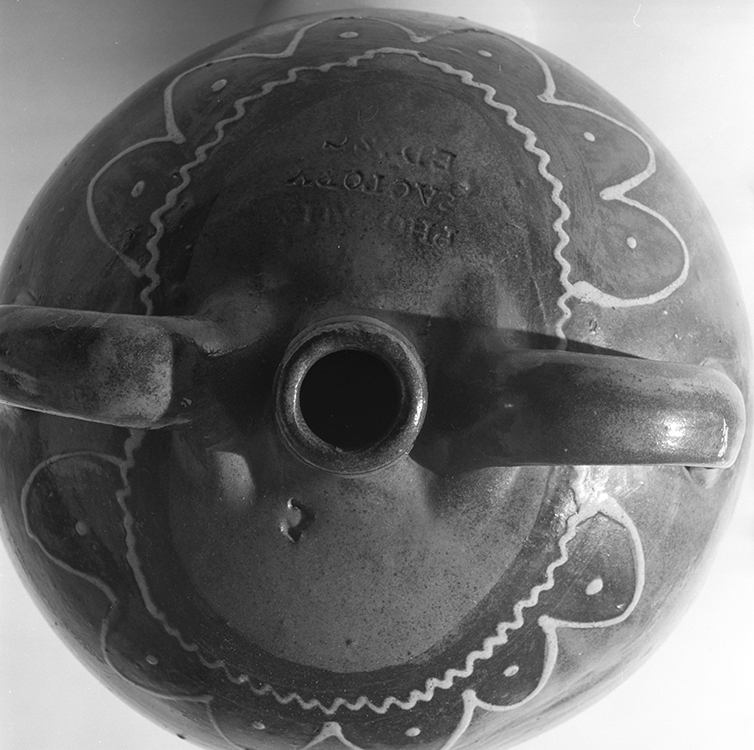
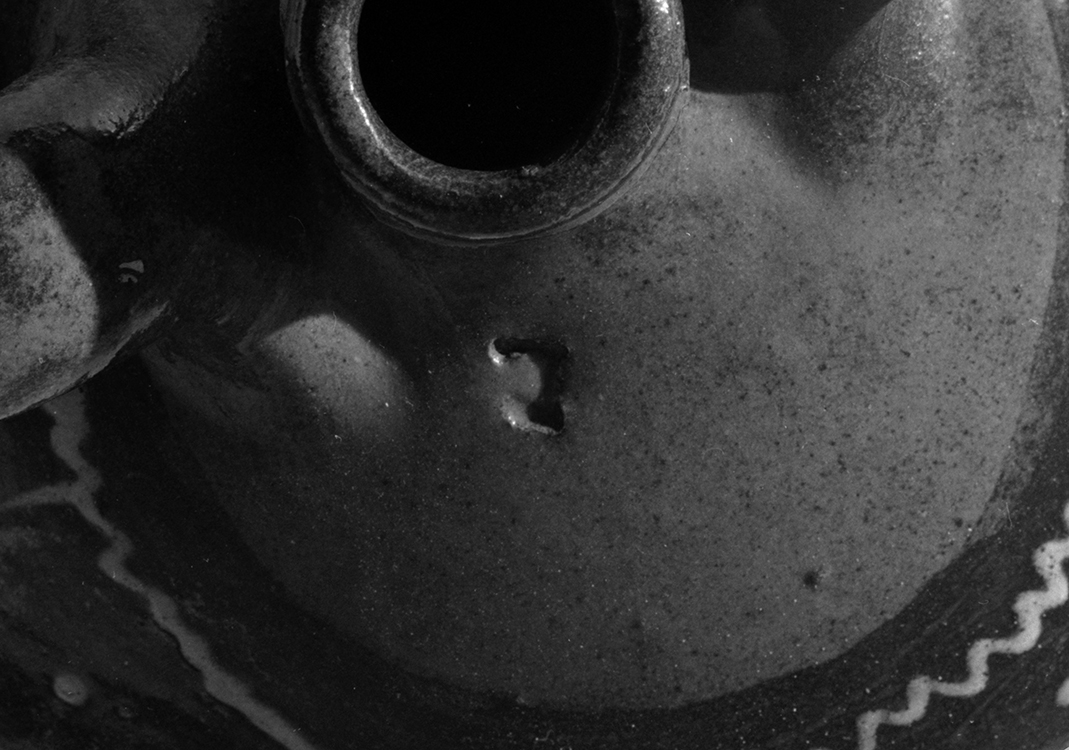
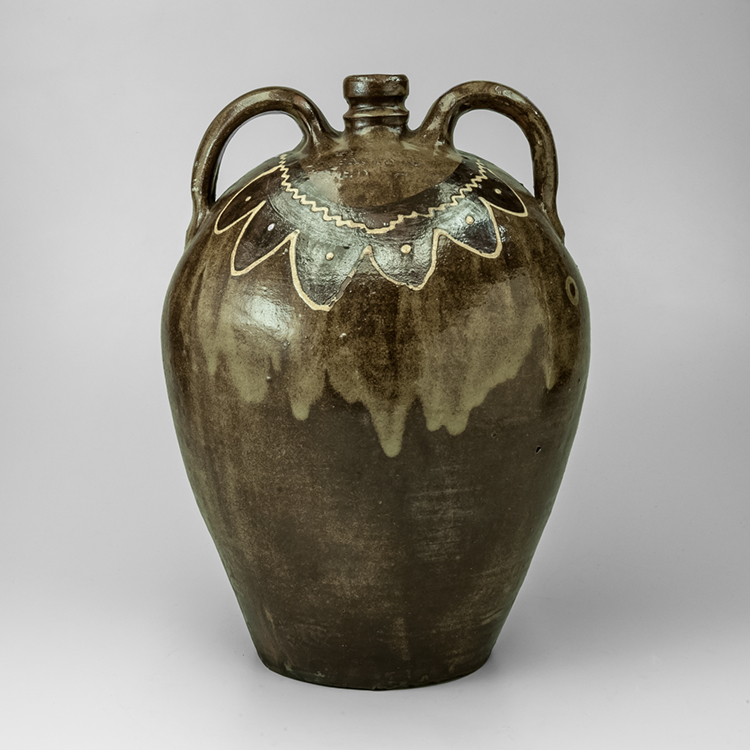
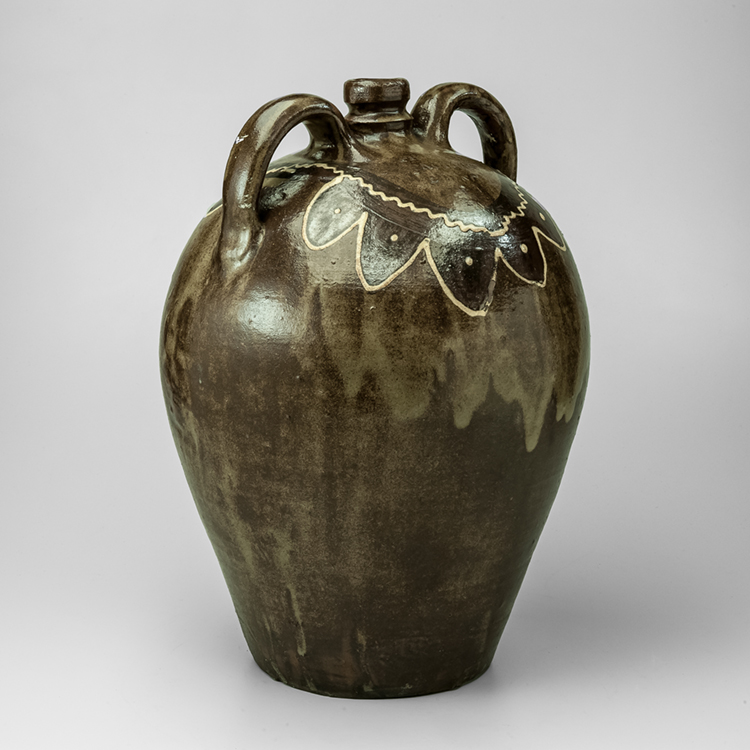
This wheel-thrown, ovoid, stoneware jug is inscribed “PHOENIX / Factory / ED.SC” and is glazed with a rich, undulating deep green alkaline glaze. An alkaline glaze involves a mix of clay and ash or lime that acted as a flux. Many scholars note that the Phoenix Factory was where slip decoration to a large degree began to be employed, and some of the more illustriously decorated pieces from the Edgefield area are often associated with this site. A brown wash is brushed beneath the white slip-trailed decoration that encircles the shoulder of the jug. Opposite the shoulder from the Phoenix Factory inscription is a stamped “L,” possibly for potter Amos Landrum who worked at the Phoenix Factory. Two opposing strap handles stand prominently on the shoulder of the jug. A strap handle is made by pulling or extruding a strip of clay, placing one end of the strip against the vessel, then looping it out to make the handle shape. This differs from a handle that is pulled from the vessel after the clay is attached.

STYLE: Much of the stoneware produced in Edgefield from about 1840 to 1860 was decorated with clay slip which was brushed or trailed onto the dried ware before it was fired. Decoration was applied to stonewares produced at the Phoenix Factory and the C. Rhodes Factory on Shaw’s Creek. The Edgefield decorative tradition appears to have originated at the Phoenix Factory where a kaolin based clay slip and an iron bearing clay slip were often combined to create figures, scenes and floral motifs. The clay slip decoration was applied to the wares before firing. Loops and swags, sometimes punctuated by tassels or flowers, were a common Edgefield decorative motif. The dominant decorative motif found on wares produced at Collin Rhodes’ factory was the maker’s mark, “C. Rhodes Factory,” boldly lettered in longhand in trailed slip and framed by a flower with stem, also in clay slip.

MAKER: The Phoenix Factory was built on the site of the former Shaw’s Creek pottery factory in Aiken County, South Carolina, just south of Edgefield. The Phoenix Factory had a number of potters working together including Thomas Chandler, Collin and Milton Rhodes, John Isaac Durham, William Durham, Robert Mathis, and Amos Landrum. The Phoenix Factory, however, was short lived, closing in 1842.

Wingard, Philip. “From Baltimore to the South Carolina Backcountry: Thomas Chandler’s Influence on 19th-Century Stoneware.” CERAMICS IN AMERICA (2013) 52-53.

Baldwin, Cinda K. “Great and Noble Jar: Traditional Stoneware of South Carolina.” Athens, GA: UGA Press, 1993.
History
AFRICAN AMERICAN HISTORY: It should be noted that enslaved craftspeople played a major role in the development of Edgefield stoneware since they were a significant portion of the labor force in Edgefield stoneware factories. Enslaved individuals were often named in court proceedings and newspaper advertisements involving transfer of ownership of the factories. The most frequently named occupation for enslaved potters was turner, but they most certainly participated in all aspects of stoneware production. Many factory owners such as Collin Rhodes used enslaved craftspeople in the pottery factories.
Artist Biography
MAKER: Collin Rhodes became a major figure in Edgefield stoneware production in the third and fourth decades of the nineteenth century. In addition to his interest in the Pottersville factory from 1836 to 1839, Rhodes owned one half interest with Robert Mathis in the Phoenix Factory in 1840, and total interest in the C. Rhodes Factory from about 1841 to 1851. The Phoenix Factory and C. Rhodes Factory were located on Shaw’s Creek on property formerly owned by John and Amos Landrum. Amos Landrum deeded the property to Rhodes in 1839. The Phoenix Factory site was in operation for less than a year, and historical and archaeological evidence indicate that Rhodes established his “C. Rhodes” factory on what appears to be the same site a few years later, probably having rebuilt the Phoenix Factory kiln.
Credit Line
Purchase Fund