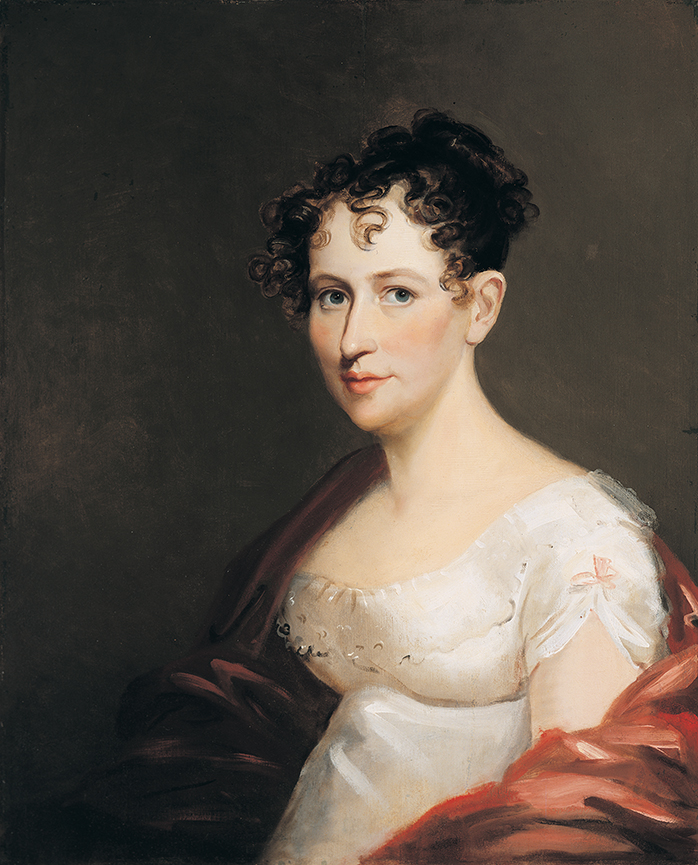
Judith Bell (Gist) Boswell
The Gist family was well connected. Judith (Gist) Boswell’s mother married Governor Charles Scott (1739-1813) as her second husband, while her daughter, Davidella Boswell (1817-1856), became the first wife of Governor Luke P. Blackburn (1816-1887).
In addition to her connection with these two Kentucky governors, Judith Boswell was also the half-sister of Sequoyah, a member of the Cherokee nation. In the 1770s Nathaniel Gist traded with the Overhill Cherokee Indians in East Tennessee and is supposed to have married the daughter of a Cherokee chief, Wurteh Watts. Their son, Sequoia, authored the Cherokee alphabet. According to documented family tradition, after Nathaniel Gist’s death, Sequoia visited his half-brothers and sisters at Canewood to “make the acquaintance of his father’s family and… he was received kindly and held in high esteem by them.”
ARTIST: Matthew Harris Jouett (1788-1827) was the third child of Captain John (Jack) Jouett, Jr., (1754-1822) and Sallie Robards (1756-1814) of Harrodsburg, Kentucky. Jouett showed artistic ability at an early age. It has been speculated that he may have studied painting at Transylvania University, since there are extant paintings of his classmates there. After college, he read law.
In 1812 he married Margaret (Peggy) Henderson Allen (1795-1873). He fought in the War of 1812, serving finally as a captain, and incurring a debt of $6,000 because of a lost payroll he took personal responsibility for. By 1815 he had achieved a reputation as an artist, earning as much as twenty-five dollars per portrait. The next year he traveled to Boston for instruction with Gilbert Stuart (1755-1828). His paintings reflect the teachings of Stuart who advised Jouett to paint people as they were, not as they wished to be seen. He also adopted some of Stuart’s techniques, especially the use of “standing white” paint. “Standing white” is a technique where turpentine is added to white paint to give strong highlights to white clothing.
Jouett was generous towards young artists who came to him for assistance or tutelage and had a major impact on early Kentucky portraiture. His studio in Lexington became a hub for Bluegrass artists. Though Jouett traveled, including a trip to the studio of Thomas Sully in Philadelphia, he did not pursue an itinerancy. He remained a resident of Lexington, Kentucky, until his death at age 39.
FRAME: Original carved and gilt frame; gilding is currently obscured by later paint.
REFERENCES: Estill Curtis Pennington, “Kentucky: The Master Painters…” (Paris, Kentucky: Cane Ridge Publishing House, 2008)
Estill Curtis Pennington, “Matthew Harris Jouett: 1788-1827, His Life and Work” (Paris, Kentucky, 2020)
William Barrow Floyd, “Matthew Harris Jouett: Portraitist of the Ante-Bellum South (Lexington, Kentucky: Transylvania Printing Company, 1980)
DESCRIPTION: Painting, oil on poplar panel of a young woman facing left. She wears an Empire dress of white and a crimson scarf. Her hair is tied with gray ribbon. The background is featureless.
Despite his popularity, Jouett was never able to obtain enough work to support his large family. Still, he remained generous towards young artists who came to him for assistance or tutelage. Although he traveled widely (for example he visited Thomas Sully in Philadelphia in 1825), Jouett remained a resident of Kentucky until his death in 1827 near Lexington.
(See E.A. Jonas, Matthew Harris Jouett Kentucky Portrait Painter. Louisville: J.B. Speed Memorial Museum, 1938)