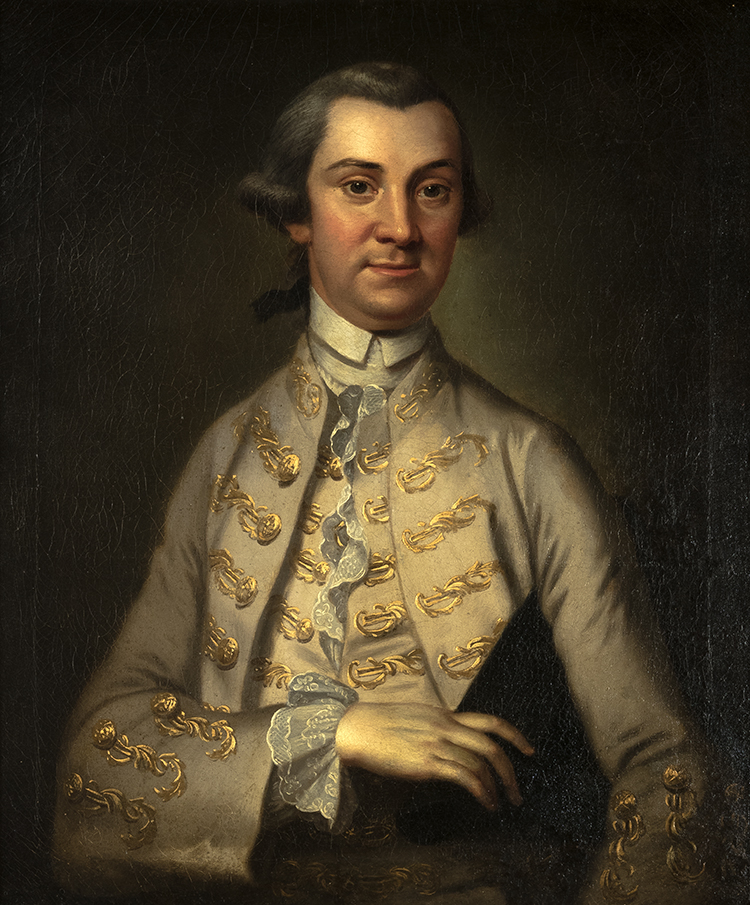
John Beale
John Beale married Mary Ross (d.1771) at St. Andrews Parish on March 18, 1762. In 1764, he was listed as a Charleston merchant engaged in the African slave trade, with one cargo for that year. In July 1771, Thomas Elfe, cabinetmaker, made a cedar coffin for the Beales’ son. John held a commission as captain from 1768-1778 and served in the in Charleston regiment of Major Bentham. Beale was listed in the poll list of 1787 as living at 34 Bay Street. There are many references to him in the Bay Street area. On October 30, 1807, The Charleston Courier noted his death on October 26 of that year “in the 72nd year of his age, the oldest wharf owner in the city.”
ARTIST: John Wollaston (active 1733-1767) was an English artist who worked in the American Colonies in the decades preceding the American Revolution. His father, also John Wollaston (d.1749), was a portrait painter as well. In addition to presumably studying with his father, Wollaston also received training from Joseph van Aken (d.1749), a painter who specialized in the depiction of fabrics in the paintings of others. Allan Ramsay (1713-1784 was another artist who painted in that style. Wollaston’s earliest documented painting is of the evangelist George Whitfield (1714-1770) painted in London about 1742 and in the collection of the National Portrait Gallery, London (NPG UK 131).
In 1749 Wollaston crossed the Atlantic and landed in New York where he began painting portraits in the fashionable London style. In 1752 he left New York for Philadelphia, and the following year he set up his easel in Annapolis. He spent about two years in Maryland and another two years in Virginia, completing about one hundred and twenty portraits. By the end of the decade he had returned to Philadelphia.
Wollaston arrived in Charleston, South Carolina, in 1765, probably after a period painting in the Caribbean Colonies. Painting in Charleston had been dominated to that point by the work of Jeremiah Theus (1716-1774); Wollaston’s arrival breathed new life into the city’s portraiture.
Wollaston was prolific, completing upwards of two hundred portraits during his time in the Colonies. His work influenced a generation of American artists, including John Hesselius (1728-1778) and Benjamin West (1738-1820).
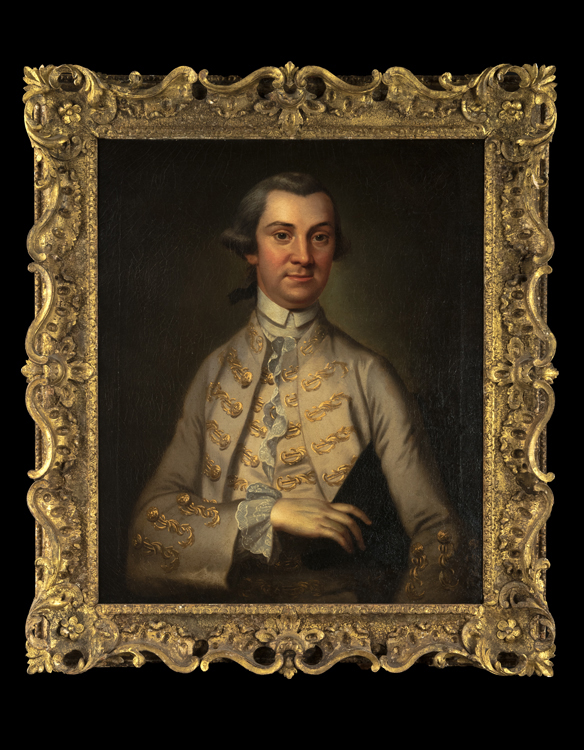
FRAME: Original carved and gilt frame made of British Scots pine, by microanalysis.
STRETCHER: White pine, by microanalysis.
RELATED WORKS: MESDA owns portraits of John Beale and his wife Mary (Ross) Beale as well as portrait miniatures thought to be by Wollaston (MESDA acc. 3049, 3050, 3809.1-2). MESDA also owns another work by Wollaston, a portrait of Daniel Ward (3351).
REFERENCES: “John Wollaston” in the National Gallery of Art Systematic Catalog
Carolyn J. Weekley, “Painters and Paintings in the Early American South” (Williamsburg, Virginia: Colonial Williamsburg Foundation and Yale University Press, 2013)
DESCRIPTION: Half-length portrait in oil on canvas of a man facing forward wearing an ecru coat and waistcoat decorated with gold embroidered decorations and lace. His coat has a tight turn-cover collar, and a black ribbon tying his natural hair. The gentelman holds a black three-cornered hat under his left arm, in his right hand.